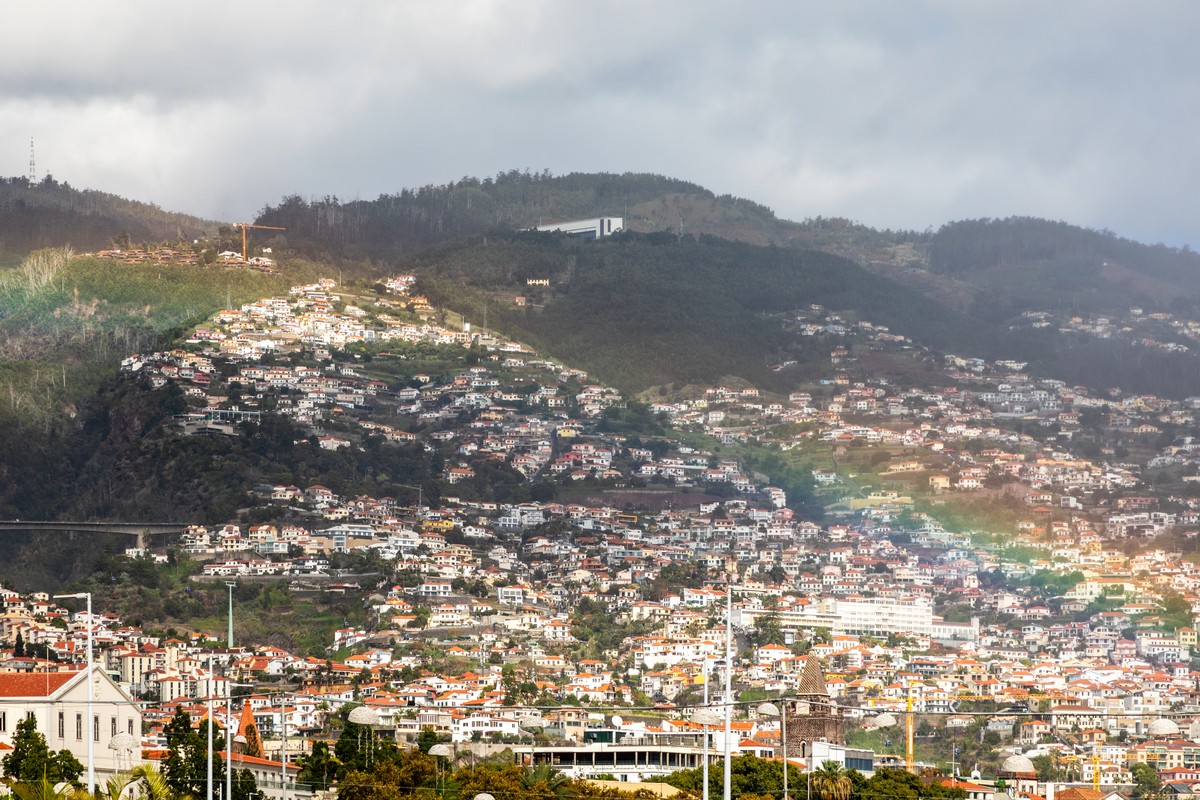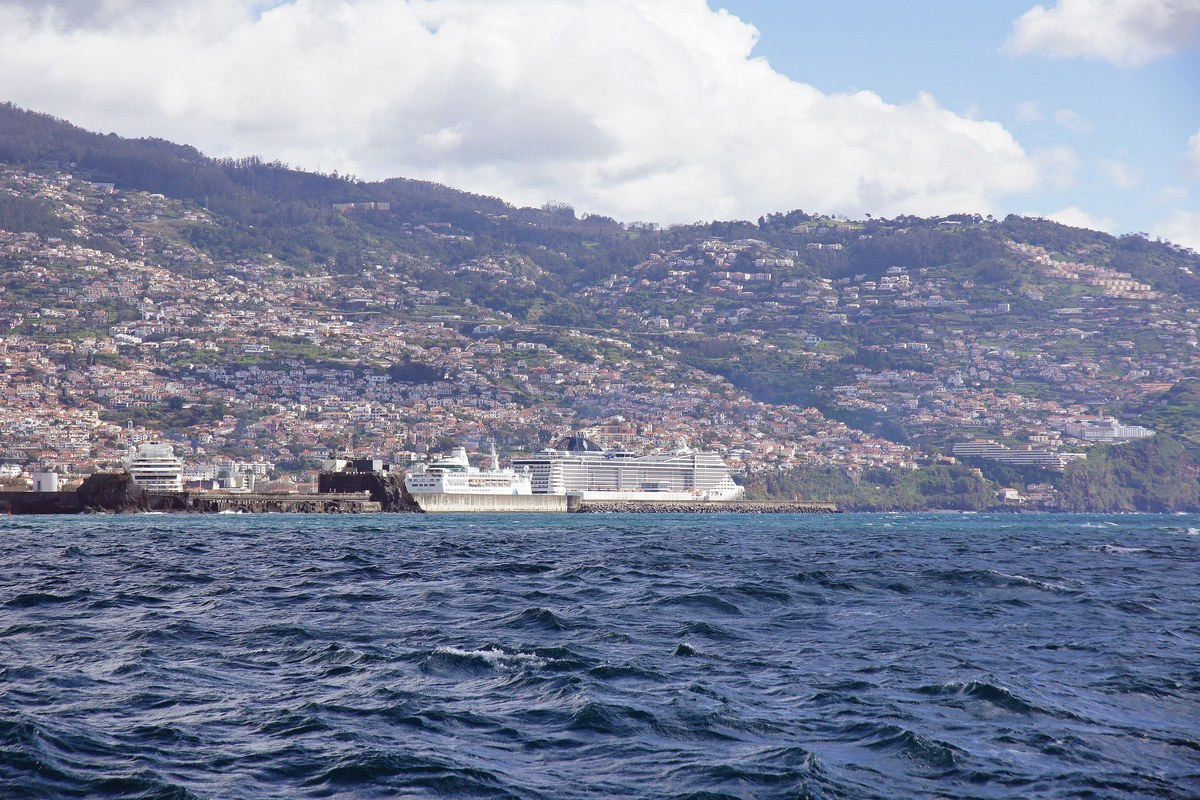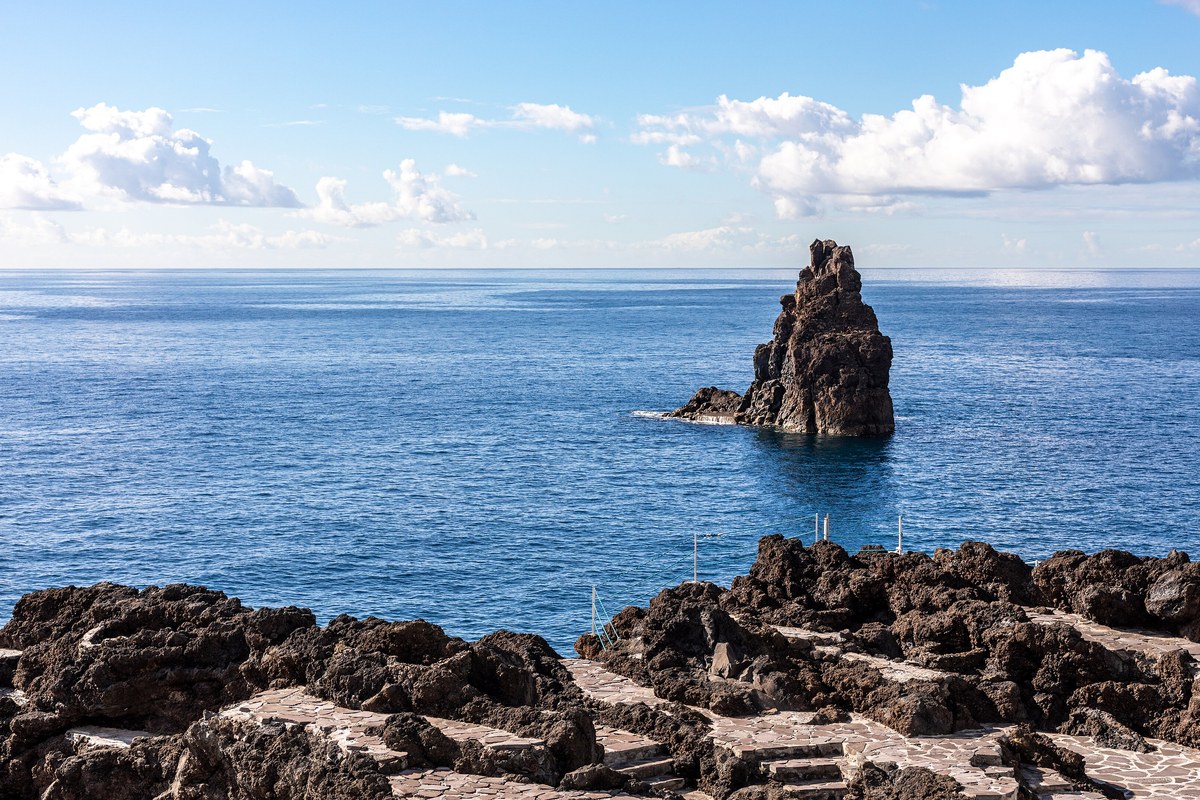

Madeira is a doing island, not a sitting island. There is almost no natural sand on Madeira itself, and the coast is mostly cliffs, pebbles and rock pools, so the island does not reward the traveller who wants to lie on a beach all week. What it rewards is the traveller who walks, climbs, swims, sails and looks. In a single week you can walk a levada through laurel forest, watch the sun rise above a sea of cloud from a 1,818 m peak, swim in a lava pool, stand on a glass platform 580 m above the Atlantic, and watch pilot whales from a boat out of Funchal.
Use this article as the activities home. It covers what to do, organised by activity type, with the practical detail you need to book and to choose. The island itself, where it is, when to go, how to get there, where to stay and what it costs in outline, is covered in our Madeira: the complete guide for UK travellers. That pillar holds the full levada chooser table, the SIMplifica fee table, the region-by-region day counts and the 7-day itinerary, and this article links to it rather than repeating it. The festive season is covered separately in our Madeira at Christmas: lights, Market Night and fireworks.
Levada walking: the island's signature activity
Levadas are old irrigation channels that carry water from the wet north and the mountains to the farms and towns of the south. About 3,100 km of them exist, and about 25 are waymarked for walking. The channels run almost level, so a levada walk gives you mountain scenery without mountain climbing: you follow the water through laurel forest, past waterfalls and through tunnels cut into the rock.
Since January 2026, every official hiking trail in Madeira needs an advance online reservation through the government's SIMplifica portal. An account is required, bookings open up to 30 days ahead, and without a reservation you will be turned away at the trailhead. Independent hikers pay €4.50 per trail, and the full PR1 summit trail costs €10.50. Children aged 12 and under go free but still need a slot. The full fee table, the passes, the exemptions and the current trail closure list are in the Madeira: the complete guide for UK travellers. Book the popular walks as soon as your dates open.
For a first walk, start with one of these; the full chooser table is in the pillar. PR6.1 Levada do Risco, 3 km return in about 2 hours, is the easiest first walk, family-friendly, ending at a waterfall about 100 m high. PR6 Levada das 25 Fontes, 8.6 km return in about 3 hours, is the classic first levada, through laurel forest to a pool fed by dozens of small falls; the falls are 30 m high. PR9 Levada do Caldeirão Verde, 13 km return in 4 to 5 hours, is longer and wilder, with 4 tunnels and a waterfall about 100 m high. PR6 and PR6.1 both start from Rabaçal, where fog hangs for more than 240 days a year, so go early. On PR9, use the 13 km return figure: one source gives 17.4 km, which includes the Caldeirão do Inferno extension, and that extension is currently closed because of rockfall. Walk safely: start early, bring layers, a waterproof and a torch for the tunnels, check trail status after storms, stick to official trails, and never swim in a levada.
Peaks and sunrise: Pico do Areeiro and Pico Ruivo
Pico do Areeiro, at 1,818 m, is the third highest peak on the island, and it is the easiest great morning in Madeira because a road runs to the top. Drive up before dawn, watch the sun rise above a sea of cloud, and you have done the island's most photographed moment before breakfast. The sun does not rise until 08:04 on 21 December, so a winter sunrise needs no brutal alarm call. Check the summit forecast the evening before, because the road, ER202, can close after storms, and parking at the summit is paid, with a shuttle on busy days. Dress for the mountain, not for Funchal: the January mean temperature at the Areeiro station, at 1,610 m, is 5.5°C, while Funchal sits at about 20°C.
Pico Ruivo, at 1,861 m, is the highest peak on the island, and Pico das Torres, at 1,853 m, is the second highest. The classic way to reach Ruivo is the PR1 trail from Pico do Areeiro, a hard one-way walk with about 760 m of ascent, through tunnels and along ridges with steps cut into the rock. It finishes at Achada do Teixeira, not where it started, so arrange a taxi, a tour or a second car. One conflict to state plainly: sources disagree on PR1. The majority figure is 7 km one-way and 4 to 5 hours, but one guide says about 3 to 4 hours for Areeiro to Ruivo and down to Achada do Teixeira, and another claims 12 km one-way. This article uses 7 km and 4 to 5 hours, the majority figure, and you should allow the longer time rather than the shorter one. If you do not want the full traverse, the short paved trail from Achada do Teixeira up to the Ruivo summit is the easier way to stand on the highest point.
Monte and Funchal: cable car, gardens, toboggan and the Old Town
Funchal is the base for most of the activities in this guide, and its best day out is the hill above it. Monte is a parish on the hillside over the city, and the morning there runs in a fixed order: cable car up, garden and church, toboggan down. The Funchal cable car opened in 2000 and runs from a lower station in the Old Town, on the seafront, up to Monte. The ride covers about 560 m of vertical climb and takes roughly 15 minutes. It runs daily, roughly 09:00 to 17:45, and is closed on Christmas Day. Check hours and fares at the station first, and note it can close in strong winds.
The toboggan is the ride down. The carros de cesto are two-seat wicker sledges on wooden runners, steered and braked by two men, the carreiros, dressed in white with straw boater hats and rubber-soled boots, who run alongside the basket and control its speed with their boots against the cobbled road. It began in 1850, not as a tourist ride but as a faster way for residents of Monte to reach the lower town. The run covers about 2 km from Monte to Livramento in around 10 minutes, at speeds of about 30 km/h. The trap first-timers fall into is assuming the toboggan goes back to Funchal. It does not. It ends at Livramento, roughly halfway down the hill, and from there you need a taxi or a bus back into central Funchal. The toboggan runs Monday to Saturday, roughly 09:00 to 18:00, and is paid in cash on the spot.
Next to the top cable car station sits the Monte Palace Tropical Garden, a 70,000 sq m garden spread down a south-facing slope above Funchal. Allow at least two hours. What to look for: more than 500 cycads from 30 of the 65 known Encephalartos species, one of the most complete collections in Europe; plants from around the world, including proteas and strelitzias from South Africa, bamboos from China and Vietnam, giant sequoias and centuries-old Portuguese olive trees; a section devoted to Madeira's native laurel forest, the Laurissilva; and the Oriental gardens, with Buddha statues, pagodas, red bridges and stone lanterns. The garden is open daily, 09:00 to 19:00 from April to September and 09:00 to 18:00 from October to March, and it is closed on 25 December. Check hours and entry prices before you go.
Do not confuse the Monte Palace garden with the Madeira Botanical Garden, the Jardim Botânico da Madeira. It is a separate, scientific garden on a terraced hillside above Funchal, run by the IFCN, the regional institute that also manages the classified walking routes. It covers about 8 hectares on the old Quinta do Bom Sucesso estate, established by the Reid family in 1881, and it opened as a public garden in 1960. It holds more than 2,000 plants, a bird park and a Natural History Museum. It is open daily from 09:00 to 18:00, except Christmas Day. Entry from 1 January 2026 is €10 for visitors over twelve, €3 for ages six to twelve, and free for children under six, per the IFCN. Back down in Funchal, the Old Town, or Zona Velha, runs about 1.5 km from Jardim Municipal to the Igreja de Santa Maria Maior, and its painted doors are the most photographed street art on the island. The Mercado dos Lavradores, the Farmers' Market, sits at its edge: a covered market with a fish hall, fruit and flower stalls, Madeira wine and sugarcane honey.
Natural pools and swimming: Porto Moniz, Seixal and the Lido
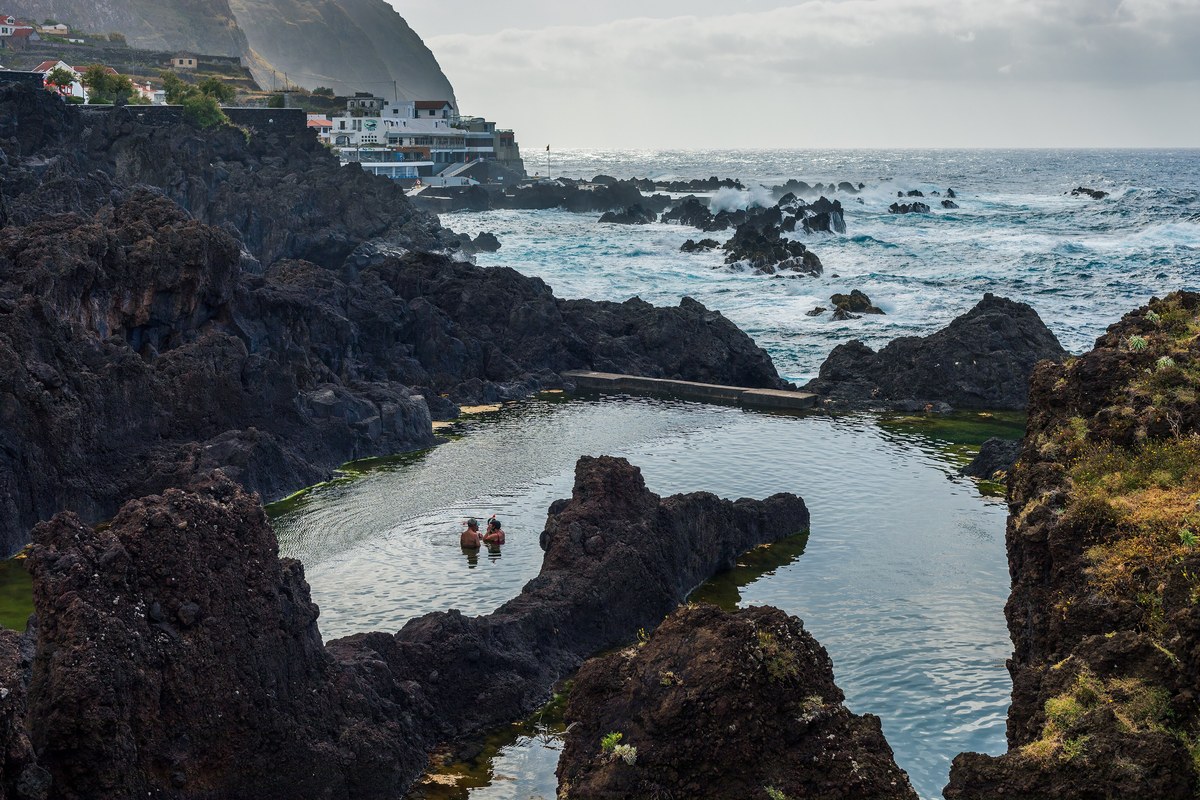
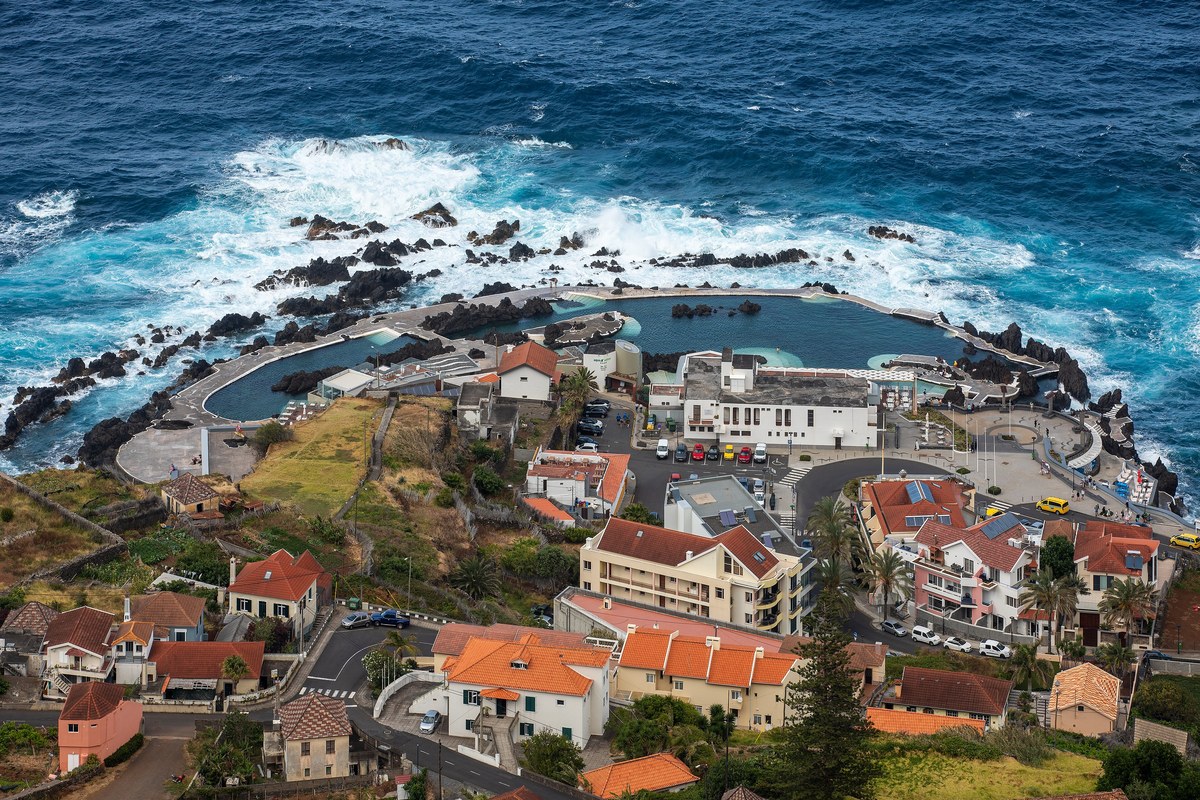
Madeira's answer to the beach is the natural pool, and the best of them is at Porto Moniz, on the far north-west coast. The pools are basins cut into black volcanic lava, filled with seawater by the tide and the waves, so you swim in the Atlantic with the swell buffered by the rock. The main complex at Porto Moniz, the Piscinas Naturais, is a proper lido: about 3,800 sq m of swimming area, about 2 m deep, with lifeguards, changing rooms, a bar, a first-aid post, a playground, and sunbeds and parasols for hire. The water averages 20 to 21°C through the year. Entry is €3 per person, with children aged 3 and under free, and the pools are open year-round, 09:00 to 17:00 in winter and 09:00 to 19:00 in summer. The pools close when the swell is too high, and between November and May the north coast swell shuts them often, sometimes for days at a time, so check before you drive across the island for them. The older Cachalote pools nearby are free but wilder, with no lifeguards, so swim there only when the sea is calm.
Seixal, about 15 km east of Porto Moniz, is the quieter swimming village. Its harbour beach is a wide stretch of fine black sand below vertical green cliffs, and the Clube Naval do Seixal pools are free between 10:00 and 19:00, with a bar, sunloungers and kayak hire. Just along the coast, the Poças das Lesmas is a sheltered, calmer swimming spot with a bar, toilets and showers. The beach itself has no lifeguard, so check the sea before you swim. In Funchal, the Lido Bathing Complex on Estrada Monumental is the seafront lido in the hotel zone, the best choice for families staying in town, and Doca do Cavacas, at the western end of the seafront, has natural rock pools. Bring swim shoes for the lava rock, a towel and a mat for the pebbles, sun protection and cash. The sea runs from about 18°C in February to 23°C in September, so the pools are at their warmest from June to October.
Whale and dolphin watching: from Funchal and Calheta
Whale watching is the activity that surprises most visitors, because Madeira is one of the best places in Europe for it. Deep water starts within a few kilometres of the coast, so whales and dolphins feed close to shore, and more than 20 cetacean species have been recorded in Madeiran waters. Most boats leave from Marina do Funchal, walkable from the Old Town, where the widest choice sits. Trips also run from the smaller port at Calheta, on the west coast. Most trips last about 2 hours. Operators generally report sightings on more than 90% of trips across a season, but the overwhelming majority of those sightings are dolphins, often in groups of dozens, so set expectations honestly: dolphins are the baseline, whales are the bonus.
| Species | When | How likely |
|---|---|---|
| Short-finned pilot whale | All year, resident | High, in pods of 10 to 30 |
| Bottlenose dolphin | All year, resident | High, often approaches the boat |
| Common and Atlantic spotted dolphin | All year, larger groups in late spring and summer | High, the most often seen |
| Sperm whale | All year, best April to October, peak May to August | Medium, the realistic big-whale sighting |
| Bryde's whale | June to September | Medium |
| Sei whale | July to October | Medium |
| Fin whale | Winter and spring, passing through | Medium, a migrant |
| Blue whale | Rare, late winter and spring | Very low, a lottery win |
There is no wrong month, because the pilot whales and bottlenose dolphins are resident all year, but there is a best one. April to September brings the widest range of species and the calmest seas. September is the single best month if you can choose: the summer crowds have gone, the Atlantic is usually flat, and the migratory species are still around. December to February brings fin whales and occasionally blue whales, but also the roughest water and the most cancellations, so winter is the season to book with a flexible day in hand. In the busier months of April to September, book in advance, because tours sell out days ahead. Swimming with dolphins is tightly restricted: only common and Atlantic spotted dolphins, at most four people at a time. Take motion sickness tablets if you are prone to it, and choose a catamaran for the steadiest ride.
Viewpoints and the coast: Cabo Girão, Ponta de São Lourenço, Cristo Rei and Câmara de Lobos
Madeira is a vertical island, and its viewpoints are activities in themselves. Cabo Girão is a sea cliff viewpoint with a glass skywalk platform on the south coast, about twenty minutes west of Funchal, above Câmara de Lobos. On height, Visit Madeira gives 580 m; a few guides give 589 m, including our own Christmas article. Visit Madeira now publishes €5 per person for visitors over twelve, free for children twelve and under, paid and booked through SIMplifica, confirmed by guides updated in September 2026 and visitor reports from October 2026. Older listings that still say €3, or free, are out of date. Arrive before the mid-morning coaches.
The easternmost point is a dry, windswept peninsula of rust-coloured cliffs, about 9 km long including its two islets. It is a protected reserve, and the only way to reach the tip is on foot, on the PR8. The official route is 4 km each way from Baía d'Abra, about 2.5 hours return, rated moderate. About two-thirds along is Casa do Sardinha, a cafe with toilets, then a short steep climb to the final viewpoint, the Miradouro Ponta do Furado. Câmara de Lobos, just west of Funchal, is the easiest half-day from the capital. Its heart is the harbour, where brightly painted boats rest on the grey pebble beach.
Forests and villages: Fanal, Santana, São Vicente and the north coast
The north coast is the green side of Madeira, wetter and cooler than Funchal. Fanal is a small forest of ancient laurel trees on the Paúl da Serra plateau, at roughly 1,150 m. The stars are the til trees, Ocotea foetens, found only in Macaronesia, with wind-sculpted trunks and moss-draped branches. Some are centuries old, predating the island's discovery in the 15th century. The fog is mostly cloud: moist Atlantic air is pushed up the north side, cools and condenses at Fanal's altitude. The cooler months from October to April bring the most cloud, and the earlier the better, but fog is never guaranteed. Park at Parque de Merendas do Fanal and walk a few minutes in, and do not miss Lagoa do Fanal, the small pond. There is no public transport: you need a car or a tour, about 25 minutes from Porto Moniz. Entry was free with no booking as of October 2026, but new rules, including a possible fee, are being rolled out: check before you go.
Santana, about 40 to 45 km from Funchal, is best known for its palheiros, triangular A-frame cottages with thatched roofs. The place to see them is the Núcleo de Casas Típicas de Santana, an open-air museum in the centre of town. Santana is also the family stop on the north coast, because of the Madeira Theme Park, with four multimedia pavilions, a replica Monte train, gardens, playgrounds and a lake with rowing boats. São Vicente is a lush valley town on the north coast, with a 17th-century church and the waterfalls that make the coast road worth driving slowly. The Véu da Noiva falls from the cliffs directly into the sea between São Vicente and Seixal; see it from the Miradouro do Véu da Noiva viewpoint, as the old road is closed. The Cascata Água d'Alto, about 1.5 km west of São Vicente, is a slender fall of about 150 m, with a small parking area in front of it.
Adventure activities: canyoning, paragliding, diving and mountain biking
Madeira's adventure activities are not add-ons to the walking: for many visitors they are the reason to come. Book with a local guide and a flexible day: all of them depend on conditions. Canyoning means moving down a mountain stream: rappelling waterfalls, sliding rock, jumping into pools. Routes range from beginner-friendly Ribeira das Cales to more demanding Ribeira da Hortelã. It runs year-round: north rivers carry greater flow in summer, southern rivers are quieter in winter. Always go with a certified local guide: conditions change quickly, especially after rain. Coasteering is the coastal version: swimming, cliff jumping, scrambling and cave exploration. Kayaking and stand-up paddleboarding are the calmer alternative: paddle past cliffs, enter sea caves, and glide through calm bays, best in the morning.
Tandem paragliding needs no experience: you fly with a certified instructor for 15 to 30 minutes, from launch sites at Madalena do Mar, Arco da Calheta and Porto da Cruz. The Garajau Marine Reserve, below Cristo Rei, is Portugal's oldest marine reserve and the island's best snorkelling, with visibility often over 20 m and water from about 18°C in winter to 24°C in summer. Jardim do Mar, Paúl do Mar and São Vicente are the prime surf spots: bigger winter waves for experienced surfers, gentler summer conditions for beginners. Mountain biking guided tours run year-round, graded from easy levada rides to downhill with shuttle uplifts for experienced riders only. At Porto Moniz, a 1.6 km zipline and a giant swing suit older children; children must weigh at least 35 kg. The hard walks are not family walks: PR1, the full PR9 and the PR8 final climb.
Food and drink experiences: the market, a wine tasting and poncha
Madeira's food is specific to the island, and tasting it is an activity. Start at the Mercado dos Lavradores in Funchal, where the fish hall, fruit stalls and flower sellers give you the island in one room. Try espetada, bolo do caco, black scabbard fish with fried banana, and lapas. Madeira wine is a fortified wine aged in warm lodges: try Bual and Malmsey with honey cake at Blandy's Wine Lodge on Avenida Arriaga. The full story is in the Madeira: the complete guide for UK travellers food section, and covered in depth in our Madeira wine guide. Poncha is local rum, honey and lemon, and Câmara de Lobos is its birthplace, so try the most authentic version in a small harbour bar.
Porto Santo as a side trip: the one sandy beach
Porto Santo is a small, dry island about 42 km north-east of Madeira, with a single golden beach of about 9 km on its southern coast. The ferry detail is in the Madeira: the complete guide for UK travellers. The Lobo Marinho, run by Porto Santo Line, sails from Funchal harbour, crossing about 2 hours 15 minutes to 2 hours 30 minutes over 71 km. It usually sails once a day each way: in November 2026 the pattern was mostly Funchal 08:00 and Porto Santo 18:00. Check-in closes 30 minutes before departure, and the timetable changes by season, so confirm on the Porto Santo Line timetable. On a day with the 08:00 out and 18:00 back, you get about 6 to 7 hours on Porto Santo: enough for the beach and little else. Bring sun protection, and hire a bike or take a taxi to see more than the beach: Vila Baleira, with the Casa Museu de Cristóvão Colombo, and Pico do Facho viewpoint.
How to fit it together: by trip length
Do not try to do everything. Madeira rewards a plan built around a base in Funchal, with the island days grouped by coast, and the walking days separated from the driving days. The full 7-day itinerary is in the Madeira: the complete guide for UK travellers. Day one is Monte and Funchal, day two is Areeiro sunrise and a first levada, day three is the west coast. Five to seven days is the ideal length. Add a north coast day: Santana, São Vicente, Seixal pools, Fanal forest, and a whale watching morning. Add the PR1 traverse from Areeiro to Ruivo, a canyoning day, a mountain biking day, and a Porto Santo overnight for the sandy beach.
Rain is part of a Madeira trip, especially from October to December, and the north coast has roughly double Funchal's rain. Indoor options: the Whale Museum in Caniçal, the Madeira Aquarium in Porto Moniz, the Monte Palace museum, a wine tasting at Blandy's, the market, and the Theme Park pavilions. In December, the days are for walking and the coast, and the nights are for the festive season. The lights switch on 1 December, Market Night is 23 December, and the fireworks are at midnight on 31 December. The full festive season is covered in our Madeira at Christmas: lights, Market Night and fireworks. If you are weighing Madeira against other December trips, see the best places to visit in December for UK travellers.
Conclusion
It is an island to do, a few things well, in the right order: a levada, a pool, a harbour town, a sunrise. Book the trails first, because the SIMplifica window opens 30 days ahead and the popular walks fill, then build the rest around them. Pack layers, swim shoes and a torch, and leave one day unplanned.