
Madeira is not a sandy-beach island. Most of the coast is pebbles, rock pools and cliffs. There are two imported-sand beaches, a handful of natural sandy spots, and one true long natural sandy beach, which is on Porto Santo, a ferry ride away. If a sandy beach is the point of the trip, Madeira is the wrong island. If pools, cliffs and swimming in lava rock are the point, it is one of the best. This guide, the beaches companion to our Madeira travel guide for UK travellers, covers them all.
The coast works in four kinds: the natural pools, where lava rock holds the Atlantic in calm basins; the two imported-sand beaches, Calheta and Machico; the natural sandy spots, above all Seixal and Prainha do Caniçal; and the pebble beaches, which are most of the coast. Porto Santo sits outside all four: the one long natural golden beach, reached by ferry.
The natural pools
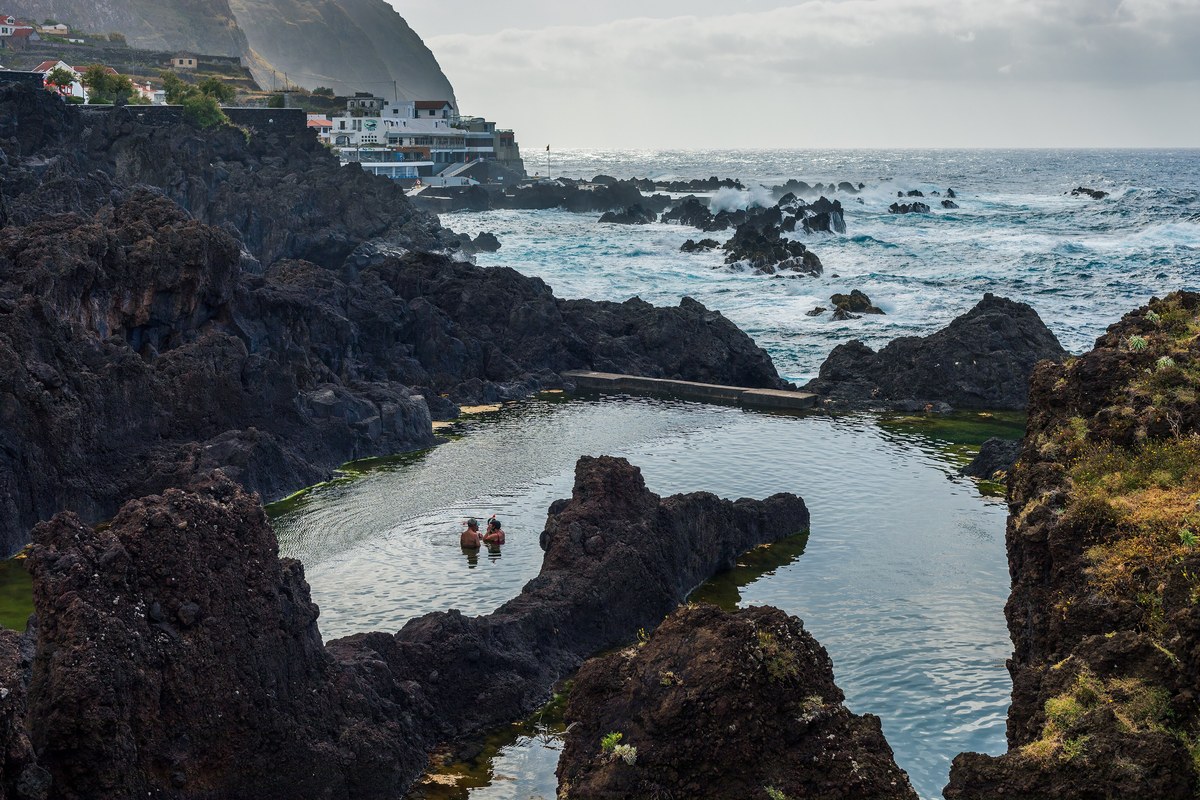
The pools are Madeira's answer to the beach problem. Volcanic rock forms natural basins at the water's edge, and the Atlantic refills them with every tide, so the water is fresh, clear and calm even when the open sea is rough. The ones travellers use are two on the north coast, one in Funchal, and one beside the black-sand beach at Seixal.
Porto Moniz: the lava-rock pools
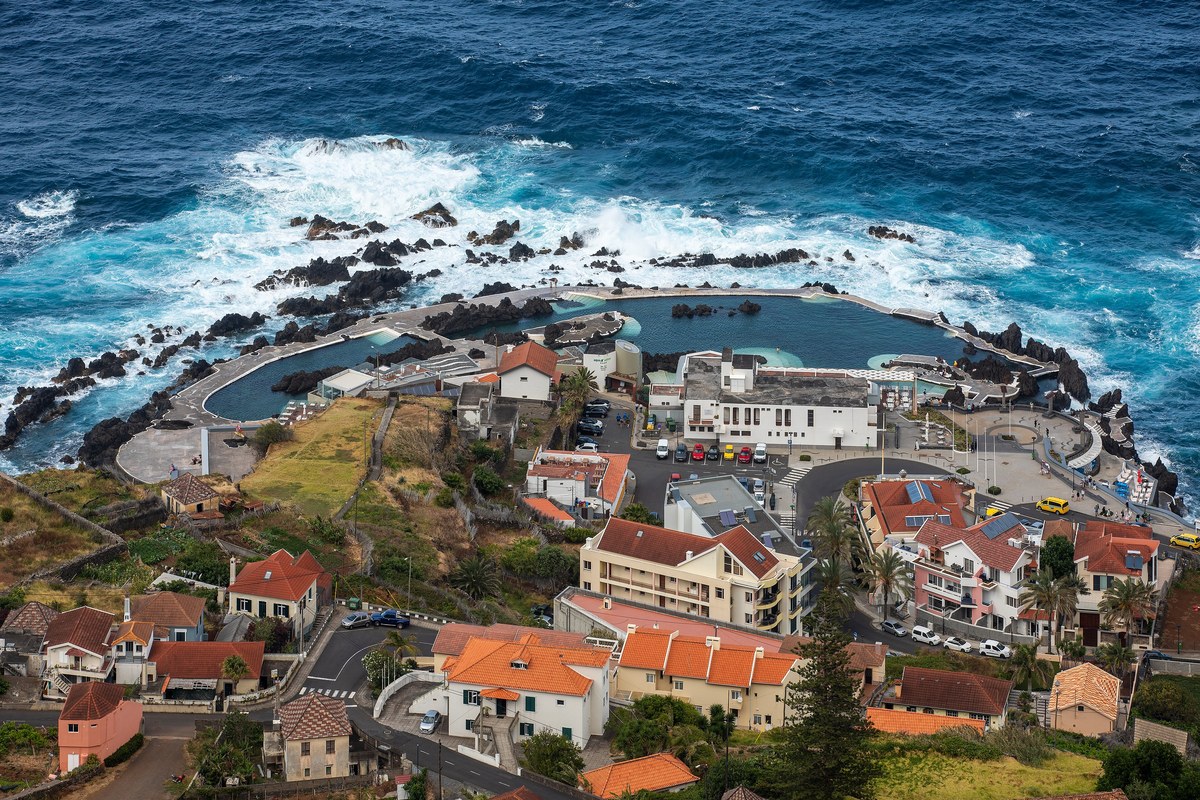
Porto Moniz, on the far northwest coast, has the best-known pools on the island, and the most developed. Lava flowing into the sea left a jumble of black rock basins, and the largest has been turned into the Piscinas Naturais, a managed complex with lifeguards, changing rooms, showers, a bar and sunbeds for hire. The swimming area covers about 3,800 sq m, is about 2 m deep, and the water averages 20 to 21°C through the year.
There are two sets of pools here, and the difference matters. The managed complex, at the western end of the seafront, charges an entry fee and has the full facilities. Entry costs about €3 per adult, with children under 3 free, and reduced rates reported for students and over-65s; check the current tariff at the gate. It is open daily all year, from 09:00 to 19:00 in summer, May to October, and from 09:00 to 17:00 in winter, November to April, The free Cachalote pools, also called the old pools, sit a few hundred metres east beside the aquarium and the fort. They are free at any time, with no facilities and no lifeguard, wilder, with sharper rock, so water shoes are essential and they suit confident swimmers rather than small children.
Porto Moniz is about 75 minutes by car from Funchal, and it is a full west-coast day rather than a quick stop. Most visitors drive or join a tour. The pools close in bad weather and high swell, and between November and May the north-coast swell regularly shuts them, sometimes for days, so check conditions before driving across the island in winter.
Seixal: black sand and lava pools
Seixal, on the north coast between São Vicente and Porto Moniz, is the prettiest beach stop on the island, and it gives you two kinds of swimming in one village. The beach itself, Praia do Porto do Seixal, is a wide stretch of fine black volcanic sand below vertical green cliffs, sheltered on one side by a breakwater. The sand is soft and warm, the water is clear. The beach is free, with showers and toilets, but it has no lifeguard, so swim only when the sea is calm.
About 1.5 km along the coast are the Seixal natural pools, the Poça das Lesmas. Paths lead down to several pools among the lava rock, and the most striking feature is a lava arch, with the entrance to one of the pools running underneath it, so you can swim under lava. There is a small kiosk, changing rooms and showers, and entry costs about €2.50. The pools are calm when the sea is rough, but stay away from the outer edge on big-swell days. Beside the beach, a large seawater pool run by the Clube Naval do Seixal is free between 10:00 and 19:00, with a bar, sunloungers and kayak hire.
One claim about Seixal needs a flag. Tour pages describe the beach as voted 3rd Best Beach in Europe. That is a tour claim, repeated on booking sites, not a verified award from a named body, so treat it as marketing. Seixal pairs naturally with Porto Moniz in a single north-coast day.
Doca do Cavacas: the pools in Funchal
Doca do Cavacas is the only natural pool on the south coast, and that makes it the most useful one for anyone staying in Funchal without a car. It sits at the western end of the Funchal seafront, between the Lido and Praia Formosa, The pools are carved into dark lava rock, filled with clear seawater, with concrete sunbathing platforms, a restaurant-bar above, and sunloungers for hire. Lifeguards are on duty, and there are toilets, showers and changing rooms.
The practical details are less settled than at Porto Moniz. Guides quote adult entry anywhere from about €2 to about €6, and the most recent detailed guide gives €5.50 for an adult, with lower prices for children. Check the current tariff at the gate. Opening hours are given as 10:00 to 20:00 by the most recent guide, with an older source giving 10:00 to 19:00, so check the hours for your visit. The pools close at high tide when the sea is rough,
The imported-sand beaches
Madeira has two beaches with golden sand, and neither of them is natural. Both were built by importing sand and sheltering it behind breakwaters, and both are the best places on the island for a conventional family beach day. They are small by Mediterranean standards, but they work.
Calheta: the first artificial beach
Calheta, on the southwest coast about 30 km west of Funchal, is Madeira's first artificial beach. It opened in 2004, using golden sand imported from Morocco. The beach is about 100 m long, with a sunbathing area of about 7,300 sq m, made of two adjacent coves, each sheltered by breakwaters, The breakwaters keep the water calm and shallow, which is why it suits families and less confident swimmers, and the waters hold Blue Flag status.
Calheta sits on the sunniest side of the island. The town has the marina, a promenade and places to eat. Sun loungers and parasols are for hire, with changing rooms, showers, first aid and water sports, and lifeguards on duty in the bathing season. It is about a 32 to 35 minute drive from Funchal. One note on the sand: the imports have drawn criticism, because some shipments were reported to come from Western Sahara rather than Morocco proper.
Machico: the golden beach by the airport
Machico, on the east coast, has the island's second artificial golden beach, and it is the easiest sandy beach to reach. The town was Madeira's first capital, and the beach sits in the bay in front of it, about 10 minutes from the airport, which makes it the natural first or last swim of a trip. The golden sand was imported from Morocco, and the beach is a crescent about 125 m long and about 70 m deep, protected by a long rock breakwater that keeps the water calm. It comes with showers, changing rooms, toilets, beach volleyball and sunbed hire, with lifeguards on duty in summer.
Machico Bay has two beach areas, separated by the river mouth and the pier, and they are easy to confuse. The golden-sand beach, Praia de Machico, also called Banda d'Além, is the one for sunbathing and families. The other, Praia de São Roque, is the bay's natural beach, a long stretch of grey pebbles, the more typical Madeira shore. Machico town, the island's second largest, has a historic centre and a fort, and is the base for the Ponta de São Lourenço coastal walk.
The natural sandy spots
Between the imported beaches and the pebbles, Madeira has a small number of beaches with natural sand. They are all dark, all small, and all worth knowing about, because they are the closest the island itself comes to a natural sandy beach.
Prainha do Caniçal: the secluded cove
Prainha do Caniçal, near the eastern tip of the island, is one of Madeira's very few natural fine-sand beaches, and the most secluded. It is a small arc of dark, copper-hued volcanic sand backed by cliffs, between Caniçal village and the Ponta de São Lourenço peninsula, The sand is soft underfoot, the water is clear, and the cove is sheltered enough for swimming and snorkelling close to the rocks. There is a basic cafe, toilets, showers and changing rooms, and a car park at the top of the cliffs, reached by steep steps down to the sand.
Timing matters here more than anywhere else on the island. At high tide the water comes right up to the rocks and leaves no sand, so arrive as the tide begins to recede, and check the tide before you go. The Dunas da Piedade dunes beside the beach contain limestone fossils, which is why the area is protected.
The other natural sand
Seixal's black sand, covered above, is the larger and easier of the two. Beyond Seixal and Prainha, natural sand on Madeira Island is limited to small pockets of dark sand mixed with pebbles, such as the small sandy section at Ribeira Brava. None of them is a long sandy beach. If a long stretch of natural golden sand is what you want, that is Porto Santo, covered at the end of this guide.
The pebble beaches
Most of Madeira's coast is pebbles, and most of its swimming happens from pebble beaches. That is not a drawback once you adjust expectations: the water is exceptionally clear, because there is no fine sand to stir up, and the pebbles are smooth and rounded rather than sharp. Bring water shoes for getting in and out, and a mat for lying down.
Praia Formosa: the largest public beach
Praia Formosa, west of Funchal city centre in the parish of São Martinho, is the largest public beach on Madeira Island. It is a complex of four adjoining beaches, Praia Formosa, Praia Nova, Praia dos Namorados and Praia do Areeiro, stretching about 2 km along the coast, with a mix of pebbles and black sand, Lifeguards are on duty during the bathing season, the waters hold Blue Flag status, and the beach is free, with cafes nearby and a long promenade linking it to the Lido and to Câmara de Lobos.
It draws hundreds of bathers a day, with sunset views across to Cabo Girão. The shore shelves gently enough for safe swimming close to the beach, and the west-facing position makes it one of the best sunset spots on the south coast.
Ribeira Brava and Ponta do Sol: the sunny south coast
Ribeira Brava, about 20 minutes by car west of Funchal, has a small pebble beach with dark volcanic sand right in the town centre, A breakwater shelters it, so the water is calm and safe for swimming, and there is a bathing complex with seawater pools beside the beach. It is one of the sunniest spots on the island, and a good stop on a west-coast drive.
Ponta do Sol, about 30 minutes west of Funchal and a few kilometres west of Ribeira Brava, is the village that claims the most sunshine on the island, and its beach sits in a small sheltered cove between sea cliffs. The beach itself is pebbles, with stones in the water, so water shoes are essential, and there is a sea bridge with ladders down to the water Facilities are light: a seasonal bar, a shower and a few permanent parasols on a first-come basis, with sunbeds for hire. The beach is supervised, but it is not ideal for small children, and Calheta's sandy beach is the better choice for them.
The Lido Bathing Complex
The Lido Bathing Complex, on the seafront promenade in the hotel zone on Estrada Monumental, is the best choice for families staying in Funchal. It is a managed bathing complex with seawater pools, a children's pool, sun terraces, a bar, sunbed and umbrella hire, changing rooms and diving facilities, and it is supervised, with lifeguards on duty. It is open all year, daily from 09:30 to 17:30, and it is accessible, with lifts and ramps for users with reduced mobility.
The Lido is not a beach and does not pretend to be one. It is a place to swim in the sea without sand or pebbles, and to let children swim in a contained pool. Entry is charged under the shared Funchal lidos tariff, about €5.50 for an adult according to recent guides, so check the current price at the gate. It is a 20 to 30 minute walk from the Old Town along the promenade, or a short bus ride, and it is open on Christmas Day, when most of the island is closed. Our guide to Madeira at Christmas covers December swimming in full.
Garajau and the marine reserve
Garajau, just east of Funchal below the Cristo Rei statue, is the best snorkelling on Madeira Island, and the reason is a line on a map. In 1986 the bay was declared the Garajau Nature Reserve, Portugal's oldest marine reserve, and fishing has been banned there ever since. With no fishing and only small boats allowed, the marine life is relaxed and abundant, and dusky grouper, sea bream and barracuda are regularly seen.
The beach itself is a pebble shore backed by high rock walls, with usually calm, clear water, a beach bar, a diving centre, toilets and changing rooms, and sunbeds for hire. It is reached from the Cristo Rei viewpoint by a cable car that drops about 200 m down the cliff in a few minutes, or by the steep path down. The reserve rules are simple: no fishing, no taking anything from the water, and no touching the marine life. Casual swimming and snorkelling close to shore need no booking, but guided dives and snorkel tours should be reserved in advance in high season. Garajau is about 15 minutes by car from Funchal and about 10 minutes from the airport.
Surf: Jardim do Mar
Madeira is not a beginner surf destination, and Jardim do Mar is the reason it is on the surf map at all. The village, on the southwest coast about 45 minutes by car from Funchal, is home to the island's most famous wave: a long right-hander breaking over a shallow reef and boulders, The season peaks from October to April, with November to March the best months.
The wave has changed. A seawall built in front of the village in the early 2000s altered the break, and the spot now works best in a short window around low tide, with heavy backwash from mid to high tide. Entry is through a small fishing port, over slippery rock, between sets, and the wave handles anything from about 4 to 20 feet, so it is for advanced surfers only. If you are not one of them, Jardim do Mar is still worth a visit as a spectator: the waves break close to the 750 m promenade. Portinho Beach, at the eastern end of the parish, is the surfers' beach, and has hosted competitions including the Red Bull Big Wave Challenge.
Beginners are better off in mainland Portugal: the waves are reef breaks, the entries are rocky, and there is no gentle beach break on the island. Experienced surfers should also look at Paúl do Mar, the next village along, and at Ponta Pequena, the go-to spot for many locals. Watch from the cliff before you paddle out anywhere on this coast.
Porto Santo: the one sandy beach
Porto Santo is the answer to the question this guide keeps raising. It is Madeira's smaller sister island, about 42 km northeast of Madeira, dry and flat, with small volcanic peaks, and its south coast is a single unbroken stretch of natural golden sand about 9 km long, The sand is fine and golden, the water is calm and shallow, The sand is locally believed to have therapeutic properties. There is little natural shade, so bring sun protection.
The Lobo Marinho ferry, run by Porto Santo Line, sails from Funchal harbour to the port near Vila Baleira, crossing about 2 hours 30 minutes over 71 km. In November 2026 the pattern was mostly one sailing each way, Funchal 08:00 and Porto Santo 18:00, and no sailings on some dates, including Christmas Day. A day trip leaves about 7 hours on the island. Flights from Funchal to Porto Santo run twice daily and take about 20 to 25 minutes. Check fares with Porto Santo Line before you plan, and book the return early in summer.
Day trip or stay over? A day trip works if the beach is the point: arrive in the morning, walk, swim and eat, and sail back in the evening. Staying over, for 2 to 3 days, gives you the beach at its quietest, the small volcanic peaks, and the island's slow pace, and it is the right choice if you want a beach holiday rather than a beach day. The full ferry pattern is in our Madeira travel guide for UK travellers.
What to bring and swimming safety
Pack for rock, not sand. Water shoes are the single most useful thing you will bring to Madeira: they make the pebble beaches, the lava pools and the rocky entries comfortable, and they protect against sharp rock and hot stone. A mat or a thick towel is the second essential, because pebbles are hard to lie on. Shade is scarce on every beach, and the sun is strong even in winter.
The sea is warm enough to swim in for most of the year. Sea temperatures around Madeira run from about 18°C in February and March to about 23°C in September and October, with the warmest swimming from June to October. December averages about 19.5°C at Funchal harbour, and the Lido and the Porto Moniz pools are open all year.
Swimming safety in Madeira is about reading the sea. Lifeguards are on duty at the main beaches and the managed pools during the bathing season, roughly April to October. Seixal beach and the free Cachalote pools have no lifeguard. The north-coast pools close when the swell is up, sometimes for days, and the free pools have no one to tell you when it is unsafe, so check conditions before you go in. Never swim at the outer edge of a natural pool on a big-swell day, and never swim alone at an unsupervised beach. If you are visiting in December, the winter swimming picture is covered in our guide to Madeira at Christmas, and the wider December picture is in the best places to visit in December for UK travellers.
Who each beach suits
| Beach or pool | Families | Swimmers | Sunbathing | Surf and snorkel |
|---|---|---|---|---|
| Porto Moniz pools (managed) | Best: lifeguards, calm water | Excellent: clear, calm | Good: terraces and loungers | Neither |
| Seixal beach and pools | Good in calm weather; no lifeguard | Good: pools in rough seas | Good: black sand | Snorkelling in the pools |
| Doca do Cavacas | Good: lifeguards, facilities, close to Funchal | Excellent: calm natural pools | Good: sun platforms | Snorkelling close to shore |
| Calheta | Best: sand, calm water, Blue Flag | Excellent: calm, shallow, sheltered | Best: golden sand | Water sports |
| Machico | Best: sand, calm water | Excellent: calm, sheltered bay | Good: golden sand | Paddleboarding |
| Prainha do Caniçal | Fair: steep steps, tide-dependent | Good: snorkelling by the rocks | Good: quiet, dark sand | Snorkelling |
| Praia Formosa | Good: lifeguards, free, close to Funchal | Good: safe swimming | Good: sunset views | Neither |
| Ribeira Brava | Good: calm water, bathing complex | Good: sheltered | Fair: small, pebbly | Neither |
| Ponta do Sol | Fair: pebbles, stones | Good: sea bridge ladders | Good: sunny, quiet | Neither |
| Lido Bathing Complex | Best: children's pool, accessible | Excellent: seawater pools | Good: sun terraces | Diving centre |
| Garajau | Fair: pebbles, cable car | Good: calm, clear water | Fair: small beach | Best snorkelling and diving |
| Jardim do Mar | Poor: advanced surf only, rocky entries | Poor: powerful reef break | Fair: pebbles, good for watching | Best surf, advanced only |
| Porto Santo | Best: 9 km of sand | Excellent: long, gentle | Best: only long sandy beach | Snorkelling in calm water |
Conclusion
Madeira does not offer a conventional beach holiday. Instead it offers lava-rock pools filled by the Atlantic, a black-sand beach under green cliffs, two small golden beaches built for families, a seafront lido in Funchal, a marine reserve full of fish, and, a ferry ride away, 9 km of natural golden sand on Porto Santo. Pack water shoes and a mat, swim where there is a lifeguard or a pool wall between you and the swell, and save the sand for Porto Santo.