
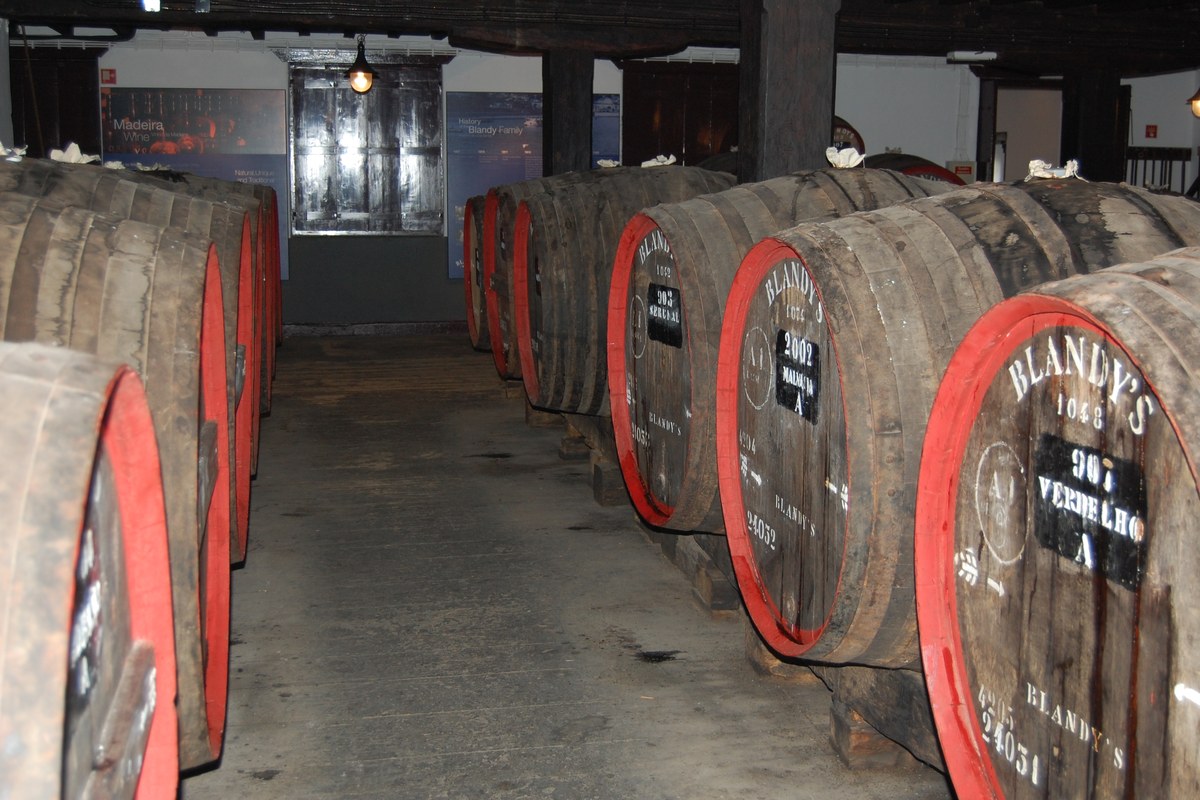
Madeira wine is the most famous thing the island makes, and it is unlike any other wine in the world. It is a fortified wine deliberately heated and aged in warm air, which gives it flavours of caramel, dried fruit, toasted nuts and spice: an opened bottle keeps for months, a sealed bottle for decades, and the finest vintages are still drinking well after a century. This guide is the deep home for the wine. Our guide to Madeira: The Complete Guide for UK Travellers gives the wine one paragraph; this page is the deep guide.
Madeira wine is not one wine. It runs from bone dry to very sweet, and the grape on the label tells you where on the scale you are: Sercial is dry, Verdelho is medium dry, Bual is medium sweet and Malmsey is sweet.
What Madeira wine is, and why it is different
Madeira is a fortified wine made only on the island of Madeira, in the Atlantic about 805 km southwest of mainland Portugal. The wine is fermented, then fortified with grape spirit to about 17 to 20% alcohol. What makes Madeira different is what happens next: the wine is deliberately heated and exposed to oxygen for months or years. The result is a wine that has already been cooked and oxidised on purpose, so heat and air, the two things that ruin ordinary wine, can no longer harm it.
The story starts with the ships. Madeira was a standard port of call for vessels heading to the New World or the East Indies from the 15th century onwards. The early wine was unfortified and tended to spoil, so producers began adding distilled spirit to stabilise it, following the example of port. By the second half of the 17th century both the Dutch and English East India Company ships were calling at Funchal regularly, with casks of Madeira loaded as ballast for the voyage.
Then came the accident that made the wine. A shipment that had crossed the equator and come back unsold was found to have improved: months of heat and rolling in a ship's hold had cooked and oxidised it into something darker, nuttier and better. Wine that had made the round trip became known as vinho da roda, the wine of the round voyage, and was highly prized.
The wine also has an American history. English merchants settled in Funchal in the 17th century and built the trade with North America, and by the end of the 18th century the North American colonies were importing about a quarter of the island's total production. Madeira was the wine of the American founders: it is the wine tradition says the signers used to toast the Declaration of Independence in 1776, though the exact toast is debated by historians.
Today a small number of historic houses make the wine, most of them based in Funchal: Blandy's, H.M. Borges, Pereira D'Oliveira, Henriques and Henriques, Justino's and Vinhos Barbeito. Their lodges are the easiest place for a visitor to learn it properly.
How it is made: fortification, estufagem and canteiro
Three steps make Madeira what it is: fortification, heating and long ageing. After the grapes are pressed and fermentation begins, grape spirit at 96% alcohol is added. For the drier styles, Sercial and Verdelho, the spirit goes in after fermentation has finished, so the wine stays dry. For the sweeter styles, Bual and Malmsey, it goes in early, stopping fermentation while sugar is still left in the wine and locking that sweetness in.
Estufagem is the fast way of giving Madeira its cooked, caramel character. The wine is held in stainless steel tanks, warmed by hot water running through coils or jackets, at about 45 to 50 degrees C for at least three months. It is used mainly for younger, larger volume Madeira, including most 3 year old wines and cooking wine. Estufagem wines cannot be sold as vintage dated frasqueira.
Canteiro is the traditional, slow way, and it is used for the finest wines. The wine ages in wooden casks, usually of 300 to 650 litres, resting on wooden beams called canteiros in the warm upper floors and attics of the lodges in Funchal. There the subtropical sun heats the casks slowly for years and often for decades, at temperatures that can reach over 30 degrees C, and about 4 to 5% of the wine is lost each year to evaporation. Canteiro wine must spend at least two years ageing by this method and cannot be bottled as canteiro Madeira before three years. Three months in an estufa roughly equals five years of canteiro.
Madeira grapes are picked much earlier than the harvest dates for most wines, so the juice has much higher acidity than other wines. That acidity, plus the fortification, gives the wine its structure. Canteiro wines survive for decades and even centuries in the bottle: a vintage Madeira can last for a century or more, and once opened it can be enjoyed, re-stoppered and stored for months without deterioration.
The grapes, driest to sweetest
Four noble white grapes give Madeira its four classic styles, each matching a level of sweetness, and each grown at a different height: the driest grows highest and coolest, the sweetest lowest and warmest. Tinta Negra makes most of the island's everyday wine, and Terrantez is rare. A grape named on a label must make up at least 85% of the wine.
| Grape | Style | Where it grows | What it tastes like |
|---|---|---|---|
| Sercial | Dry | Coolest vineyards, up to 1,000 m, mainly north side | Pale, dry and tangy, with citrus, green apple and toasted nuts |
| Verdelho | Medium dry | 300 to 600 m, mainly north side | Fuller than Sercial, with honey, spice and ripe citrus |
| Bual (Boal) | Medium sweet | Warmer spots, 100 to 300 m, south coast | Dark and medium rich, with raisin, caramel, toffee and coffee |
| Malmsey (Malvasia) | Sweet | Closest to sea level, warmest spots | Richest and sweetest, with dried fruit, molasses, toffee and chocolate |
| Tinta Negra | Dry to sweet | Across the island, about 80 to 85% of vineyards | Varies with the style; base of most everyday Madeira |
| Terrantez | Dry to rich | Very little grown, mainly old vineyards | Varies from dry to rich; rare and distinctive |
Serve Sercial cellar cool as an aperitif; it is pale, dry and austere, with citrus and almond notes and piercing acidity. Verdelho, fuller and softer, with honey, spice and ripe citrus, goes with ham and pates. Bual, dark and medium rich with raisin, caramel and coffee, is served at room temperature with hard cheese or fruit tart. Malmsey, the richest and sweetest, with dried fruit, molasses, toffee and chocolate, is the partner for honey cake, chocolate desserts and Christmas pudding. Sercial is the same grape as the esgana cao, literally dog strangler, of the Portuguese mainland.
Tinta Negra is a red grape, and it is the grape behind most Madeira wine, grown on roughly 80 to 85% of the island's vineyards. Most everyday Madeira, the 3 year old wines and the wine sold for cooking, is Tinta Negra aged by the fast estufa process. Since 1993, wine made from Tinta Negra may not use the noble grape names on the label. Instead it is labelled by sweetness: seco, meio seco, meio doce and doce. A bottle that says meio doce rather than Bual is almost certainly Tinta Negra: a younger, simpler and cheaper wine, and the right bottle for cooking.
Terrantez is a white grape of which very little is now grown. Some replanting is taking place, but yields are low, so it is mainly found in old vintages or soleras. It can vary in style from dry to rich, so ask about it in a tasting room if you want to try something unusual.
Styles and ages: what the label means and what to buy
Madeira labels carry two kinds of information: the grape, which tells you the sweetness, and the age, which tells you how long the wine spent in cask. The age statement on a blended Madeira is the age of the youngest wine in the blend, so a 10 year old has no wine younger than ten years in it.
| Label | What it means | What to buy it for |
|---|---|---|
| 3 year old, or Finest | Youngest age statement, usually Tinta Negra, usually estufagem aged | Cooking and a first taste |
| 5 year old, or Reserve | At least 5 years in cask | Best value introduction |
| 10 year old, or Special Reserve | At least 10 years in cask | Depth without the vintage price |
| 15 year old, or Extra Reserve | At least 15 years in cask | A step up; a good gift |
| 20, 30, 40 and 50 year old | Blends judged to taste at least that old | Special occasions |
| Colheita, or single harvest | Single vintage, aged at least 5 years in cask by canteiro | A birth year or anniversary bottle |
| Vintage, or frasqueira | Single vintage, single grape, at least 20 years in cask | The top of the range |
Colheita and frasqueira are the two single vintage styles, and the difference between them is time in cask. A colheita is a wine from a single harvest that must be at least five years old before bottling, and it can be bottled at any time after that. Most producers stop calling a wine colheita once it passes 19 years, because at 20 years it can be called vintage. A frasqueira, or vintage Madeira, must be aged at least 20 years in cask, and often 30 or 40 years or more. Frasqueira is made only from a single noble grape variety.
For a first bottle, a 5 year old in the style you like is the best value, and a 10 year old is the best bottle to bring home as a gift. Buy the 3 year old for cooking, a colheita for a birth year or an anniversary, and a frasqueira only as a special bottle. Buy by grape, not by age alone: a 10 year old Sercial and a 10 year old Malmsey are entirely different wines.
Where to taste in Funchal: the lodges and wine bars
Funchal is the centre of the Madeira wine trade, and the lodges are all within walking distance of each other. Start with one guided lodge tour, then use the tasting rooms to try the styles you liked best.
Blandy's Wine Lodge, Avenida Arriaga 28
Blandy's Wine Lodge is the essential first stop. It sits on Avenida Arriaga in the heart of Funchal, opposite the Municipal Garden and next to the Sé Cathedral, in a 17th century former Franciscan convent bought by Charles Ridpath Blandy in the mid 19th century. The Blandy family is the only one of the original founding families that still owns and manages its own wine company: John Blandy arrived in 1808 and founded his own business in 1811.
A guided tour takes you through the cooperage, past the museum, and into the canteiro lodge in the attic, where about 650 barrels and vats age in the warmth under the roof. Tours run in English, German, French and Portuguese from Monday to Saturday, and in Spanish from Monday to Friday, and they usually last 45 minutes to an hour and end with a tasting at the bar. The lodge also has the 1811 Bistro and Wine Bar, a shop, and two smaller lodges at Funchal airport. Hours are given as Monday to Friday 10:00 to 18:30, Saturday 10:00 to 18:00 and Sunday 10:00 to 13:00 and 14:00 to 18:00, but other guides disagree, so check the lodge website before you go. Tour prices were not established from an official source, so check the website rather than relying on figures from guides or reviews.
Other lodges and wine shops
H.M. Borges, at Rua 31 de Janeiro 83, is a family owned producer founded in 1877. Tastings run in three tiers: Silver with 2 wines, Gold with 3 wines including a special edition, and Diamond with 6 wines, from a 5 year old to a rare frasqueira. The tasting room takes walk ins, on weekdays from 09:00 to 12:30 and from 14:00 to 17:30. Tour prices were not established from an official source, so check the Borges website before you go. Pereira D'Oliveira, at Rua dos Ferreiros 107, is another long established house with a tasting room in central Funchal, and the house locals most often name as their own. Visitors report that tastings of the youngest wines are free, and you should expect to pay for the older pours.
Henriques and Henriques is the producer to visit outside central Funchal. Established in 1850 in Câmara de Lobos, it owns about 10 hectares of its own vineyards at Quinta Grande, planted on terraced slopes at 200 to 400 metres. The tasting room at Avenida da Autonomia 10 has a small museum among the barrels, tastings of the 3 year old wines are free, and vintage frasqueira and solera wines are available for a fee. Justino's, based in Caniço, has a tasting room but does not actively promote itself to visitors, so check before setting out, and Vinhos Barbeito in Câmara de Lobos should be booked in advance. The lodge shops have the widest range of aged and vintage bottles, and Perola dos Vinhos on Rua da Alfândega 119 stocks Justino's and Henriques and Henriques. Everyday bottles are cheaper in supermarkets.
Vineyards and the wine country
Madeira wine is made in Funchal, but the grapes grow all around the island, on tiny terraces cut into steep slopes above the sea. The plots are held up by walls of basalt stone, called poios, that ring the island like steps, and the vines are trained on low pergolas called latadas, raised off the ground to fight fungal disease in the damp subtropical air. The average grower's plot is only 0.3 hectares, the harvest is done entirely by hand, and a few large companies buy from hundreds of small growers.
The heart of the wine country is Estreito de Câmara de Lobos, the village up the hill behind Câmara de Lobos and the centre of Madeira's most favoured wine growing area, where the Levada do Norte walk passes through vineyards trained over the typical pergolas. The north coast is the other wine country: São Vicente and Seixal grow the cooler climate grapes, above all Sercial and Verdelho. There is no single open vineyard with a cellar door, so the usual way to see the wine country is an organised tour, often by jeep, that drives through the terraces, visits a producer and ends with a tasting. The Levada do Norte walk through Estreito shows the vineyards on foot.
Food pairings: what to drink with what
Match the wine to the dish: Sercial as an aperitif, cellar cool; Verdelho with ham, pates and savoury starters; Bual with hard cheese, dried fruit and cakes, at room temperature; Malmsey with chocolate desserts and honey cake. The island's own pairing is bolo de mel, the honey cake, with Bual or Malmsey. The cake is made with sugarcane molasses, dried fruits, nuts and spices, it is made in October and aged, and it is cut by hand, never with a knife. It keeps for months, until Easter, and its dark, spiced sweetness meets the caramel and dried fruit of the wine exactly. The pairing is the centrepiece of the festive table, covered in full in our guide to Madeira at Christmas: Funchal Lights, Market Night and the New Year Fireworks. The 3 year old bottles are the ones to cook with.
Buying and taking wine home to the UK
Buy everyday bottles in the supermarket and special bottles in the lodge shops, which have the widest range of aged, colheita and vintage bottles. A 5 year old in the style you like is the best value, and a 10 year old is the best gift bottle. For cooking, buy the cheapest 3 year old; for a present with a date on it, a colheita from the year that matters; for a bottle to keep for decades, a frasqueira.
UK customs rules come from GOV.UK and apply to travellers arriving in Great Britain, meaning England, Wales and Scotland; different rules apply for Northern Ireland. Madeira wine is a fortified wine at about 17 to 20% alcohol, so it falls in the category of alcoholic drinks up to 22% alcohol, and an adult traveller can bring in 9 litres without paying tax or duty: 12 standard 75 cl bottles. The same traveller can also bring in 18 litres of still wine and 42 litres of beer, and other goods worth up to 390 pounds. You can split the 9 litre allowance, and there is no alcohol allowance for travellers under 17.
If you go over an allowance you must declare your goods, online before you travel or at the border, and you pay tax and duty on all the goods in that category, not just the amount above the allowance. The allowance is per person and cannot be combined with anyone else's, and duty free purchases count towards it too. Keep your receipts: if your wine was made in the EU using only EU ingredients, bought in the EU and brought in from an EU country, you may be able to claim a zero rate of customs duty on anything you declare over the allowance. Bottles must go in hold luggage, not hand luggage, so wrap each bottle in clothing and put it in the middle of the case. Shipping options and bottle sizes were not established in this research, so ask in the lodge shop and check the label.
The Rum Tour: the island's other drink
Madeira also makes agricultural rum, distilled from fresh sugarcane juice, and it is the base of poncha, the island's traditional drink. The Rum Tour runs through the island's working sugarcane mills. Wine is fermented grape juice, fortified and heated; rum is distilled sugarcane juice, drunk young or after a few years in barrel.
Engenhos do Norte, also known as the North Mills Distillery, is the best place to see it. It stands in Porto da Cruz on the northeast coast, was built in 1927, and is the only steam operated rum distillery on the island, a working mill that still produces aguardente de cana and Madeira agricultural rum. A guided tour takes you from the harvesting of sugarcane through fermentation and distillation, and ends with a tasting of the different rums. Engenhos da Calheta, on the southwest coast, has been in operation since 1901 and produces sugarcane rum using old steam powered machinery that still operates today. Visitors can tour the working factory, watch a film explaining the production, and taste fresh sugarcane juice or rum in the small bar at the end. Visitor reports say entry is free and tastings are sold by the glass at small prices, and the best time to visit is the sugarcane harvest season, usually March to May, when the distillery is most active.
Poncha is made with aguardente de cana, honey, sugar and lemon juice, and it is served in traditional bars and taverns across Madeira. A poncha made with fresh lemon at a mill bar tastes very different from one made in a hotel bar, and the rum also goes into the island's sweets, including the honey cake.
The Wine Festival
The Madeira Wine Festival is the island's harvest festival, and it is the best time of year to visit for wine. The 2027 festival runs from 22 August to 12 September 2027, confirmed by Visit Madeira. It takes place in the streets of Funchal and in the vineyards and wine cellars of the rural areas. In Funchal, the centre is the Madeira Wine Lounge at Praça do Povo, with wine tastings, gastronomy and themed dinners, alongside the European Folklore Week and Concerts in the Vineyards.
The heart of the festival is the Wine Harvest Festival in Estreito de Câmara de Lobos. Every year, in the first half of September, thousands gather in the village for a live re-enactment of the harvest, with grape picking, an ethnographic parade and the pisa e repisa, the traditional grape treading in the stone lagar, where visitors can step in and tread with everyone else. The pillar article gives 11 September for the 2027 harvest re-enactment, but that date could not be verified against the official programme, so check it before you plan around it. Go for the harvest weekend in Estreito, and book accommodation early, because late August and early September is high season.
Conclusion
Madeira wine rewards the traveller who tastes it where it is made. Start with a guided tour at Blandy's, try the four noble grapes in order from dry to sweet, and buy a 5 or 10 year old bottle of the style you like to take home. Walk the terraces at Estreito if you can, taste a poncha at a working rum mill, and if your dates allow, time the trip for the Wine Festival in late August.