
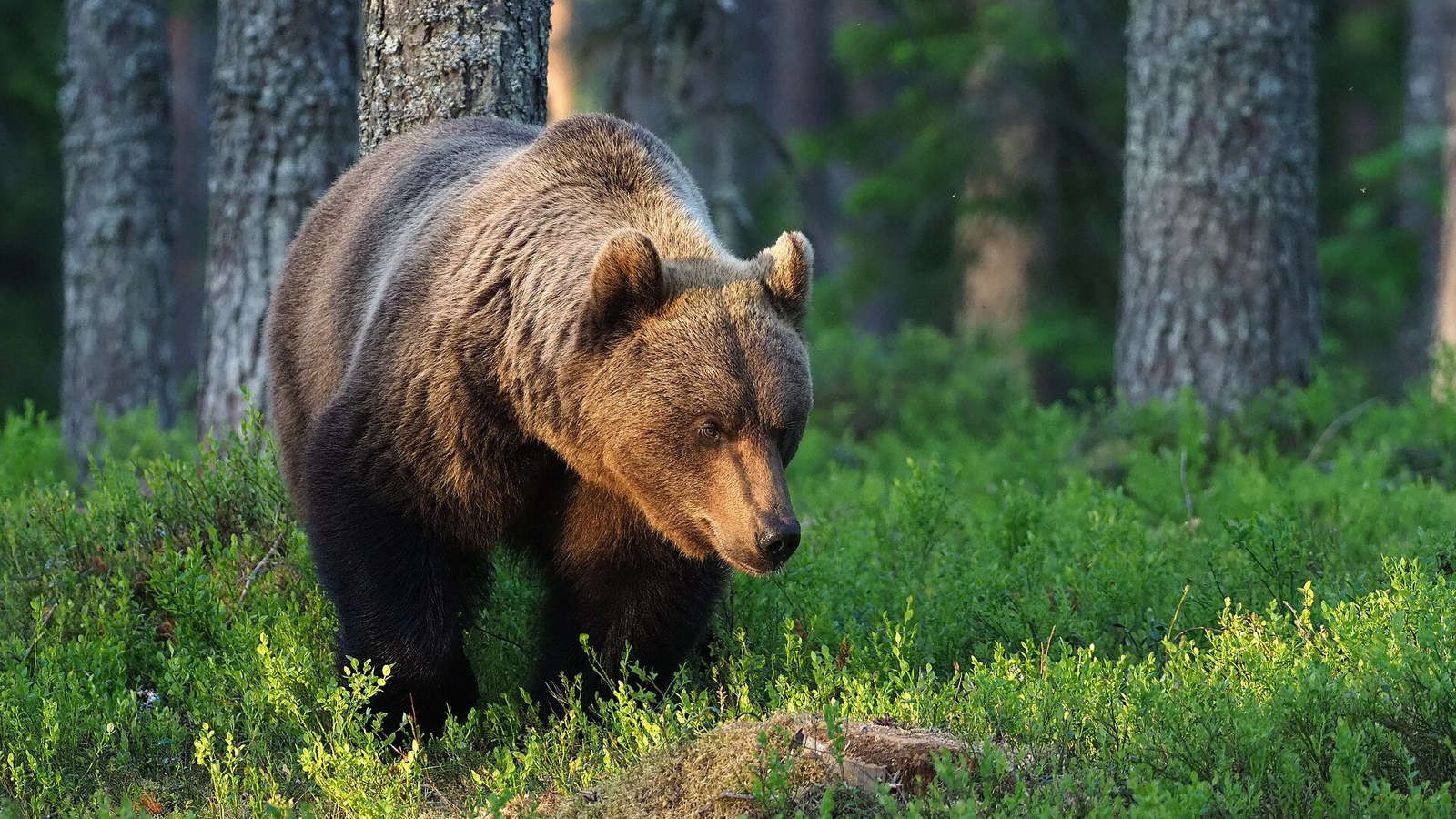
The most reliable way to see a wild brown bear in Europe is an overnight hide in the forests of eastern Finland, where bears visit feeding clearings a few metres away. Romania's Carpathians hold more bears than anywhere else in the EU, Slovenia runs forest hides an hour from its capital, and Spain offers the free alternative: public viewpoints and a telescope at dawn. The season runs from late spring to autumn, and any website quoting you a percentage chance of a sighting is making the number up.
Europe holds about 20,400 brown bears in 10 populations, from Spain's Cantabrian Mountains to the Finnish-Russian border (Large Carnivore Initiative for Europe). They are strictly protected under the EU Habitats Directive and the Bern Convention, and they are also shy, largely nocturnal and spread thinly across a lot of forest. That combination explains everything about how bear watching works here: casual hikers almost never see one, so the people who do see bears use a hide, a viewpoint or a guide. This guide covers the places where each model works, what it costs, and when to go, using conservation-authority figures throughout. Where a national park is the setting, our guide to Europe's best national parks and their quiet months helps you plan the wider trip.
Brown bears in Europe at a glance
| Question | Answer |
|---|---|
| How many bears? | About 20,400 in 10 populations; the Carpathian population (9,000) is the largest |
| Most reliable viewing | Overnight hides in Finland's Kainuu border forests, roughly May to August |
| Most bears in one country | Romania: estimates range from about 6,000 (long-used EU figure) to a contested 2025 DNA census of 10,657 to 12,787 |
| Free viewing | Spain's Cantabrian viewpoints (miradores) with binoculars or a telescope, April to June and late August to October |
| Typical hide cost | About 70 euros for a Romanian evening hide; 99 to 220 euros for a Finnish hide night |
| Worst time | Winter: bears are denning, roughly November to March or April depending on latitude |
How bear watching in Europe actually works
There are three honest models, and every destination in this guide uses one of them. The first is the overnight hide: a small wooden cabin at a forest clearing where a licensed operator places food (in Finland, usually carrion such as roadkill; smaller amounts elsewhere), and you sit in silence from late afternoon to morning while bears come and go. The second is the viewpoint: in Spain, wardens and locals watch known feeding slopes from public miradores with telescopes, at distances of hundreds of metres, and nothing is baited. The third is guided tracking in Slovakia, Italy or Greece, where you read tracks, scat and feeding signs with a guide and a sighting is a bonus, not the product.
One warning before the destinations: no park, NGO or scientist publishes sighting odds, because a sighting depends on the site, the season, the weather and luck. The percentages that circulate online are self-reported marketing claims by individual hide operators about their own baited clearings. Two are quoted in this guide, always with the operator's name attached, so you can judge them for what they are.
Finland: the benchmark hide country
If seeing a bear is the point of the trip, go to Finland. The viewing industry is concentrated in the Wild Taiga districts of Kuhmo and Suomussalmi in Kainuu, along the Russian border, roughly 100 km south of Oulanka National Park. The border zone is the secret: entry is permit-only, bear hunting is banned inside it, and bears drift across from Russia through some of the quietest forest in Europe.
The format is a night, not an evening. At centres such as Martinselkonen (Suomussalmi), Boreal Wildlife Centre (Viiksimo, near Kuhmo) and Bear Centre (Vartius), you walk 400 m to 1 km to the hide in the late afternoon, settle onto a bunk or a photography seat, and stay until about 07:00. Leaving mid-session is not allowed. Bears feed at clearings in front of the hides and can pass within a few metres; wolverines are regular supporting cast, and wolves appear occasionally. Large hides run from the end of April to mid-August, with June and July the peak (mating season, maximum activity, and cubs appearing from late May). Bears remain active into September and October at some sites before denning.
Prices, from the operators' own pages: a night costs 159 euros at Bear Centre, 170 euros in Martinselkonen's large hide (220 euros for a small photography hide) and 220 euros at Boreal, which also sells 2 and 3-night packages. Bear Centre quotes an 80 to 95 percent chance at its own site; treat that as the operator's claim about its baited clearing, not a statistic. Transfers run about 2 hours from Kajaani (KAJ) or Kuusamo (KAO) airports.
And the correction this article owes you: Oulanka and every other Finnish national park is free to enter (Metsähallitus policy), but Oulanka is a hiking park whose bears stay away from people. The hides, not the trails, are the viewing product.
Romania: the most bears, and the sharpest context
Romania's Carpathians are part of Europe's largest bear population block (9,000 across Romania, Poland, Slovakia and Serbia). How many are in Romania alone is genuinely disputed: EU project material long used "more than 6,000", the Environment Ministry used about 8,000 in 2024, and the country's first DNA-based census, announced in 2025, gave 10,657 to 12,787, a figure WWF Romania has criticised for unpublished methodology. What is not disputed is the density around Brasov and the southern Carpathians, which is why the viewing industry is based there.
The standard product is an evening hide trip sold from Brasov: about 40 minutes' transfer, then roughly 2 hours of silent watching with a guide in a forest hide, in small groups, priced from about 70 euros per person, with seasons typically running May to October depending on the operator. A second style operates around Baile Tusnad and Lake Saint Anne, where covered observatories with one-way glass take larger groups. Operators here are blunter than Finland's: the honest ones state in writing that a wild sighting cannot be guaranteed.
Two things belong in any honest Romania guide. First, the Libearty Bear Sanctuary at Zarnesti, the world's largest brown bear sanctuary with more than 130 rescued bears in 69 hectares of forest, is a moving and worthwhile visit, but its bears are rescued captives that can never be released. It is not wild bear watching, and it should never be sold as such. Second, Romania's coexistence problem is Europe's most severe in absolute terms: official figures report 26 people killed and 274 seriously injured by bears over 20 years, and about 7,500 emergency bear calls in 2023 alone. The single most repeated rule for visitors follows from it: never feed bears, above all the roadside bears on the Transfagarasan, where stopping to feed or photograph them is illegal and is exactly how bears learn to approach cars and people.
Slovenia: dense forest bears, an hour from the capital
Slovenia's end-2023 genetic census counted 695 to 797 bears in a country smaller than Wales, with local densities in the southern Dinaric forests among the highest reported anywhere for the species. Viewing centres on Kocevje and the Sneznik plateau around the Loz valley: evening watches from adapted hunting stands and photography hides, in complete silence, with local guides.
The destination organisation at Kocevje runs a 2-day bear programme (April to the first half of September, groups up to 8) combining an evening hide watch with tracking and a beekeeper visit, priced 450 to 730 euros per person depending on group size, including a night's stay, meals and local transport, and it states plainly that sightings are not guaranteed. Single-evening hide tours run from about 160 euros per person (April to October). Kocevje is 60 km from Ljubljana, which makes Slovenia the easiest capital-city bear trip in Europe. Slovenia also manages its growing population with an annual cull quota, which conservation groups challenge every year; the debate is part of the landscape here.
Spain: the Cantabrian model, telescopes instead of hides
Spain does everything the opposite way. The Cantabrian population is about 370 bears (2020 genetic estimate) in two subpopulations, western and eastern, across Asturias, Leon and Palencia. There is no baiting and there are no hides. Instead, named public viewpoints (miradores) overlook the slopes where bears feed: Gua and La Peral (Principe) in Somiedo Natural Park, and Fonduveigas and others in Fuentes del Narcea. You go at dawn or dusk, because Cantabrian bears are mostly nocturnal, with binoculars at minimum and a telescope if you can borrow or hire one. Asturias's own tourism authority says, in so many words, that sightings are never guaranteed.
The reward for the lower odds is a wilder kind of watching, and it is free: you are looking at completely unhabituated bears doing what they would do if you were not there. Two windows matter. April to June is the best of the year: bears graze open meadows after hibernation, mothers with new cubs use high clear slopes in May and early June, and mating activity peaks. The second window, late August to October, is feeding season on hazelnuts, berries and then acorns and beechnuts. Local ecotourism companies in Cangas del Narcea, Degana and Ibias run guided trips with optics and local knowledge. Asturias Airport (OVD) is the gateway.
Sweden and Estonia: more hides, different forests
Sweden holds about 2,800 bears (2022 national inventory; provisional 2023 figures were lower, around 2,450, after heavy licensed hunts). The established hide is Wild Nordic at Jarbo in Gavleborg, just over 2 hours from Stockholm Arlanda: a 4 to 6 person hide where bears usually stay 20 to 30 m away and can come within 6 to 7 m, running 1 May to 10 September at 2,500 to 3,000 SEK per person depending on group size. Wild Nordic unusually publishes its own success history, 90 percent on average in 2016-2020 falling to 72 to 77 percent recently as county bear numbers dropped, which tells you more about hide honesty than any single figure. One myth to bury here: Scandinavian bears do not fish for salmon. The Scandinavian Brown Bear Research Project's diet work is mostly berries, ants and moose calves. There is no Brooks Falls in Europe.
Estonia is the value option. The Environmental Board counts 900 to 950 bears, and the Alutaguse forests in the north-east hold about half of them. NaTourEst's classic hides there (bunk cabins for 9, photo holes, no flash, guide drops you and leaves) cost 135 euros a night, with a comfort hide at 145 euros, about 1.5 hours from Tallinn or Tartu. The season ends after the second week of October, when the days shorten and the bears wind down.
Slovakia, Italy and Greece: go for the tracking, not the odds
Slovakia has around 1,050 to 1,200 bears across the Tatras, the Fatra ranges and Polana (the density hotspot), but no real viewing infrastructure: the established product is a guided hiking day in the Western Tatras with binoculars, and a sighting is luck. Italy is a conservation story: the Marsican bear, a distinct subspecies found only in the Central Apennines, numbers roughly 50 around Abruzzo National Park and is critically endangered in Italy. Guided dawn and dusk excursions run from Pescasseroli (April to September, no baiting, no calls), and the operators themselves say no route can guarantee an encounter. Greece holds the southern end of the Dinaric-Pindos population in the Pindos and Rhodope mountains; the conservation group ARCTUROS estimates roughly 565 to 870 bears nationally (its own caveat: an extrapolation, not a census), and what exists for visitors is niche tracking tourism where tracks and signs are the realistic reward. In all three countries, book the guide for the landscape and the learning, and treat a bear as a privilege.
When to go: the bear year
Bears run on a food calendar, and the calendar, not a percentage table, is what should set your dates.
- Spring emergence (March to May): bears leave their dens after 5 to 7 months in the north (Cantabrian bears may shorten or skip denning). Adult males emerge first, solitary females next, and mothers with newborn cubs last, weeks later. Early-season hides see lean males; the cub photographs start in late May.
- Mating season (May to July): the year's peak bear activity. This is why June and July are the prime months at the Finnish hides, under near-24-hour northern daylight.
- Summer (July to August): berries ripen, bears feed hard, and activity shifts toward evening in the hotter south. Cantabrian bears go quieter in the mid-summer heat.
- Autumn hyperphagia (September to November): bears eat almost constantly on beech and oak mast and late berries to build fat for winter. Spain's second window and the tail of the Romanian and Slovenian hide seasons sit here, and the bears you see are at their heaviest and most impressive.
- Winter (November to March/April): denning. Cubs are born in the den in January and February. There is no viewing product anywhere in Europe in deep winter, whatever an old guide tells you.
Safety and ethics in bear country
Official guidance from Finland's Large Carnivore portal, Slovakia's State Nature Conservancy and Spain's environment ministry agrees on the essentials. There is no single official viewing distance for Europe; Slovakia's intervention team treats anything under 100 m as a close encounter, which is a good working rule on foot.
- Avoid the meeting: in poor visibility, make noise as you walk (talk, clap, sing) so bears hear you and leave first. Walk marked trails in daylight, in a group where you can.
- If you meet a bear: stay calm, speak quietly, and back away slowly the way you came. Do not run (a bear is faster than you), do not stare into its eyes, and do not climb a tree. A bear standing on its hind legs is usually just trying to see and smell you better.
- Two red lines: never get between a mother and cubs (if you see a cub, its mother is close; leave), and if you find a carcass, leave immediately, because a bear is likely guarding it nearby.
- Food discipline: never feed a bear, never leave food or rubbish outside overnight, store food in sealed or bearproof containers, clean cooking gear at once, and never cook in or beside your tent. Fed bears become conflict bears, and conflict bears get shot.
- Dogs: keep them on a leash in bear country; a loose dog can confront a bear and lead it straight back to you. Spain's bear-watching guidance is stricter still: leave dogs out of watching activities entirely.
- In a hide: silence is the whole product. Whisper at most, phones off, no flash photography, no perfume or rustling clothes, and never leave before the session ends. Assume drones are prohibited near wildlife in protected areas unless a park office tells you otherwise in writing.
On the ethics of baited hides, be clear-eyed: the Finnish, Romanian, Estonian and Slovenian products work because food is placed at the clearing, under licence, by local operators. Defenders argue the practice concentrates tourism on a few bears that are habituated to the hide rather than to people, and funds rural jobs and a protective presence in the forest. Critics argue that feeding any wild bear risks the dependency that official guidance blames for conflict. Italy's Abruzzo operators advertise the opposite model as their selling point. Decide which model you are comfortable paying for; just do not let anyone sell you a baited hide as untouched wilderness.
Costs and practical notes
| Destination | Product | Price (operator-published) |
|---|---|---|
| Finland (Kainuu) | Overnight hide, per person | 159 to 220 euros |
| Romania (from Brasov) | Evening hide trip, per person | From about 70 euros |
| Slovenia (Kocevje) | Single evening hide / 2-day programme | From about 160 euros / 450 to 730 euros |
| Sweden (Jarbo) | Overnight hide, per person | 2,500 to 3,000 SEK |
| Estonia (Alutaguse) | Overnight hide, per person | 135 to 145 euros |
| Spain (Cantabria/Asturias) | Public viewpoints | Free (guided trips priced per operator) |
For a hide night, pack like a sniper, not a hiker: warm, silent layers (it is cold at 04:00 even in July), soft-soled shoes, a head torch you will barely use, food and water for the whole session, and patience. Photographers want the longest lens they own; bears at Finnish hides can be close enough for a wide angle, while Spain is telescope country and phone photos there are a lost cause. Book hides before flights in peak season, because the best Finnish and Slovenian dates go first. If your wildlife ambitions run bigger than bears, our 10-day Kruger safari plan applies the same plan-by-season logic to Africa's big game.
Sources
- Large Carnivore Initiative for Europe: brown bear populations
- European Commission: large carnivores and the Habitats Directive
- Metsähallitus: fees and free access in Finnish national parks
- Martinselkonen Wilds Centre: bear watching hides
- Boreal Wildlife Centre: hide booking and prices
- AMP Libearty Bear Sanctuary, Zarnesti
- Turismo Asturias: the best places to see bears in Asturias
- Fundación Oso Pardo: the Cantabrian brown bear
- Wild Nordic: bear hide, Jarbo
- NaTourEst: brown bear watching, Estonia
- Large Carnivores Finland: what to do if you meet a bear
- Slovak State Nature Conservancy: bear safety