
Why timing changes everything in Europe's best parks
The best national parks in Europe are often the same parks that feel overrun in July and August. The lakes, waterfalls and ridge walks do not change. What changes is the month, the day of the week and the hour you arrive. This guide covers 12 national parks in Europe that reward a shoulder season trip. Each one includes the quieter window the evidence supports, the one walk or viewpoint worth building a day around, and the practical check that can catch visitors out.
Answer: For most of Europe best national parks, the quieter windows are May to early June and September to October. Waterfalls run strongly in spring, beech and larch colour peaks in autumn, and the main summer pressure eases. High mountain parks are the exception. Their trails and huts are a late June to mid September story, and winter closes much of the Swiss National Park path network.
How to use this guide
Start with the quick-pick table if you already know your month. Read the park section in full if you are choosing between two parks, because the honest trade-offs sit there, not in the table.
What off-peak really means here
Off-peak does not mean empty, and this guide does not promise empty trails. It means fewer visitors than the peak weeks at that same park, based on what the park sources themselves say about their seasons. At Plitvice, for example, the supported wording is that crowds have thinned by late October, not that the park is deserted.
Quick-pick table: 12 parks and their quieter window
The table compares only facts checked for this draft: country, the landscape in one line, and the quieter window. Prices are left out on purpose, because several parks price by season, card type or vehicle, and a single fixed figure would mislead.
| Park | Country | Known for | Quieter window in this guide |
|---|---|---|---|
| Plitvice Lakes | Croatia | 16 named lakes joined by waterfalls, UNESCO listed in 1979 | May, and late October when crowds have thinned |
| Triglav | Slovenia | Slovenia only national park, Mount Triglav at 2,864 metres | Late spring and September, outside the main hut rush |
| Swiss National Park | Switzerland | Oldest national park in the Alps, founded in 1914, strict reserve | June, and autumn for the deer rut |
| Berchtesgaden | Germany | Germany only alpine national park, Konigssee electric boats | Late May to early June, and September |
| Picos de Europa | Spain | First national park in Spain, declared in 1918, Cares Gorge | September to October, autumn colour in the beech forests |
| Jotunheimen | Norway | Home of the Giants, Galdhopiggen at 2,469 metres | Late June and early September, within the short hut season |
| Vatnajokull | Iceland | Largest national park in Europe, about 14 percent of Iceland | June and September, outside the main summer circuit weeks |
| Saxon Switzerland | Germany | Bastei Bridge, stone bridge built in 1851, free to visit | May and late September, early in the day |
| Tre Cime, Dolomites | Italy | Three Peaks, Cima Grande at 2,999 metres, UNESCO listed in 2009 | Late June and early September |
| Cinque Terre | Italy | Smallest national park in Italy, five villages and terraced hillsides | Late May, and early October when the park is less packed |
| Calanques | France | Only land, sea and peri-urban national park in Europe, created in 2012 | Early June and late September |
| Bavarian Forest | Germany | First national park in Germany, founded in 1970, let nature be nature | Late May to June, and autumn |
How to choose in three steps
- Pick your month first, then the park. A high mountain park in October and a coastal park in October are two very different trips.
- Match the walk to your group. Besseggen is a full ridge day for experienced hikers. The Bastei viewpoint and the Plitvice boardwalks suit a gentler day.
- Check the one rule that applies to your park before you book anything else: the trail card, the toll road booking, the fire-risk closure or the trail closure list.
Plitvice Lakes, Croatia - 16 lakes that build their own waterfalls
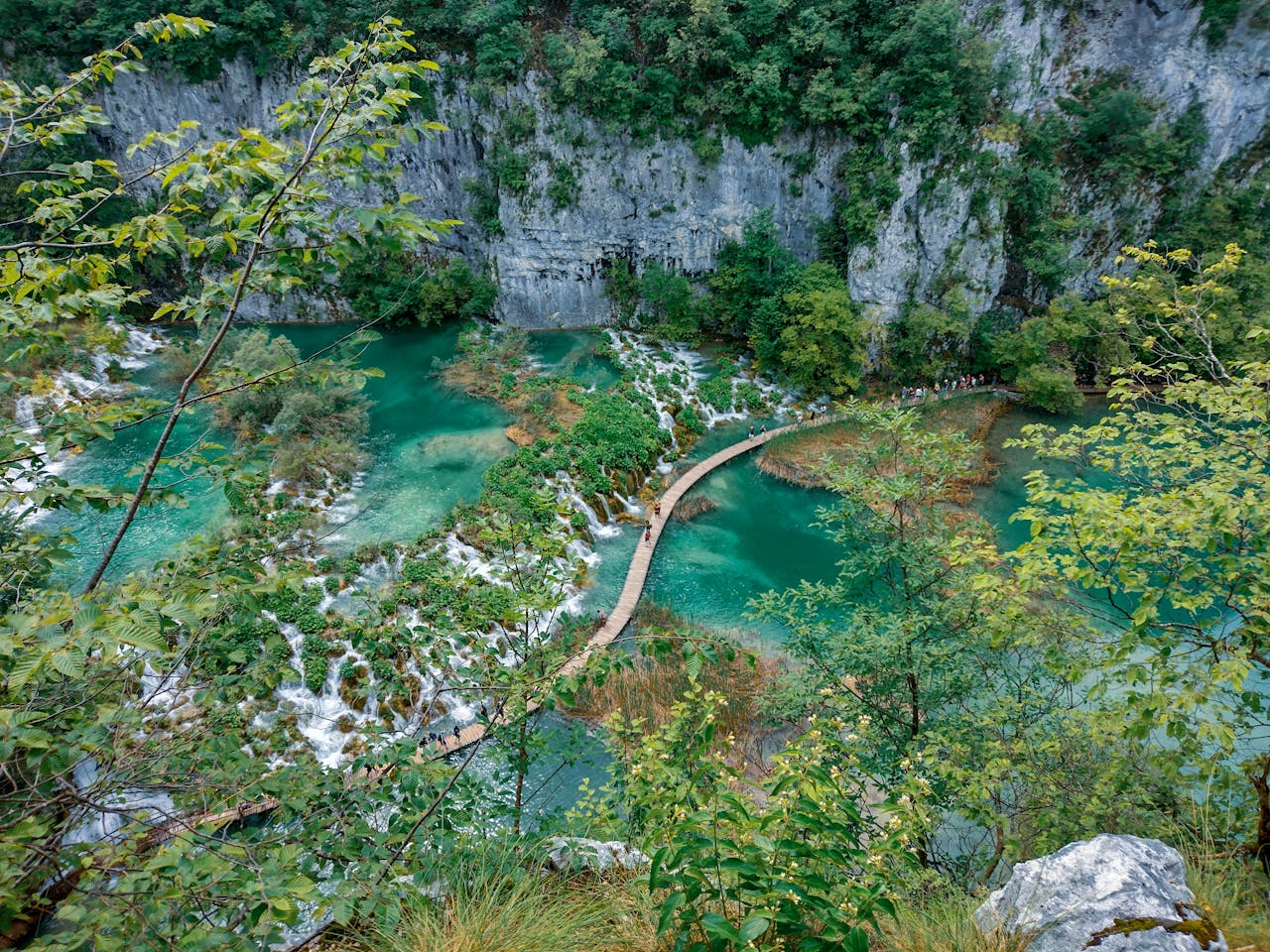
Plitvice Lakes is the oldest and largest national park in Croatia, proclaimed on 8 April 1949 and inscribed on the UNESCO World Heritage List on 26 October 1979. Its 16 named lakes step down a valley in cascades, joined by waterfalls that are still forming. The reason is tufa, also called travertine. Mineral-rich water deposits natural barriers between the lakes, so the landscape is not finished. It is still being built, slowly, by the water itself.
When it is quieter and what to do in one day
May brings strong waterfall flow after spring rain and snowmelt. By late October the crowds have thinned and autumn colour turns the beech forest around the lakes. Walk a full route that links the Upper and Lower Lakes instead of stopping only at the largest waterfall, and start at the first entry time you can.
Check before you go
Tickets and entry rules change by season, so confirm the current ticket and any timed entry on the official park site before you travel. Swimming is not the point here. This is a boardwalk and viewpoint park, and staying on the paths protects the tufa.
Triglav, Slovenia - one country, one national park
Triglav is Slovenia only national park, covering about 840 square kilometres of the Julian Alps, roughly 4 percent of the country. At its centre stands Mount Triglav at 2,864 metres, the highest peak in Slovenia and a national symbol. Inside the park story sits Lake Bohinj, Slovenia largest permanent natural lake, and the emerald Soca River. Lake Bled is different. It lies outside the park boundary and works best as a base town, not as a park attraction.
When it is quieter and what to do in one day
Late spring and September give you valley walks, gorges and lake days without the main summer hut pressure. A strong one-day plan is Lake Bohinj and a gorge walk, with a mountain hut day added only if the weather and your experience support it.
Check before you go
Entry to the park itself is free, but individual sights, gorges, parking and transport can charge separately. High mountain huts are typically a May to October story, so an off-peak Triglav summit plan needs a hut and weather check, not just a date.
Swiss National Park, Switzerland - nature left completely alone
Founded on 1 August 1914, the Swiss National Park is the oldest national park in the Alps and the only national park in Switzerland. It covers about 172 square kilometres near Zernez in the Engadin, and it is run as a strict nature reserve. That word, strict, is the experience. Nature is left to develop without intervention, visitors stay on marked trails, and there is no camping in the park. You are a witness here, not a participant.
When it is quieter and what to do in one day
June brings alpine flowers as the lower paths reopen. Autumn brings the deer rut, one of the park best-known wildlife events. Base yourself in Zernez, choose one marked trail that matches the current open list, and carry binoculars for ibex, chamois, deer and marmots.
Check before you go
Admission is free, but the trail network closes in winter and reopens path by path in spring depending on snow. Check the open trails list before you plan a route, and do not plan any winter sports in the park. They are not permitted.
Berchtesgaden, Germany - the silent boats of Konigssee
Established in 1978, Berchtesgaden is Germany only alpine national park. Its centrepiece is Konigssee, a deep, fjord-like lake under the Watzmann massif, which rises to 2,713 metres. Electric boats have crossed Konigssee for more than 100 years. They run quietly by design, and the boat crew trumpet stop, where the note echoes off the rock walls, is part of the trip, not a gimmick added for tourists.
When it is quieter and what to do in one day
Late May to early June and September suit a boat trip to St. Bartholoma combined with a valley or lakeside walk. Arrive for an early boat. The lake is the park headline act and it fills first.
Check before you go
The boat is a paid service, separate from entering the park landscape. Check the sailing season and the last return boat before you walk far from the landing stage.
Picos de Europa, Spain - the first national park in Spain
Picos de Europa was declared on 22 July 1918 as the Montana de Covadonga National Park, making it the first national park in Spain. It now covers about 64,660 hectares across Asturias, Cantabria and Castilla y Leon, in three limestone massifs. The names to know are Torre Cerredo at 2,648 metres, the highest summit, and Naranjo de Bulnes at 2,519 metres, the orange limestone tower that climbers treat as a landmark of Spanish alpinism. Between them sit deep gorges, glacial lakes and villages that still make Cabrales cheese, cured in caves.
When it is quieter and what to do in one day
September to October brings autumn colour to the beech forests and an easier pace on the famous paths. The Cares Gorge trail, about 12 kilometres one way between Poncebos and Cain, is the one-day classic. The Lakes of Covadonga and the Fuente De cable car are the shorter alternatives.
Check before you go
The Cares trail is a linear gorge walk, not a loop, so plan the return before you start. Weather turns quickly in limestone mountains this close to the Bay of Biscay, about 20 kilometres away.
Jotunheimen, Norway - home of the giants
Jotunheimen means home of the giants, and the name fits. The park holds more than 250 peaks above 2,000 metres, including Galdhopiggen at 2,469 metres, the highest mountain in Norway, and Glittertind, the second highest.
When it is quieter and what to do in one day
The hiking season is short, roughly late June to mid September, when trails are clear and huts are open. The Besseggen ridge is the signature hike, a narrow ridge between the green Gjende lake and the darker Bessvatnet. Sources put it at up to eight hours and recommend it for experienced hikers only, so treat it as the main event, not an add-on.
Check before you go
Most Besseggen walkers take the Gjende boat from Gjendesheim to Memurubu and walk back over the ridge. Book the boat and the hut bed before you rely on them in a short season. Outside that season, this is a ski and winter mountain area, not a casual walking trip.
Vatnajokull, Iceland - fire under the ice
Vatnajokull National Park was established in 2008, joining the Vatnajokull ice cap with the older Skaftafell and Jokulsargljufur parks. At about 14,141 square kilometres it covers roughly 14 percent of Iceland, making it the largest national park in Europe, and it joined the UNESCO World Heritage List in 2019. This is a park built by two forces at once. Volcanoes sit under the glacier, and glacial rivers cut the canyons. Dettifoss, Svartifoss with its black basalt columns, and the Asbyrgi canyon all belong to the same story.
When it is quieter and what to do in one day
Skaftafell is the most accessible base for a one-day visit, with marked trails to Svartifoss and glacier viewpoints. June and September sit either side of the busiest summer circuit weeks, but glacier and ice cave activities are guided activities, not walks you improvise.
Check before you go
Distances are the real cost in Iceland. The park is vast and its visitor centres are spread out, so choose one sector per day. Never step onto a glacier without a qualified guide and the right equipment.
Saxon Switzerland, Germany - a bridge built into the rocks
Do not let the name mislead you. Saxon Switzerland is in Germany, near Dresden, and its national park was founded on 1 September 1990, days before German reunification. Its sandstone towers drew Romantic painters long before it drew hikers. The Bastei Bridge is the image everyone knows. A wooden bridge was built here in 1824 and replaced by the present sandstone bridge in 1851, linking rock towers high above the Elbe River.
When it is quieter and what to do in one day
Access to the park and the Bastei Bridge is free, which makes this one of the easiest parks in this guide for a low-cost day by train from Dresden to Bad Schandau or Rathen. Go early in the day in May or late September, walk the Bastei viewpoints, then add a section of the Malerweg, the Painters Way, if you want a longer walk.
Check before you go
Free does not mean formless. Climbing here follows the Saxon free-climbing tradition with its own rules, and some rock areas close to protect nesting birds. Read the signs at the trailhead.
Tre Cime in the Dolomites, Italy - three peaks, one loop
The Tre Cime di Lavaredo are three unmistakable peaks: Cima Grande at 2,999 metres, Cima Ovest at 2,973 metres and Cima Piccola at 2,857 metres. They sit in the Tre Cime Nature Park, about 11,635 hectares established in 1981, inside the Dolomites UNESCO World Heritage listing from 2009. The loop trail from Rifugio Auronzo is about 10 kilometres and is usually walked in three and a half to five hours. It is also a First World War landscape. Between 1915 and 1917 this was a front line, and tunnels and positions still mark the ground.
When it is quieter and what to do in one day
Late June and early September are the practical shoulders of a short summer season. Walk the full loop rather than stopping at the first viewpoint, because the famous north faces appear on the far side of the circuit, near Rifugio Locatelli.
Check before you go
Access by car uses a regulated toll road from the Misurina and Lake Antorno side, open in summer, with online booking and a time slot. Prices change, so book on the official channel for your date instead of trusting any fixed figure in a blog post, including an older version of this one.
Cinque Terre, Italy - the smallest park with five villages in it
At just 3,860 hectares, Cinque Terre is the smallest national park in Italy, and also the most densely populated, because five villages live inside it. The area became a UNESCO World Heritage Site in 1997 and a national park in October 1999. The landscape is man-made as much as natural. For centuries, residents built dry stone terraces for vines, olives and citrus, held up by thousands of kilometres of dry stone walling. The park protects that working landscape, not just the cliffs.
When it is quieter and what to do in one day
Late May and early October are the sweet spots in the live reporting for this park, when the villages are less packed than in high summer. With one day, walk one section of the coastal path, ride the local train between villages, and leave time to sit in one village rather than racing all five.
Check before you go
Paid trails need the Cinque Terre Card, sold in trekking and train versions, and prices vary by season and card type. Check the official price list and the open trails list on the morning of your walk. Trails close after heavy rain, and proper closed footwear is required on the paid paths.
Calanques, France - a national park at the edge of a city
Created on 18 April 2012 as France tenth national park, the Calanques is the only national park in Europe that is land, sea and peri-urban at once. It covers 8,500 hectares of land and 43,500 hectares of sea between Marseille, Cassis and La Ciotat. A calanque is a narrow, steep inlet cut into white limestone. The result is a park you can reach by city bus in the morning and be swimming from a rocky cove by midday, which is exactly why it needs careful management.
When it is quieter and what to do in one day
Early June and late September keep the sea warm enough for most swimmers while the main summer pressure eases. Pick one calanque and walk it properly. En-Vau is the famous name, Sugiton is the one closest to the Marseille university campus at Luminy.
Check before you go
In summer, access can be restricted for fire risk, and some popular calanques use a reservation system in peak season. Check the park access map for the exact day you plan to walk. Carry more water than you think you need. There is little shade on limestone.
Bavarian Forest, Germany - let nature be nature
The Bavarian Forest was founded in 1970 as the first national park in Germany, and extended in 1997 to about 243 square kilometres. Together with Sumava National Park across the Czech border, it forms the largest unbroken protected forest area in Central Europe. Its philosophy is the attraction: let nature be nature. Trees fall and stay where they fall, and a new forest grows out of the old one without planting plans. Rachelsee, the park only glacial lake, and the Baumwipfelpfad treetop walk give the wilderness two easy entry points.
When it is quieter and what to do in one day
Late May to June brings the forest at its greenest, and autumn brings colour and mushrooms season in the villages around the park. A one-day visit pairs a forest trail from a visitor centre such as Neuschonau with the treetop walk, and leaves the high ground around Grosser Rachel for a longer day.
Check before you go
This is a forest park, not a summit park. Wildlife enclosures near the visitor centres exist so visitors can learn about lynx, wolves and bears that are otherwise almost impossible to see in the wild forest. Do not expect sightings on the trail itself.
Planning an off-peak park trip that actually works
Getting there by train
Several parks in this guide are realistic without a car: Saxon Switzerland from Dresden, the Swiss National Park via Zernez, Cinque Terre by the Levanto to La Spezia line, and Berchtesgaden from Munich and Salzburg. Others, such as Vatnajokull and Jotunheimen, need a bus, a boat or a long transfer built into the plan.
What to pack for shoulder season
- Layered clothing and a waterproof shell, because May and October weather changes fast in the mountains
- Sturdy closed footwear, which some parks require on paid or rocky trails
- A reusable water bottle, sun protection and a small first aid kit
- Offline maps, because signal drops in gorges, forests and high valleys
Travel that leaves the park as you found it
- Stay on marked trails, which is a strict rule in the Swiss National Park and good practice everywhere
- Take all litter out, including food scraps
- Keep distance from wildlife and never feed animals
- Use refill points and public transport where the park provides them
Read more in the RoamFeast travel, food and festival guides.
Explore the National Parks cluster guides
These five companion guides go deeper on one part of planning a quieter national park trip: visits in the United States, the best month for Europe, a crowd-avoidance system, hiking, and photography.
- Best National Parks in USA ranked by 2025 visits
- Best Time to Visit National Parks in Europe month guide
- How to Avoid Crowds in National Parks 5 step system
- National Parks Hiking Guide with verified trails
- National Parks Photography Guide for viewpoints and light
Sources
- Plitvice UNESCO story
- Triglav official
- Swiss NP official
- Picos Turismo Asturias
- Vatnajokull official
- Jotunheimen Visit Norway
- Tre Cime Dolomiti official
- Calanques park authority
- Cinque Terre official
- Saxon Switzerland official
- Bavarian Forest official