

Coney Island Singapore is a free island park off Punggol with five beaches, a mangrove boardwalk and more than 80 bird species. It opens 7am to 7pm daily, and the easiest way in is the North East Line to Punggol Coast MRT, then a walk of about 20 to 30 minutes to the West Entrance.
Coney Island Singapore is the name of the island park off the coast of Punggol in northeastern Singapore, also known as Pulau Serangoon. This guide is about that island, not Coney Island in New York. It is a car-free park of 81 hectares on an island of about 100 hectares, run by the National Parks Board (NParks), with beaches, a mangrove boardwalk, cycling paths and bird hides. It suits a free half-day out for locals and for visitors who want a quiet, natural side of Singapore away from the city centre.
At a Glance
| Fact | Detail |
|---|---|
| Where | Off Punggol, northeastern Singapore. Also called Pulau Serangoon. |
| Park size | 81 hectares as listed by NParks. The island is about 100 hectares. The park was 50 hectares when it opened in October 2015. |
| Entry | Free. No booking needed. |
| Hours | 7am to 7pm daily. Gates close at 7pm. |
| Entrances | Two. West Entrance near Punggol Promenade. East Entrance near Lorong Halus Wetland. |
| Cars | No carparks on the island. Nearest carpark is at Punggol Settlement. Access is on foot or by bicycle only. |
| Best for | Cycling, birdwatching, mangroves, beaches, photography, a half-day nature break. |
| Not for | Swimming beach days, shopping, or a full day out on its own. |
How to Get to Coney Island Singapore
How to go to Coney Island by MRT: take the North East Line to Punggol Coast station (NE18), the northern end of the line. The station opened on 10 December 2024. Leave by Exit 2 toward the Civic Commons, then follow signs to Punggol Promenade and walk about 20 to 30 minutes to the Coney Island Park West Entrance. Published walk times vary from about 12 to 30 minutes depending on route and pace, so allow 30 minutes and enjoy the waterfront walk. For the full step-by-step route guide, with bus, taxi and entrance choices, see how to get to Coney Island Singapore by MRT, bus and on foot.
By bus, take Bus 84G or 84W from Punggol Bus Interchange and get off at Punggol Road End (Punggol Point). From there, walk about 10 to 15 minutes, or about 500 metres, along the Punggol Promenade Nature Walk to the West Entrance. If you come by taxi or ride-hailing, set your drop-off to Punggol Settlement or the West Entrance. From Changi Airport, ride the MRT and change onto the North East Line to Punggol Coast, then follow the MRT route above. Give yourself plenty of time, since the park gates close at 7pm.
The island has two bridges, one at each end. The Coney Island bridge at the west end connects to Punggol Promenade, and most visitors use it. The east bridge leads to the Coney Island East Entrance near Lorong Halus Wetland. If you leave by the East Entrance, plan your onward trip first: there is no bus stop at that exit, and the walk toward Pasir Ris is long and hot. Start at the west end unless you have a clear reason to use the east end.
Opening Hours, Entry and Rules
Coney Island opening hours are 7am to 7pm daily. Entry is free and no booking is needed. Gates close at 7pm, and NParks asks all visitors to leave by then. There is no lighting on the island, and it is not safe to explore after dark. In January 2022, a group of visitors was filmed behind the closed gates and NParks security opened the gates within the hour. Do not test the closing time. Plan to be off the island by 6:30pm at the latest.
NParks asks visitors to stay on marked trails, not to stray into the vegetation, and not to camp or fish. Do not feed the monkeys, and do not hold a plastic bag or water bottle where monkeys can see it, since they may grab it. Do not enter the Haw Par Beach Villa. Wear long pants and covered shoes for protection from insects such as sandflies. Keep a safe distance from wildlife such as stray dogs, wild boars and box jellyfish, which have been spotted in the area. NParks notes that stray dogs are territorial and might feel threatened by pet dogs.
Two rules need care. First, pet dogs: sources conflict. One guide says dogs are welcome on a leash, while another says dogs are not allowed except certified assistance dogs. Check current NParks pet rules before you bring a dog. Second, swimming: do not plan to swim. Guides report that swimming is not allowed or not encouraged, and NParks does not list swimming as an activity. Follow on-site signage at the beaches.
The Five Beaches
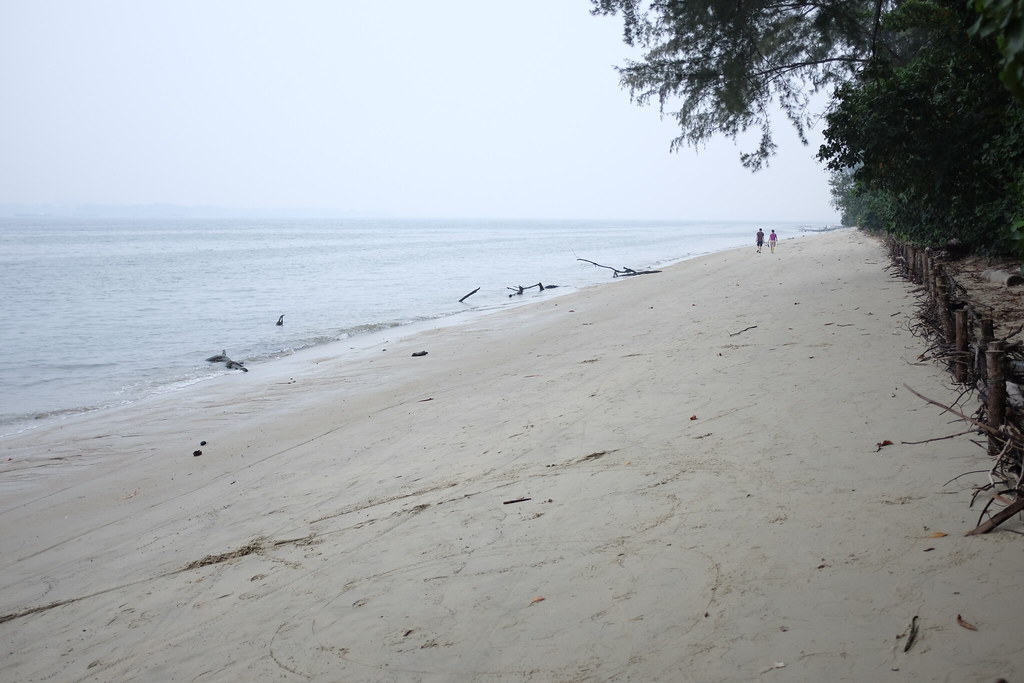
The park has five themed beaches, named Beach A, Beach B, Beach C, Beach D and Beach E, facing Pulau Ubin across the water. The beaches were left uncleared during development, so they look natural, with sand, shells, driftwood and shore plants. Each beach has a plant theme. Beach A has back mangrove trees, some critically endangered. Beach B has beachfront shrubs and coastal climbers. Beach C has rare coastal trees that were locally extinct and replanted here. Beach D and Beach E have coastal hill forest trees, including sea almond.
There is no single best beach, but two are worth knowing. Beach A is the most accessible from the West Entrance and a good first stop. Beach C is a favourite with regular walkers for sitting on the rocks, looking across to Pulau Ubin, and reaching the mangrove boardwalk and estuary nearby. Go early for quiet sand, and go late in the day for softer light. The beaches have no shops, no sunbeds and no beach bars. Bring water, and take your litter out with you.
Cycling the Island
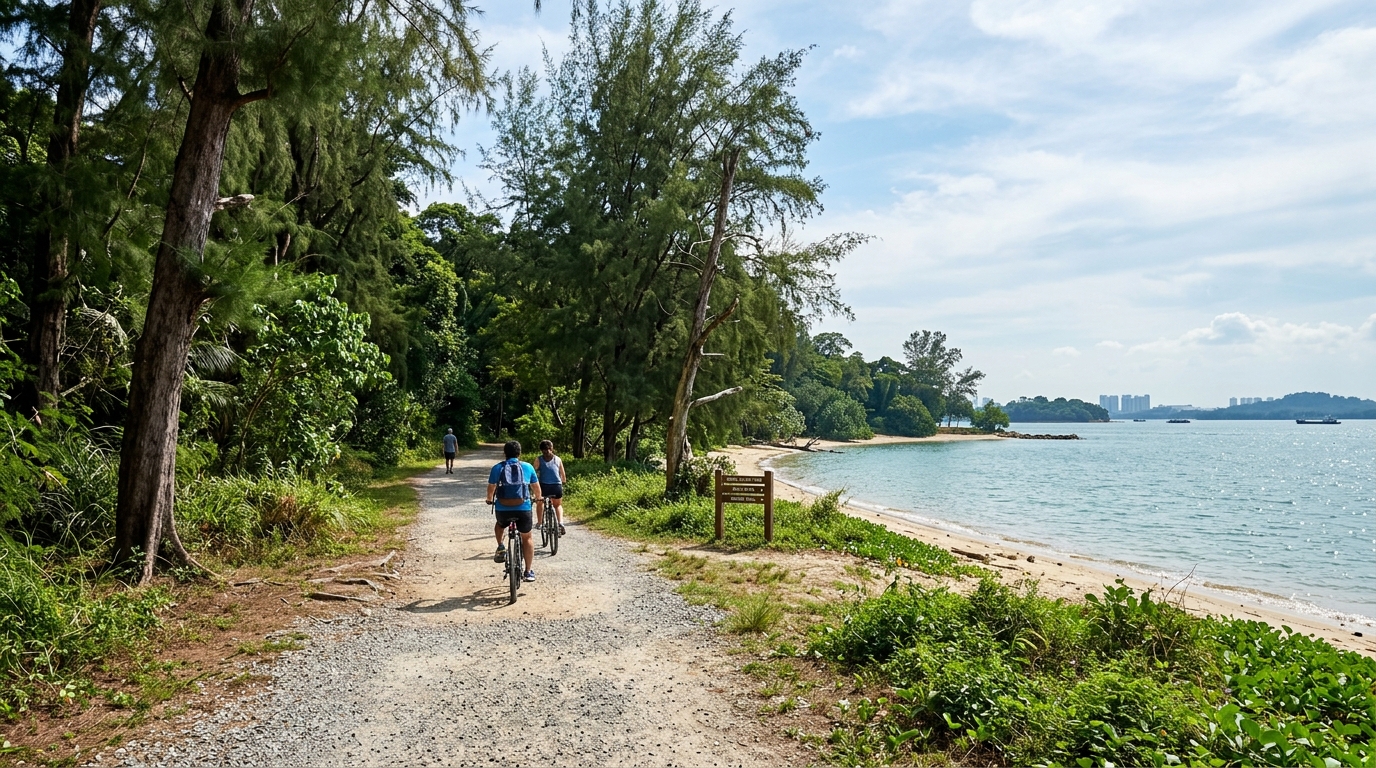
Cycling is the easiest way to see the whole island. The main path runs about 2.5 km from west to east, on gravel, dirt and sand, with some bumpy and narrow stretches shared with walkers. Go slow, give walkers room, and watch for roots and soft sand. A relaxed ride with stops for photos, the boardwalk and a beach sit takes about two hours. Walking the same route with stops takes two to three hours.
Rent bikes near Punggol Settlement before you enter. Jomando Adventure and Recreations at The Punggol Settlement rents bikes for all ages. Guides list about S$6 to S$10 per hour depending on the shop and bike type, so check the price at the shop before you ride. Rental shops may open later on weekdays, so confirm the opening time if you plan an early start. There are bicycle parking lots at both entrances. Only non-motorised bicycles are allowed on the island.
Mangroves, Estuary and Birdwatching
The mangrove boardwalk sits on the way to Beach C. From the boards you can watch the mud for giant mudskippers, mud lobsters and tree-climbing crabs, and look up for birds in the mangrove trees. The estuary at Beach C is where the river meets the sea, and it is one of the best spots on the island for close-up wildlife watching. Step carefully on the boards after rain, and wear closed shoes you do not mind getting muddy.
More than 80 species of resident and migratory birds have been spotted in the park, from the Baya Weaver to the Oriental Magpie-robin. The park also has bird hides along the trails. Bring binoculars or a zoom lens, and go early: birds are most active in the first two hours after opening. The only two wild Paku Raja cycads left on mainland Singapore stand near Beach C. They grow very slowly and can live for as long as 1,000 years. The park is also home to 86 tree species and more than 157 animal species, including smooth-coated otters, whose dam sits at the east entrance.
The NParks Explore A Route (NEAR) app covers the Coast-to-Coast Trail, a 36 km trail that ends at Coney Island Park. Use it to add context to your walk, but do not expect Coney-specific augmented reality content inside the park itself.
Wildlife and Safety
Coney Island is a living habitat, not a zoo, and the animals set the terms. Long-tailed macaques are the animals you are most likely to meet. Do not feed them, do not hold food or shiny objects in the open, and keep bags closed. Macaques have snatched food from visitors, including a banana from a child. If a macaque approaches, stay calm, move away, and do not stare or show your teeth.
Wild boars live on the island too. If you see one, keep your distance and do not block its path. Stray dogs are territorial and may feel threatened by pet dogs, so give them a wide berth. Box jellyfish have been spotted in the area, which is one more reason not to swim. Sandflies and mosquitoes are the most common complaint from visitors. Wear long pants and covered shoes, use insect repellent, and expect bites even with repellent. One visitor account says sandfly bites left marks for months, so prevention is worth the effort. Heat is the other risk: the promenade approach is sunny, shade is patchy, and there is no piped water on the island. Carry more water than you think you need, wear a hat and sunscreen, and rest in the shade.
History of the Island
Coney Island was first known as Pulau Serangoon, sometimes spelt Pulo Serangoon. In the 1930s and 1940s it was called Haw Par Island, when it was owned by the Aw brothers, Aw Boon Haw and Aw Boon Par, the founders of Tiger Balm. In 1950 the island was sold to businessman Ghulam Mahmood, who opened it by 1951 as Singapore Coney Island, promoted as Singapore's first island health resort, with a dance hall, a restaurant and bar, and seaside accommodation. About three years later it was put up for auction. The name Coney Island came from the owner's plan to model the resort on the Coney Island of New York.
The government acquired the island from a Thai businessman in 1972. Land reclamation started in 1975 and increased the island to about 154 acres, or 62 hectares. Further reclamation in the 1990s, linked to the Punggol 21 plan, enlarged it to about 100 hectares. On 10 October 2015, after 15 months of construction, the 50-hectare Coney Island Park opened on the island. The park kept the island's natural state as far as possible: toilets use rainwater and solar-powered pumps, and timber from uprooted trees was reused as benches and boardwalks. Neither electricity nor piped water is available on the island.
Haw Par Beach Villa
The Haw Par Beach Villa is the island's best-known ruin. It was built in 1937 for Aw Boon Haw, after he bought the island, as a 600-square-metre bungalow. It was damaged during the Japanese Occupation and never restored. Today it stands behind trees and fencing, with crumbling walls and moss-covered paths, slowly being taken back by the forest.
Do not enter the villa. NParks lists it as off limits, and the structure is unsafe. View it from the marked paths only, and do not cross fences or barriers. The villa is a photo subject from a distance, not a place to explore. Its story is a useful reminder that the island was once a private retreat and a failed resort before it became a public park.
What Changed in 2024-2026
The biggest change is access. Punggol Coast MRT opened on 10 December 2024 as the northern end of the North East Line, and it made the island far easier to reach than before. Punggol Coast Mall opened progressively from March 2025 with more than 120 stores, connected to the station. Punggol Coast Hawker Centre opened nearby on 25 July 2025 with 40 stalls in a separate building. Together they give visitors a daytime food base that did not exist a few years ago.
One more change is worth knowing. The Outward Bound Singapore (OBS) Coney Island campus opened on 11 September 2026. It is a youth camp campus for school programmes, not a visitor attraction, and visitors should not treat it as a stop on their walk. Finally, NParks now lists the park as 81 hectares, updated 27 January 2026, which is the figure this guide uses.
Where to Eat Near Coney Island
There is no food or drink for sale inside the park, so plan meals around your visit. Bring water and snacks, and eat before or after. The closest option is The Punggol Settlement, about 500 metres from the West Entrance, with a 7-Eleven and several restaurants. Most restaurants there are dinner-focused, so check hours before you go: House of Seafood opens daily from 5pm to 11pm, Georges By The Bay opens weekdays from 4pm to 1am, and Tandoor Lounge has lunch slots from 12pm to 2:30pm plus dinner from 5:30pm, closed on Tuesdays. Punggol Coast Mall and Hawker Centre, near the MRT station, add daytime options, including halal stalls at the hawker centre. For full hours, see the Punggol Settlement restaurant list.
Half-Day Plan and Nearby Extensions
Coney Island works best as a half-day trip. Arrive before 8:30am on a weekday, when trails are quiet and wildlife is active. Walk or cycle from the West Entrance to Beach C, take the mangrove boardwalk, spend time at the estuary, then return along the main path and stop at the Casuarina Exploratory play area if you have children. Leave by 6:30pm at the latest so you are off the island before the gates close.
To fill a full day, pair the island with the area around it. Punggol Waterway Park and Lorong Halus Wetland sit close by, and the Coast-to-Coast Trail ends at Coney Island Park for walkers who want a longer route. Punggol Coast Mall and Hawker Centre cover lunch or dinner. Do not treat the island as an all-day outing on its own: there are no shops, no food and no shade infrastructure inside the park, and most visitors are done in two to three hours.
Coney Island Compared: Pulau Ubin, Sungei Buloh and Sentosa
| Place | What it is | Pick it if |
|---|---|---|
| Coney Island | Free island park, walk-in access, beaches, mangroves, cycling, birding. | You want a free half-day nature break with easy MRT access. |
| Pulau Ubin | More rustic island with kampong life and Chek Jawa wetlands, reached by bumboat from Changi Point. | You want a longer, wilder island day and do not mind the boat trip. |
| Sungei Buloh | Wetland reserve with boardwalks and hides, focused on birding and mangroves. | Birding and mangroves are the main goal. |
| Sentosa | Resort island with swimmable beaches, attractions and commercial facilities. | You want swimming, attractions and food on site. |
Tips for Visiting
- Go early on a weekday. Arrive before 8:30am for quiet trails and active wildlife. Weekends bring more families and cyclists.
- Carry water and snacks. There is no piped water and no food for sale inside the park.
- Use the toilets first. Use the toilets at Punggol Settlement and Punggol Point before you enter. Facilities inside the park are limited.
- Dress for insects and sun. Long pants, covered shoes, insect repellent, hat and sunscreen. Sandflies are a real problem here.
- Keep bags closed. Monkeys grab loose food and shiny objects. Do not feed them.
- Families: the Casuarina Exploratory play area is built from fallen casuarina trees, with a wooden bridge, stepping stones and log fences. The interior trails are rugged in places and may not suit young children or strollers. The East and West ends are wheelchair accessible and stroller friendly.
- Photography: bring a zoom lens for birds. Best light is early morning and late afternoon. Good spots are the entrance gate, Beach C, the mangrove boardwalk and the casuarina forest.
- Plan your exit. Be off the island by 6:30pm. Gates close at 7pm and there is no lighting.
Sources
- NParks: Coney Island Park - park size, hours, entrances, rules, wildlife warnings.
- NParks: Beaches at Coney Island Park - five themed beaches.
- National Library Board: Coney Island (Pulau Serangoon) - history, island size, reclamation.
- Punggol Settlement: The Food Settlers - restaurant hours.
- Land Transport Guru: Punggol Coast MRT Station - opening date, station layout, Exit 2.
- Prime Minister's Office: OBS Coney Island Campus opening - 11 September 2026.
- DEI: Punggol Coast Mall guide - mall and hawker centre opening dates, stall count.