
The Giza Plateau holds the three 4th-Dynasty pyramids, the Great Sphinx, and rows of royal tombs. The strongest modern finding is the ScanPyramids Big Void, reported in Nature in 2017, plus a sealed corridor measured in 2023. Claims of a city under the pyramids have no peer-reviewed evidence behind them. This guide separates the two.
What the Giza Plateau holds
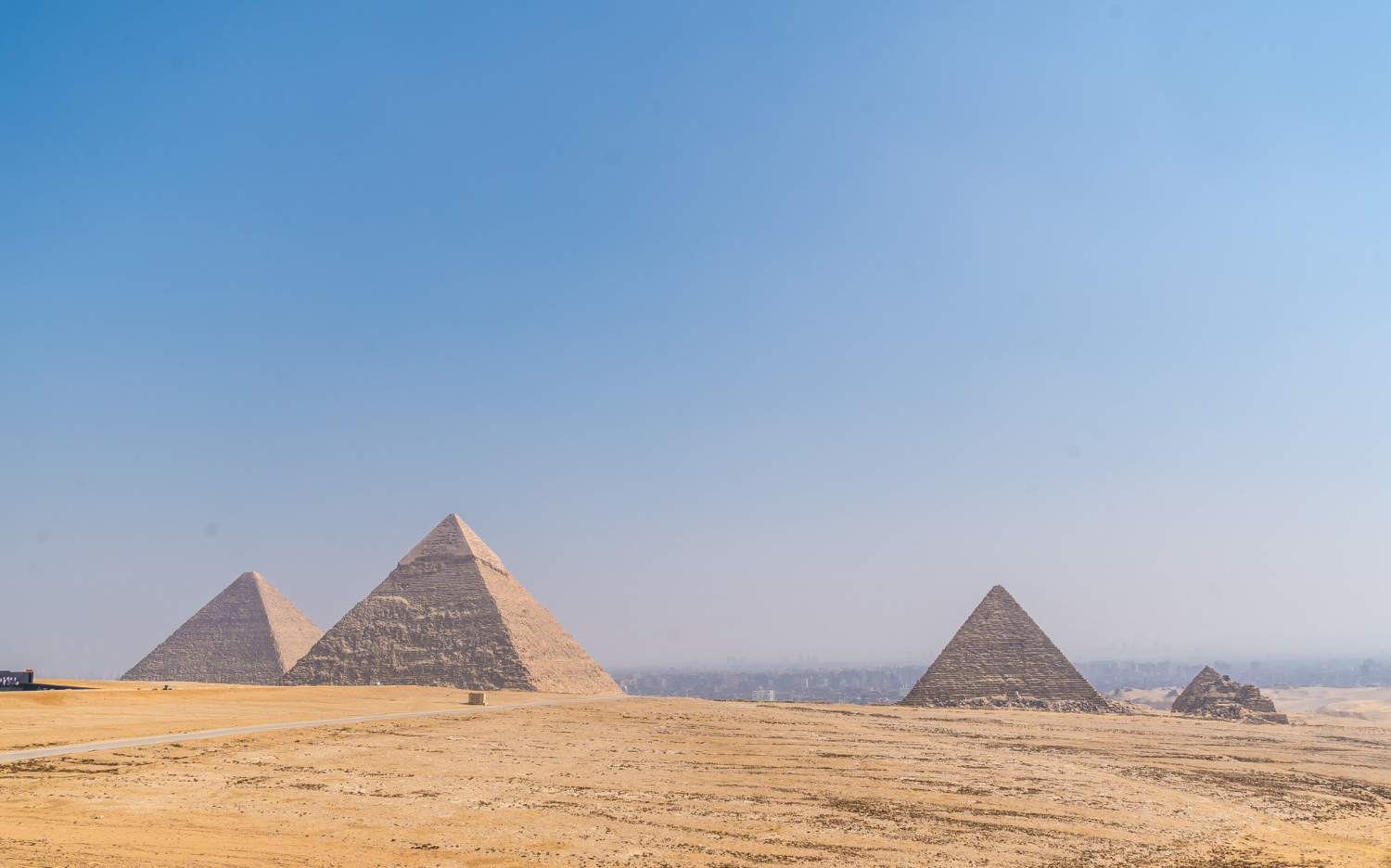
The Giza Plateau is a 4th-Dynasty royal burial ground on the west bank of the Nile, about 12 to 15 km southwest of central Cairo. Three kings built here in turn, roughly between 2580 and 2510 BCE: Khufu, his son Khafre, and Khafre's son Menkaure. Each pyramid had a mortuary temple, a causeway, and a valley temple, and the ground around them filled with smaller pyramids for queens and flat-topped mastaba tombs for officials and royal family members. The pyramids form part of the UNESCO World Heritage listing "Memphis and its Necropolis - the Pyramid Fields from Giza to Dahshur", inscribed in 1979.
The three pyramids
The Great Pyramid of Khufu is the largest of the three and the only one of the original Seven Wonders of the Ancient World still standing. It was built from roughly 2.3 million limestone blocks, averaging about 2.5 tonnes each. Khafre's pyramid looks taller from some angles because it stands on higher ground and keeps some of its original smooth casing stones at the top. Menkaure's is far smaller, at about 65 m, and was partly cased in granite rather than limestone.
| Pyramid | Builder | Original height | One fact to know |
|---|---|---|---|
| Great Pyramid | Khufu | About 146.5 m (about 138.5 m today) | Tallest human-made structure in the world for about 3,800 years, until Lincoln Cathedral in 1311 |
| Khafre's Pyramid | Khafre | About 136.4 m | Keeps original casing stones at its apex, the clearest view of how all three once looked |
| Menkaure's Pyramid | Menkaure | About 65 m | Smallest of the three; its lower courses were cased in red granite |
The Great Sphinx and the Valley Temple
The Great Sphinx is a lion-bodied statue with a human head, carved from a single ridge of limestone bedrock, about 73 m long and 20 m high. Egyptologists generally identify the face as Khafre's, and the statue guards the front of his pyramid complex. Below it stands Khafre's Valley Temple, built of huge limestone blocks faced with granite, where priests once prepared the king's body for burial. The Sphinx is viewed from a fenced enclosure at close range; you cannot climb on it, and the closest viewpoint is the terrace in front of the Valley Temple.
Tombs, temples and the boat that moved to the museum
The plateau holds far more than the three pyramids and the Sphinx. The Eastern and Western cemeteries hold rows of mastaba tombs; the painted tomb of Queen Meresankh III in the Eastern Cemetery is one of the finest open to visitors on a separate ticket. Beside the Great Pyramid stood the Solar Boat Museum, built over the pit where Khufu's full-size cedar boat was found in 1954. That museum is now closed: the restored boat was moved to the Grand Egyptian Museum, where it is on display.
What the scans actually found
The real modern findings at Giza come from peer-reviewed scan projects, above all ScanPyramids. ScanPyramids launched in October 2015, led by Cairo University and the French HIP Institute, and it scans the pyramids with non-invasive tools, mainly cosmic-ray muon tomography and infrared thermography. Muons are particles from cosmic rays that pass through stone and are partly absorbed by it, so detectors placed inside a pyramid can map where the stone is thinner, and therefore where a void sits, without drilling. Its two major results are below, plus one careful ground-radar find from 2024.
The Big Void, reported in 2017
ScanPyramids reported a large, previously unknown void above the Grand Gallery of the Great Pyramid in Nature in November 2017 (Nature, 2017: the big void in Khufu's Pyramid). The void is at least 30 m long, with a cross-section similar to the Grand Gallery below it. Three different muon detector types, run by independent teams, saw the same signal, which is why the result is trusted. The paper is honest about the limit: it states there is currently no information about the purpose of this void. Nobody has entered it, and no report has shown treasure, a tomb, or writing inside. It is most often explained as a structural space connected with how the pyramid was built, but that remains a hypothesis, not a finding.
The North Face Corridor, measured in 2023
The North Face Corridor is a sealed corridor behind the chevron-shaped stones above the Great Pyramid's original entrance, measured precisely in 2023 (Nature Communications: Precise characterization of the North Face Corridor, 2023). Muons first flagged a void there in 2016; the 2023 study pinned it down to about 9 m long and about 2 m by 2 m in section, starting less than a metre behind the chevron. At the March 2023 announcement, an endoscopic camera pushed through a gap between stones showed the corridor standing empty, with a gabled roof. Like the Big Void, it has produced no objects. The gabled shape above the entrance passage suggests a weight-relieving role, spreading the load of the masonry above the descending corridor.
The L-shaped structure in the Western Cemetery, reported in 2024
A joint Japanese and Egyptian team reported an L-shaped structure buried in the Western Cemetery in 2024, found with ground-penetrating radar and electrical resistivity tomography. The structure measures about 10 by 15 m at only 0.5 to 2 m below the surface and appears to have been backfilled after construction, with a second, deeper anomaly about 10 by 10 m beneath it. The team published in the journal Archaeological Prospection and said the shape is too regular to be natural; whether it is a tomb entrance or something else is not yet known, and follow-up excavation was reported. This is what a careful scan find looks like: modest size, named authors, a journal paper, and open questions.
Viral claims vs evidence
The claims of a vast underground city beneath the Khafre pyramid are not supported by peer-reviewed evidence, and Egypt's antiquities authorities have rejected them. This section sets out what was claimed, what the record shows, and how to judge the next headline yourself.
What was claimed in March 2025
In March 2025, the Khafre Research Project, led by Corrado Malanga and Filippo Biondi, announced at a press conference that satellite radar had revealed a huge complex under Khafre's pyramid: eight cylindrical shafts about 648 m deep, two cubes of about 80 m per side, and further structures reaching about 2 km down, which the team dated to roughly 38,000 years ago. The story spread worldwide within days. Two facts matter for judging it: the team worked from public satellite data and did not carry out work at the site, and the Khafre claims were announced to the press, not published in a peer-reviewed journal.
What the evidence shows
The evidence against the claims is strong, and it comes from named specialists. Zahi Hawass, Egypt's former antiquities minister, responded on 23 March 2025, calling the claims "completely wrong" and "fake news", and stated that no radar devices had been used inside Khafre and no permission had been granted for such work. Egypt's Ministry of Tourism and Antiquities issued no acknowledgment of the findings. Satellite archaeologist Sarah Parcak has stated that satellite radar data cannot see through rock. Ground-penetrating radar specialist Lawrence Conyers has said the claimed imaging is physically impossible. Egyptologist Salima Ikram has noted there is no peer-reviewed paper and no raw data for anyone to evaluate. On 10 August 2026, the journal Remote Sensing retracted the team's 2022 paper applying the same method to the Great Pyramid, after an investigation confirmed serious methodological flaws and statistical errors (MDPI: retraction notice, Remote Sensing, 2026). The authors disagree with the retraction. Separately, Hawass has said his own team is studying a passage inside Khufu's pyramid, but as of late 2026 no data from that work has been published either.
How to tell a real find from a viral one
Real finds at Giza follow a pattern you can check in minutes. Use this checklist on any pyramid headline:
- A named journal paper exists, not just a press conference or a video. Check the journal name and the paper's DOI.
- The team had permission to work at the site, and Egyptian authorities are named as partners, as with ScanPyramids.
- Independent teams can repeat the measurement and get the same answer, as three muon teams did for the Big Void.
- The claim is modest: a void of a stated size, with the purpose stated as unknown.
- The claim survives specialist scrutiny in print, rather than only in interviews.
The underground city claims fail each of these checks. That does not mean Giza holds nothing more: the Big Void's purpose is genuinely unknown, and Khafre has barely been scanned by muons at all. It means the answer, when it comes, will arrive as a journal paper with measurements, not as a render shared online.
Visiting the plateau today
Visitors enter the plateau on a general ticket and buy separate tickets for pyramid interiors and some tombs. Ticketing has moved to card payment and official online booking, and the main entrance has moved to the new gate on the Fayoum Road side, with electric shuttle buses moving visitors around the plateau.
What you can enter
You can enter the interior of the Great Pyramid on a separate ticket, following the ascending passage and the Grand Gallery up to the King's Chamber, which holds Khufu's granite sarcophagus. Numbers per day are capped, so this ticket sells out first. The interiors of Khafre's and Menkaure's pyramids open on a conservation rotation, usually one at a time, and each is a shorter, simpler descent than the Great Pyramid. The Sphinx, the Valley Temple and the pyramid exteriors are covered by the general ticket. The tomb of Meresankh III needs its own small ticket. Interior passages are steep, low in places, warm and humid, and are not suitable if you have mobility or breathing difficulties.
Tickets and opening hours
Ticket prices change often, so treat these figures as a guide and confirm them on the official portal before you go. Visitor guides reported in 2026 a general plateau ticket of about EGP 700 for foreign adults and about EGP 350 for students, the Great Pyramid interior at about EGP 1,500 (students about EGP 750), and the Khafre and Menkaure interiors at roughly EGP 200 to 280. Children under 6 are free, and students need valid ID for the reduced rate. Official tickets are sold at egymonuments.com and at the gates, card only. The plateau opens daily at 7:00; guides list closing at 16:00 in winter and 17:00 in summer, with the last ticket sold about 30 minutes before closing, and shorter hours in Ramadan.
The Grand Egyptian Museum next door
The Grand Egyptian Museum stands about 2 km from the plateau and is now fully open: it was inaugurated on 1 November 2025 and opened to the public on 4 November 2025. It holds the complete Tutankhamun collection and Khufu's solar boat, the vessel that used to sit beside the Great Pyramid. Entry is by timed ticket booked in advance on the museum's official site; foreign adult prices reported in 2026 run from about EGP 1,450 to 1,590 depending on the ticket type. Most visitors pair the museum in the morning with the plateau in the afternoon, or the other way round to suit the light.
When to go and what to expect
October to April is the most comfortable season on the plateau, when midday heat is manageable; see the best time to visit Egypt guide for month-by-month temperatures. Within the day, arriving at opening gives you the coolest air, the softest light on the pyramids' east faces, and the best chance of a Great Pyramid interior ticket. Allow three to four hours for the plateau itself, more with the museum. The ground is open desert with little shade, so bring water, a hat and sunscreen, and expect firm but polite persistence from horse, camel and souvenir sellers near the entrances; agreeing a price before any ride avoids most problems.
Sources
- Morishima et al.: a big void in Khufu's Pyramid found by observation of cosmic-ray muons, Nature, 2017
- Procureur et al.: Precise characterization of a corridor-shaped structure in Khufu's Pyramid by observation of cosmic-ray muons, Nature Communications, 2023
- Remote Sensing: retraction notice for Biondi and Malanga 2022, 10 August 2026
- The Egypt Files: The city under Khafre, the claim and the retraction
- National Geographic: Is there a city under the pyramids?
- Decrypt: Experts respond to the Khafre claims, March 2025
- Archaeology Magazine: L-shaped structure in the Western Cemetery, 2024
- Egypt Fun Tours: Pyramids visitor guide, hours and 2026 ticket figures