
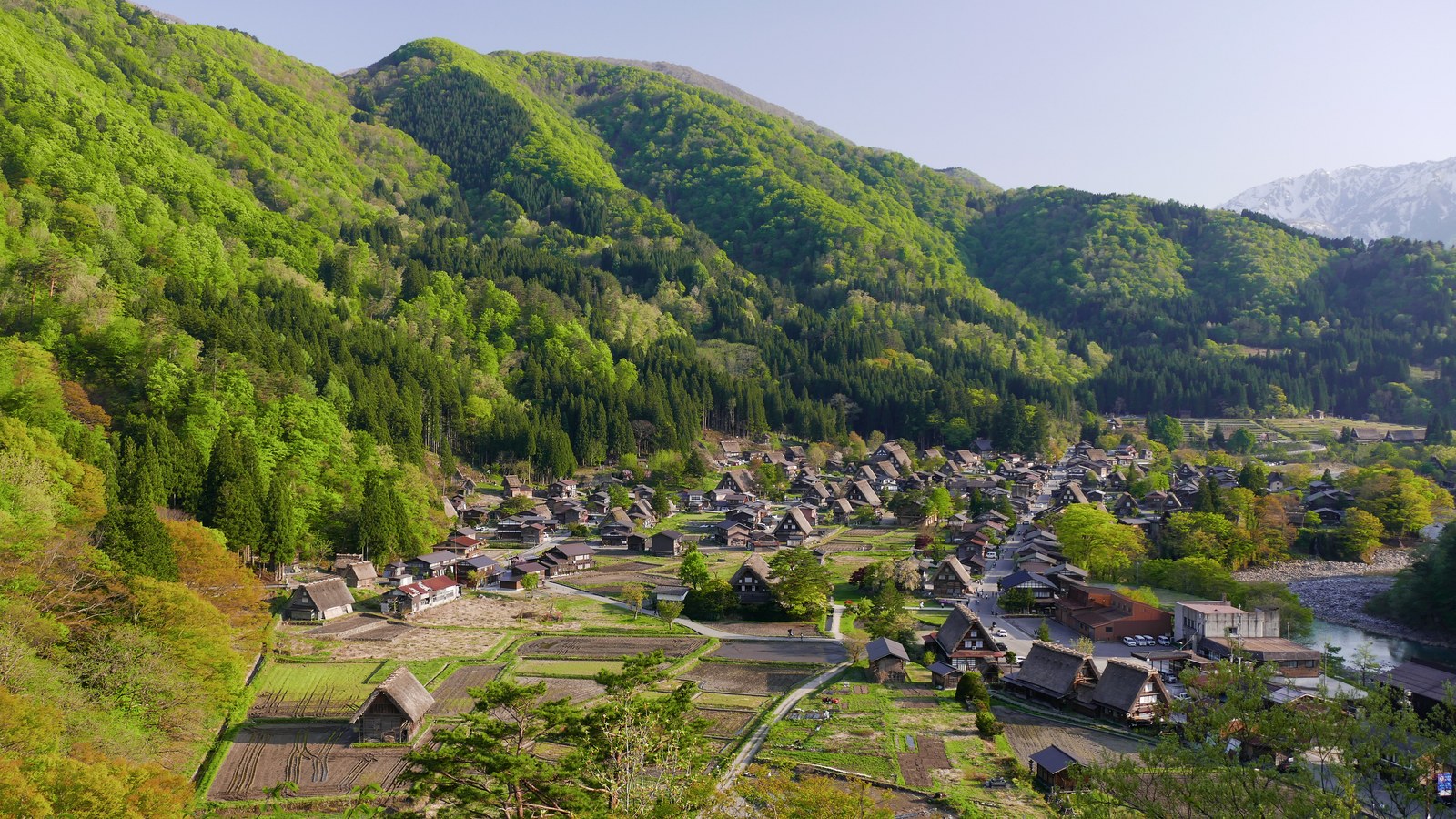
The seven places in this guide are Kanazawa, Shirakawa-go, Iya Valley, Furano, Beppu, Naoshima, and Yakushima. Each one earns its place on a different strength: castle town craft, thatched-roof village life, a mountain gorge, summer flower fields, geothermal pools, art on an island, and ancient forest. This guide gives the route, season, and entry for each, with facts you can check.
Quick picks
Use this table to match a place to what you want from the trip. Read the full section for route and entry detail before you book anything.
| Place | Why go | Best season | Getting there in brief |
|---|---|---|---|
| Kanazawa, Ishikawa | Castle town craft, garden, samurai district, teahouse streets | Year-round; garden is best in spring or autumn | Hokuriku Shinkansen from Tokyo |
| Shirakawa-go, Gifu | Gassho-zukuri farmhouses, UNESCO village | Year-round; snow in winter, green in summer | Highway bus from Takayama, Kanazawa, or Nagoya |
| Iya Valley, Tokushima | Mountain gorge, vine bridge, quiet rural Shikoku | Autumn foliage, early to mid-November | Car from Ikawa-Ikeda IC, or bus from Oboke Station |
| Furano, Hokkaido | Flower fields, lavender at Farm Tomita | Lavender late June to early August, peak mid-July | JR to Nakafurano or Lavender Farm Station in summer |
| Beppu, Oita | Seven geothermal Hells, onsen town | Year-round | Bus from Beppu Station, about 20 minutes |
| Naoshima, Kagawa | Contemporary art, architecture, island setting | Spring or autumn; book Chichu ahead | Ferry from Uno or Takamatsu |
| Yakushima, Kagoshima | Ancient cedar forest, long hikes, UNESCO site | Year-round; pack rain gear in every season | Jetfoil, car ferry, or flight from Kagoshima |
How to pick from the seven
Pick by how much time you have and what you want the trip to feel like. Two places fit a short add-on to a Tokyo or Osaka stay: Kanazawa and Beppu both work as two- to three-night stops with simple rail and bus links. Shirakawa-go pairs well with Kanazawa or Takayama, since the bus links run between them.
Three places need a full day or more of travel and a slower pace. Iya Valley rewards a car and an overnight stay, because buses are few. Naoshima needs a full day with ferry times planned in advance, and Chichu Art Museum needs a timed reservation. Yakushima needs three or more nights if you want both the Jomon Sugi trek and the moss ravine.
Furano is the only one that depends on a narrow season. If lavender is the reason to go, plan for late June to early August and check Farm Tomita's bloom update before you go. The other six work year-round, with different seasons giving different light, colour, and weather.
1. Kanazawa, Ishikawa
Kanazawa is a castle town on Honshu, between the Sea of Japan and the mountains, in Ishikawa Prefecture. It keeps a samurai district, a teahouse district, a major garden, and a living craft trade in one walkable centre.
Why go to Kanazawa
Kanazawa was the seat of the Kaga clan, the Maeda family, in the Edo period (1603-1867). The name means marsh of gold, and the city supplies 99 percent of Japan's gold leaf, according to the Japan National Tourism Organization (JNTO). That history is still visible in the streets, not only in museums.
What to do in Kanazawa
- Walk Kenrokuen Garden and Kanazawa Castle Park, side by side in the city centre.
- Walk the Nagamachi Samurai District, including the Nomura Samurai House.
- Walk the Higashi Chaya District for teahouses, gold-leaf craft shops, and the Yasue Gold Leaf Museum.
- Visit the 21st Century Museum of Contemporary Art and Omicho Market, and check the museum site before you go for current hours and any closures.
Getting to Kanazawa
Take the Hokuriku Shinkansen from Tokyo, about 2.5 hours by the usual timetable. From Osaka, the route runs via Tsuruga. Check the JR timetable for the day you travel, since service patterns change. More on Kanazawa on the JNTO site.
2. Shirakawa-go, Gifu
Shirakawa-go is a historic village in Gifu Prefecture, in the Shogawa River valley. It is a UNESCO World Heritage Site, registered on 9 December 1995 together with Gokayama in Toyama as the Historic Villages of Shirakawa-go and Gokayama.
Why go to Shirakawa-go
Shirakawa-go is known for gassho-zukuri farmhouses, steep thatched roofs shaped like hands in prayer, built to shed heavy snow. The attics were used for silkworms. The village has 114 gassho-style houses, and Ogimachi is the largest and most accessible of its villages.
What to do in Shirakawa-go
- Walk Ogimachi village and step inside an open farmhouse to see the roof frame from within.
- Climb to the Shiroyama Viewpoint for the panorama over the village.
- Stay overnight if you can, since the village changes character after the day buses leave.
Getting to Shirakawa-go
Go by highway bus. From Takayama Station the ride is about 50 minutes, from Kanazawa Station about 1 hour 15 minutes, and from Nagoya Meitetsu Bus Center about 2 hours 35 minutes. Book seats ahead in peak seasons, and check the official village site for current bus and event detail.
3. Iya Valley, Tokushima
Iya Valley is a deep mountain gorge in western Tokushima Prefecture, near the centre of Shikoku. It is inland, not an island, and not on the coast. This is the correction that matters most in this guide: older versions of this article called it an island, which is wrong.
Why go to Iya Valley
Iya Valley is a place to slow down. The gorge is steep and quiet, with small settlements along the river, and the vine bridge is the draw that brings most visitors. The valley suits travellers who want mountain roads, river views, and a rural corner of Shikoku without a city stop.
What to do in Iya Valley
- Cross the Iya Kazurabashi vine bridge, about 45 m long and 2 m wide, about 14 m above the Iya River, with gaps between the deck planks and a sway underfoot. Steel cables inside the vines reinforce it, and it is rebuilt every 3 years. It is a National Important Tangible Folk Cultural Property.
- Walk to Biwa Falls beside the bridge.
- Drive deeper to East Iya (Oku-Iya) for the Double Vine Bridges, the Men's and Women's bridges, if you have a car and a full day.
- Visit in autumn for foliage, which usually shows from early to mid-November.
Getting to Iya Valley
Drive about 1 hour from Ikawa-Ikeda IC. Without a car, take a train to JR Oboke Station, then a bus to the Kazurabashi stop, then about 5 minutes on foot. Buses are infrequent, so a rental car is the practical option for East Iya. One guide lists bridge hours as Apr-Jun 8:00-18:00, Jul-Aug 7:30-18:30, Sep-Mar 8:00-17:00, and a fee of 550 yen for adults and 350 yen for elementary school students. Check the official Miyoshi city tourism site before you go, since hours, fees, and closures change, and the bridge may close in heavy-rain warnings.
4. Furano, Hokkaido
Furano is a flower town in central Hokkaido. The reason most visitors come is Farm Tomita, the best-known flower farm in the area, with 9 gardens across about 15 hectares and about 100 flower species.
Why go to Furano
Furano is a summer flower stop. Lavender blooms from late June to early August, with the peak around mid-July. Other flowers carry the season from June into early October, so a visit outside the lavender peak still shows colour, but it will not show lavender at its best.
What to do in Furano
- Walk the gardens at Farm Tomita. Entry is free of charge.
- Walk the lavender fields in the morning for softer light and fewer crowds.
- Pair Furano with Biei, a nearby town known for rolling fields and wide views, if you have a full day.
Getting to Furano
Take a JR train to Nakafurano Station, then walk about 25 minutes, or use JR Lavender Farm Station in the summer period when it is open, about 7 minutes on foot. A Lavender Bus runs from Asahikawa Airport to Nakafurano Station. Lavender timing shifts with the weather each year, so check Farm Tomita's official bloom update before you go.
5. Beppu, Oita
Beppu is an onsen city in Oita Prefecture, Kyushu. Its best-known sights are the Hells, seven viewing-only geothermal pools. You do not bathe in the Hells. You look at them, then you bathe in a separate onsen bath elsewhere in town.
Why go to Beppu
Beppu shows geothermal activity at street level. The seven Hells each have a different colour and character, from cobalt blue to blood red to boiling mud. Four of the seven are Places of Scenic Beauty, designated by the Japanese government.
What to do in Beppu
- Visit the seven Hells: Umi (Sea), Chinoike (Blood Pond), Tatsumaki (Tornado), Shiraike (White Pond), Oniishi Bozu (Monk's Head), Oniyama (Demon Mountain), and Kamado (Cooking Pot). Umi Jigoku water is 98 C.
- Try a foot bath at Umi, Chinoike, Oniishi Bozu, or Kamado, where free foot baths are available.
- Try onsen tamago (eggs cooked in the hot springs) and jigoku-mushi pudding, steamed with hot spring heat.
- Book a separate onsen bath in town for a soak, since the Hells are viewing only.
Getting to Beppu
From Beppu Station, take bus No. 2, 5, 24, or 41, about 20 minutes to Kannawa or Umi-Jigoku-mae. Five Hells sit in the Kannawa district, and two (Chinoike and Tatsumaki) sit in Shibaseki, about 3 km away. JNTO lists a shared ticket at 2,000 yen for all seven, or 400 yen per hell. Confirm on the official Beppu Jigoku site before you go, since prices change. More on the Hells of Beppu on the JNTO site.
6. Naoshima, Kagawa
Naoshima is a small island in Kagawa Prefecture, in the Seto Inland Sea. It is the centrepiece of Benesse Art Site Naoshima, a cluster of museums and outdoor installations spread across the island.
Why go to Naoshima
Naoshima pairs contemporary art with a small island setting. The museums sit in the landscape, and the Art House Project puts installations inside old houses in Honmura village. It suits travellers who like art and architecture and who are willing to plan ferry times and reservations.
What to do in Naoshima
- Visit the Chichu Art Museum, with works by Monet, Turrell, and De Maria in a Tadao Ando building. Book a timed reservation in advance, since walk-up tickets are limited and popular slots sell out.
- Visit the Benesse House Museum, the Lee Ufan Museum, and the Art House Project in Honmura.
- See the Yayoi Kusama pumpkins, the Red Pumpkin at Miyanoura Port and the Yellow Pumpkin on the coast.
- Check the Benesse site before you go for hours and closures. Several museums close on Mondays, and the Benesse House Museum opens every day.
Getting to Naoshima
Take a ferry from Uno Port in Okayama, about 20 minutes to Miyanoura Port, or from Takamatsu Port, about 50 minutes by car ferry, with a faster high-speed boat option. Fares vary by service, so check the ferry timetable and fare at the port or on the ferry operator's site. On the island, use the town bus, the free Benesse shuttle, or rent an e-bike near Miyanoura Port. Ferries run infrequently, so plan the return crossing before you start the day.
7. Yakushima, Kagoshima
Yakushima is a round, mountainous island off southern Kyushu, in Kagoshima Prefecture. It was registered as a UNESCO World Heritage Site in 1993, Japan's first inscription alongside Shirakami Sanchi. About 90 percent of the island is mountainous and forested.
Why go to Yakushima
Yakushima is a forest trip. Its yakusugi, ancient cedar trees, include specimens over 1,000 years old. Microclimates run from subtropical at the coast to subarctic on the high peaks, and the island is wet in every season. Mt. Miyanoura, at 1,936 m, is the highest mountain in Kyushu.
What to do in Yakushima
- Hike to Jomon Sugi, the best-known ancient cedar, on a trek of about 22 km round trip taking 10 to 12 hours. Go only if you are fit, with a guide if you are unsure, and start early.
- Walk Shiratani Unsuikyo Ravine, a moss forest that helped inspire the forest in the film Princess Mononoke.
- Walk Yakusugi Land for shorter paths among giant cedars, if a full-day trek is not for you.
- Visit Nagata Inaka Beach, Japan's largest sea turtle nesting site.
Getting to Yakushima
From Kagoshima, take a jetfoil from Kagoshima Port, about 2 to 2.5 hours to Miyanoura, or a car ferry, about 4 hours, or a flight from Kagoshima Airport, about 35 minutes. Book ahead in spring and autumn, and allow for rough weather, which can cancel boats. Pack serious rain gear, and carry food and water on the long hikes. More on Yakushima on the JNTO site.
Green Expo Yokohama 2027: a separate trip, not one of the seven
Green Expo Yokohama is the 2027 International Horticultural Expo, GREEN x EXPO 2027. It runs from Friday 19 March 2027 to Sunday 26 September 2027, 192 days with no closed days, at the former Kamiseya Communication Facility in Yokohama, Kanagawa. It is an A1 class expo, approved by AIPH and recognised by BIE. Older versions of this article dated it to 2026. That was wrong. There is no 2026 Green Expo.
The Expo site covers about 100 hectares, with an 80-hectare exhibition area. Hours are 09:30 to 21:30, with last entry at 21:00, per guides citing official information. Guides citing official ticketing list an advance one-day adult ticket at 4,900 yen, with a mandatory date-and-time reservation. Confirm hours, ticket types, and reservation rules on the official Expo site before you go. Do not buy a pass that claims a 35 percent Green Pass discount, since no such pass appears in official Expo ticketing.
Plan Green Expo as its own day or as an add-on to a Yokohama or Tokyo stay. It is not a reason to visit the seven places above, and none of the seven places is an Expo venue. If your trip falls in the Expo window, pair it with Kanazawa or Beppu only if your route already passes through those regions.
Practical planning for Japan
Entry
Nationals of more than 70 countries and territories enter Japan visa-free for short stays of up to 90 days, including the US, UK, Canada, Australia, New Zealand, and EU states. Your passport must be valid for the stay, and an onward or return ticket is the practical requirement. Check the Ministry of Foreign Affairs (MOFA) list for your country before you travel, since exemption rules change. Visit Japan Web, the official portal for immigration and customs declarations, can speed airport processing, but it is not a visa. Japan's JESTA electronic travel authorisation is a 2028 change, not a current requirement.
Rail pass
The nationwide Japan Rail Pass covers 7, 14, or 21 consecutive days, in Ordinary and Green cars. JR lists the 7-day Ordinary adult pass at 50,000 yen on its own online service, with higher agent prices from 1 October 2026. The pass is not an automatic saving since the October 2023 price rise, so compare the pass price against individual tickets for your actual route before you buy. Note that Nozomi and Mizuho Shinkansen services need a separate special ticket and are not included. Check japanrailpass.net before you buy, since prices and the online price freeze window change.
Money, phones, and getting around
Carry cash for rural buses, ferries, and small shops, since cards are not accepted everywhere outside cities. An IC card covers most city transport and many local buses. For data, use an eSIM or pocket Wi-Fi, and download offline maps before heading to Iya Valley or Yakushima, where signal is patchy. In villages, follow local signs, keep noise down, and do not photograph private homes without permission. Check official attraction sites before you go for current hours, fees, and closures, since all of them change.