
A complete safari guide has to answer five things honestly: when the migration does what, what the parks charge, where else deserves your days, where the gorillas are, and what you may not do. The published answers: up to 1.5 million wildebeest move through the Serengeti-Mara ecosystem each year (WWF); calving happens on the southern Serengeti plains from January to March; Serengeti entry costs USD 70 a day before VAT and the Maasai Mara USD 100 to 200 a day; mountain gorilla trekking exists in three countries, Rwanda, Uganda and DR Congo, and Congo's park is currently closed to tourism; and recreational drones are banned in every national park in this guide.
The previous version of this guide got several of those answers wrong, and the errors are worth naming because they still circulate widely. It said drought had shifted wildebeest calving from December to November; no park authority publishes any such shift. It told readers to follow real-time migration heat-maps released by WWF; WWF publishes no such product, and neither does any park authority checked. And its drone answer told Kruger visitors they needed a permit from SANSA, which is South Africa's space agency and issues no aviation permits of any kind. This rebuild replaces every one of those claims with the responsible authority's own published position.
The Great Migration, on the authorities' terms
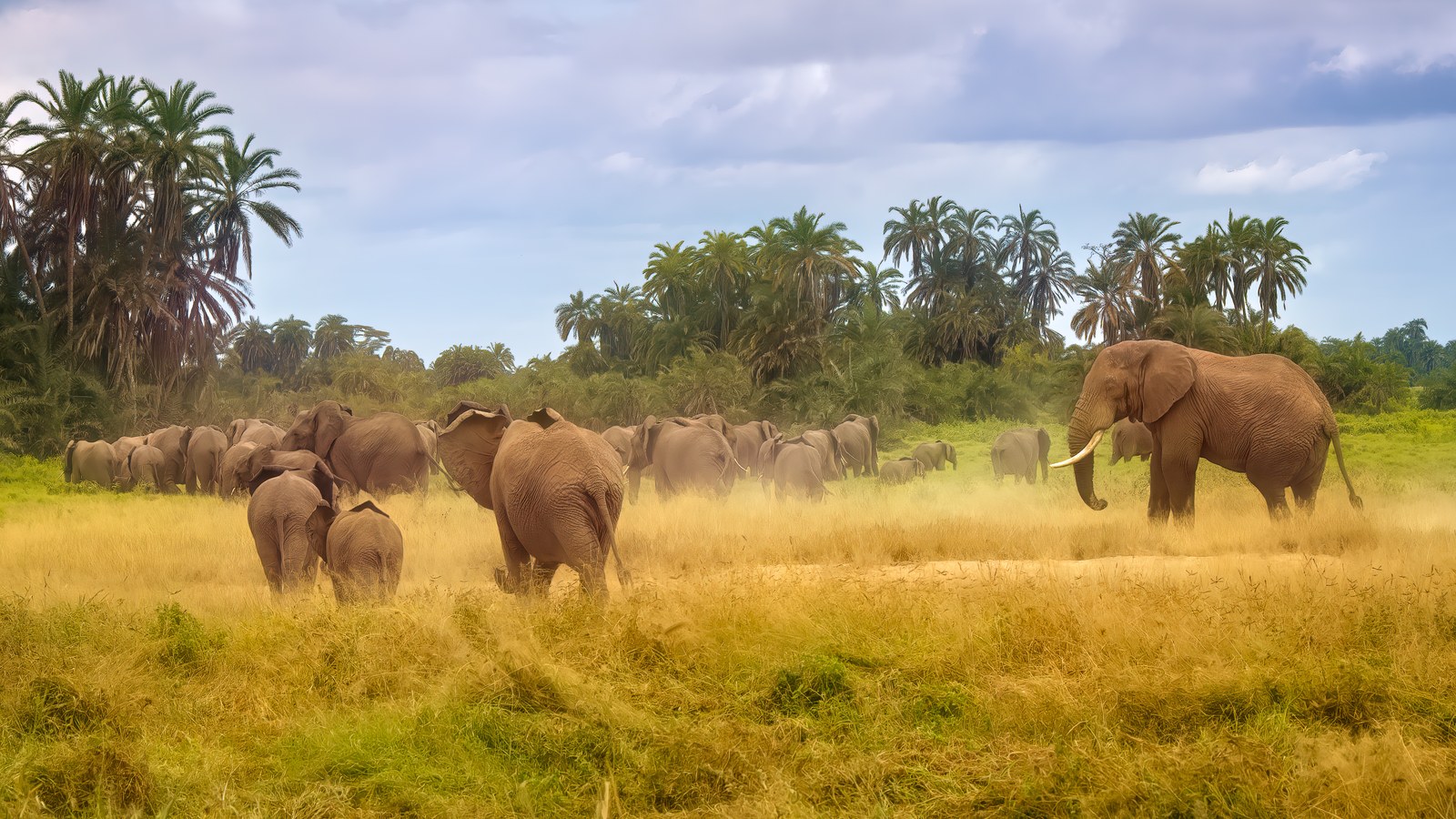
Start with scale, in UNESCO's wording: the Serengeti hosts "the annual migration of two million wildebeests plus hundreds of thousands of gazelles and zebras", on a "1,000 km long annual circular trek" across the wider Serengeti-Mara ecosystem. UNESCO's ecosystem figures are 2 million wildebeest, 900,000 Thomson's gazelles and 300,000 zebras, alongside 4,000 lions, 1,000 leopards, 225 cheetahs, 3,500 spotted hyenas and 300 wild dogs. WWF frames the moving herd itself at "up to 1.5 million wildebeest". Notice what no authority does: none of them publishes a month-by-month timetable, and none guarantees river-crossing dates. The calendar below is the standard seasonal framing every operator works to, labelled as exactly that.
| Stage | Where | Usual window | What is guaranteed |
|---|---|---|---|
| Calving | Southern Serengeti short-grass plains, including the Ndutu area | January to March, peak in February | Nothing. Timing follows the rains |
| The move north and west | Central Serengeti to the Western Corridor and the Grumeti River, rutting as they go | About April to June | Nothing. Herds split and regroup with grazing |
| River crossings | Northern Serengeti and the Maasai Mara, at the Mara River | About July to October, while herds are in the north | Nothing. Crossings happen when herds reach the river, not to a schedule |
| The return south | Back through the eastern Serengeti to the southern plains | About November to December, as the short rains return | Nothing. Rain timing decides |
Two planning consequences follow. First, calving is a southern-plains event in the early months of the year; a guide that places it in November, or sends you to the Mara for it, has the map upside down. Second, crossings are the most mis-sold event in safari travel: the honest way to see one is to base in the northern Serengeti or the Mara for several days in the crossing window and accept the herds' timetable, not to book a single date. For routes, budgets and booking windows, see our Africa safari trip planning guide.
Four parks that anchor a first safari
Serengeti National Park, Tanzania
The migration's main stage: 1.5 million hectares of savannah in UNESCO's listing, a World Heritage Site under criteria (vii) and (x), managed by the Tanzania National Parks Authority (TANAPA). This is the park for the full migration cycle, calving in the south, the western corridor, and the northern river crossings, and for the predator density UNESCO's figures above describe.
Maasai Mara National Reserve, Kenya
The Mara is a national reserve, not a national park, and it is not run by Kenya Wildlife Service. It covers 1,510 sq km under its own ecosystem management plan, is managed by the County Government of Narok, and its Mara Triangle sector is run by the Mara Conservancy Ltd on the county's behalf. It is the Kenyan chapter of the same ecosystem: when the herds cross into the Mara, this is where the famous Mara River crossings happen. Its fees are the steepest in this guide in high season, which the next section sets out.
Kruger National Park, South Africa
SANParks describes Kruger as spanning "nearly 2 million hectares", with 148 mammal species and 546 bird species recorded, and all of the Big Five present. Its logic is the opposite of the migration's: SANParks itself markets Kruger as a winter game-viewing park, because in the dry season the bush thins, natural water dries up, and animals concentrate at waterholes. One health note in SANParks' own words: Kruger falls within South Africa's malaria-endemic area, and SANParks advises consulting a doctor about prevention before you travel.
Okavango Delta, Botswana
The Okavango breaks the rule that floods belong to the wet season. UNESCO, which inscribed the delta in 2014 as its 1,000th World Heritage Site (criteria (vii), (ix) and (x); property 2,023,590 hectares), states it plainly: "the annual flooding event occurs in the dry season". Rain falls in the Angolan highlands, the flood pulse travels down the Okavango River for months, and the flood-tide peaks in the delta in June and July, in the middle of Botswana's dry season, which is exactly when game concentrates around the water. It is one of the world's few large inland deltas with no outlet to the sea; about 40 percent of the property is the Moremi Game Reserve, and UNESCO counts Botswana's elephant population, the world's largest at about 130,000, with the delta as its core area.
The Big Five, and where the name came from
The Big Five is a hunting term, not a size chart. In Bristol Museums' summary, it names "the five most difficult and dangerous animals for hunters to pursue on foot": lion, leopard, rhinoceros, elephant and Cape buffalo. The label comes from the big-game hunting era and has simply been inherited by conservation and safari travel. Knowing that explains the list's odd shape: the buffalo is there because of its danger to hunters on foot, not because it outranks a giraffe or a hippo in size or rarity.
What entry actually costs, at the published tariffs
| Park | Non-resident adult, per day | Notes from the tariff |
|---|---|---|
| Serengeti (TANAPA) | USD 70 peak / USD 60 low, before VAT; USD 82.60 / USD 70.80 with 18% VAT | Children 5 to 15: USD 20 before VAT; under 5 free |
| Maasai Mara (Narok County) | USD 100 (January to June) / USD 200 (July to December) | Includes the Mara Triangle; children 9 to 17 USD 50; children 8 and under free; the reserve notes final charges are set at the gate by the county or the Mara Conservancy |
Do the multi-day maths before you fall for a headline tour price, because park fees are per person per day and sit on top of your vehicle, guide and lodge. Five peak-season days in the Serengeti are USD 413 per person in entry alone; five August days in the Mara are USD 1,000 per person. Neither figure appears in most brochures, and both come straight off the authorities' own tariff pages.
Gorilla trekking: three countries, two bookable
| Country and park | Authority | Permit, foreign non-resident |
|---|---|---|
| Rwanda, Volcanoes National Park | Rwanda Development Board (RDB) | USD 1,500 per person per day |
| Uganda, Bwindi Impenetrable and Mgahinga | Uganda Wildlife Authority (UWA) | USD 800, including the guide fee, the day's park entry and a community contribution; USD 600 for April, May and November treks under UWA's 2026 low-season offer |
| DR Congo, Virunga National Park | Virunga National Park | Not on sale. Tourism is suspended and the park is closed to tourism until further notice |
Mountain gorillas live in exactly these three countries and nowhere else, which is why the old version of this guide's Rwanda-only framing mattered: Uganda is a full alternative, at a little over half Rwanda's price, and its low-season rate undercuts it further. Congo is the honest exception. Virunga, the third gorilla park, has been closed to visitors since 2020 and its gorilla and Nyiragongo treks remain suspended while the conflict in North Kivu continues; the park publishes no current trek price, and anyone offering to book you a Virunga trek today is selling something the park itself is not. For the Rwanda option in full, permits, the 12 families and the one-hour rule, see our gorilla trekking in Rwanda guide.
Photography: what is free, and what is a permit
Your own camera, used as a visitor, is not a permit problem in these parks. In the Serengeti, TANAPA's tariff levies no separate charge for personal photography; the paid line is commercial filming, which TANAPA's tariff (Section X) sets at USD 300 per person per day for the Serengeti, covering entrance, camping and filming. The Maasai Mara's own fees page states "Still photos and private videos are free", and separately prices commercial filming in the Mara Triangle from KSh 500,000 per week. In South Africa's national parks, making a film or taking photographs for a commercial purpose without a SANParks filming permit is unlawful under the protected-areas regulations (Regulation 20(1)(h)). The pattern holds everywhere in this guide: hobby photography rides on your entry ticket; commercial production is a permitted, paid activity arranged with the park authority in advance.
Drones: leave them at home
This section exists because bad drone advice is everywhere, including, until now, in this article. Three different bodies get confused, so here they are separated. SANSA is the South African National Space Agency, created under the National Space Agency Act 36 of 2008, and it runs satellites and space-science programmes; it issues no drone permits, and it never has. Drone regulation in South Africa belongs to the South African Civil Aviation Authority (SACAA), under Part 101 of the Civil Aviation Regulations, in force since 1 July 2015, under which purely private flying is personal use with no commercial outcome. And permission inside a national park belongs to neither of them: it belongs to the park authority, and SANParks states that flying a drone "is not permitted in any National Park irrespective of purpose". Under the protected-areas act it is illegal to fly below 2,500 feet above a national park without the management authority's express permission, and SANParks warns that anyone found flying one in a park will be arrested on the spot with their equipment confiscated. The single drone route in a SANParks park is a SANParks filming permit, for which there is a dedicated drone filming application form, and it is a route for productions, not holidaymakers.
Tanzania and Kenya line up the same way. TANAPA's published park rules state: "It's not allowed to use/operate drones in any park", with written permission available only through the filming and research process. Kenya regulates drones through the Kenya Civil Aviation Authority under the Civil Aviation (Unmanned Aircraft Systems) Regulations, 2020, and flying in a park or reserve additionally needs the park authority's written permission; even the Maasai Mara, which publishes a drone fee of KSh 30,000 per week for the Mara Triangle, is selling permission, not open access. The working rule for any African national park: assume your drone stays in its case unless the park authority has given you written permission, which in practice means research and commercial filming only.
Sources
- UNESCO World Heritage Centre, Serengeti National Park listing (property 156): herd and predator figures, the 1,000 km annual circular trek, 1.5 million hectares, criteria (vii) and (x): whc.unesco.org/en/list/156
- WWF, "Why Ecological Connectivity Matters": up to 1.5 million wildebeest moving through the Mara/Serengeti ecosystem: worldwildlife.org
- Tanzania National Parks Authority (TANAPA), official park tariff schedule: Serengeti conservation fees (USD 70 peak / USD 60 low before 18% VAT) and Section X filming fees (Serengeti USD 300 per person per day): tanapa.go.tz
- Maasai Mara National Reserve, Entry Fees and Rules (updated 15 October 2026): non-resident USD 100 / USD 200, "Still photos and private videos are free", commercial filming and drone fees: maasaimara.ke/entry-fees-rules
- Greater Maasai Mara Ecosystem Management Plan 2023-2032: the reserve's 1,510 sq km and its management by the County Government of Narok, with the Mara Triangle run by the Mara Conservancy Ltd: kws.go.ke
- UNESCO World Heritage Centre, Okavango Delta listing (property 1432): inscribed 2014, 2,023,590 hectares, the dry-season flood peaking in June and July: whc.unesco.org/en/list/1432
- SANParks: Kruger National Park page (nearly 2 million hectares; 148 mammals; 546 birds; malaria-endemic advisory) and the SANParks statement on drones in national parks (prohibited irrespective of purpose; filming permit route): sanparks.org
- South African Civil Aviation Authority, Part 101 of the Civil Aviation Regulations (in force 1 July 2015): caa.co.za; South African National Space Agency, About SANSA: sansa.org.za
- TANAPA park Rules and Regulations: "It's not allowed to use/operate drones in any park"; Kenya Civil Aviation Authority, Civil Aviation (Unmanned Aircraft Systems) Regulations, 2020: kcaa.or.ke
- Uganda Wildlife Authority, Conservation Tariff 2024-2026 and the 26 February 2026 tariff circular: gorilla permits USD 800, low-season USD 600: ugandawildlife.org
- Virunga National Park: tourism suspended, gorilla and Nyiragongo treks closed until further notice: visit.virunga.org, virunga.org
- Bristol Museums, "Why Are They Called The Big 5 Animals?": the hunting origin of the term: bristolmuseums.org.uk