
Japan's best places are not a secret, but the details that decide a trip often are: the JR Pass no longer pays for the classic Tokyo to Kyoto run, Mount Fuji hides all summer, Osaka Castle's tower is a 1931 museum (with no rooftop garden), and Shirakawa-go's winter light-up admits nobody without a reservation. These are the nine places worth building a Japan trip around, with the verified fact that matters for each and the seasons matched honestly to the JMA calendar.
Quick picks
| Place | Go for | Need to know |
|---|---|---|
| Tokyo | The full city spectrum | Senso-ji is its oldest temple (645) |
| Kyoto | Temples and shrines | Fushimi Inari is free and open 24 hours |
| Osaka | Food and neon | Castle tower is a museum, entry ¥1,200 |
| Mount Fuji area | The view itself | Winter mornings; June is the worst month |
| Hiroshima and Miyajima | History and the floating gate | Torii fully restored since Dec 2022 |
| Nara | Deer and the Great Buddha | Deer are wild; feed only shika senbei |
| Kanazawa | Gardens and old districts | 2.5 hours from Tokyo by shinkansen |
| Nikko | Shrines, lake and falls | Autumn colour comes in two waves |
| Takayama and Shirakawa-go | Old town and farmhouses | Winter light-up is reservation-only |
1. Tokyo
Tokyo is several cities sharing one rail map, so plan it by district: Asakusa for the old downtown around Senso-ji, Tokyo's oldest temple, formally founded in 645 and reached through the Kaminarimon gate and the 250-metre Nakamise shopping street (grounds always open, free); Shinjuku for skyscrapers and the free observatories of the Metropolitan Government Building; Shibuya for the Scramble Crossing; Ueno for the museum cluster and spring blossom; Akihabara for electronics and anime. The teamLab museums are worth booking ahead: Borderless is permanent at Azabudai Hills, while Planets in Toyosu (barefoot, walking through water) currently runs until the end of 2027.
2. Kyoto
Kyoto holds Japan's deepest concentration of temples and shrines. Start at Fushimi Inari Taisha: roughly 10,000 donated torii gates climbing Mount Inari, free and open 24 hours, with the full loop about 4 km and 2 to 3 hours (the halfway viewpoint makes a good turnaround). Kinkaku-ji, the Golden Pavilion, charges ¥500, cash at the gate, and is viewed from across its pond. In Arashiyama, set expectations honestly: the famous bamboo grove is a path of a few hundred metres that takes 10 to 15 minutes and fills by mid-morning, so go before 08:00 and build the half-day around Tenryu-ji and the Togetsukyo Bridge instead. In Gion, respect the local rule: photography is banned on the district's private roads and visitors are asked not to enter the narrow private alleys at all; the main street, Hanamikoji, stays open.
3. Osaka
Osaka is Kyoto's loud neighbour: come for Dotonbori's canal-side neon and street food (takoyaki, okonomiyaki, kushikatsu), and for Osaka Castle, understood correctly. The castle's main tower is a 1931 ferroconcrete reconstruction housing a history museum (entry ¥1,200, park free), worth it for the museum and the top-floor view; there is no rooftop garden, whatever older guides say. Universal Studios Japan is a full-day, pre-booked park in its own right, not an evening add-on. And Expo 2025 has ended (it closed on 13 October 2025), so plan nothing around it.
4. The Mount Fuji area
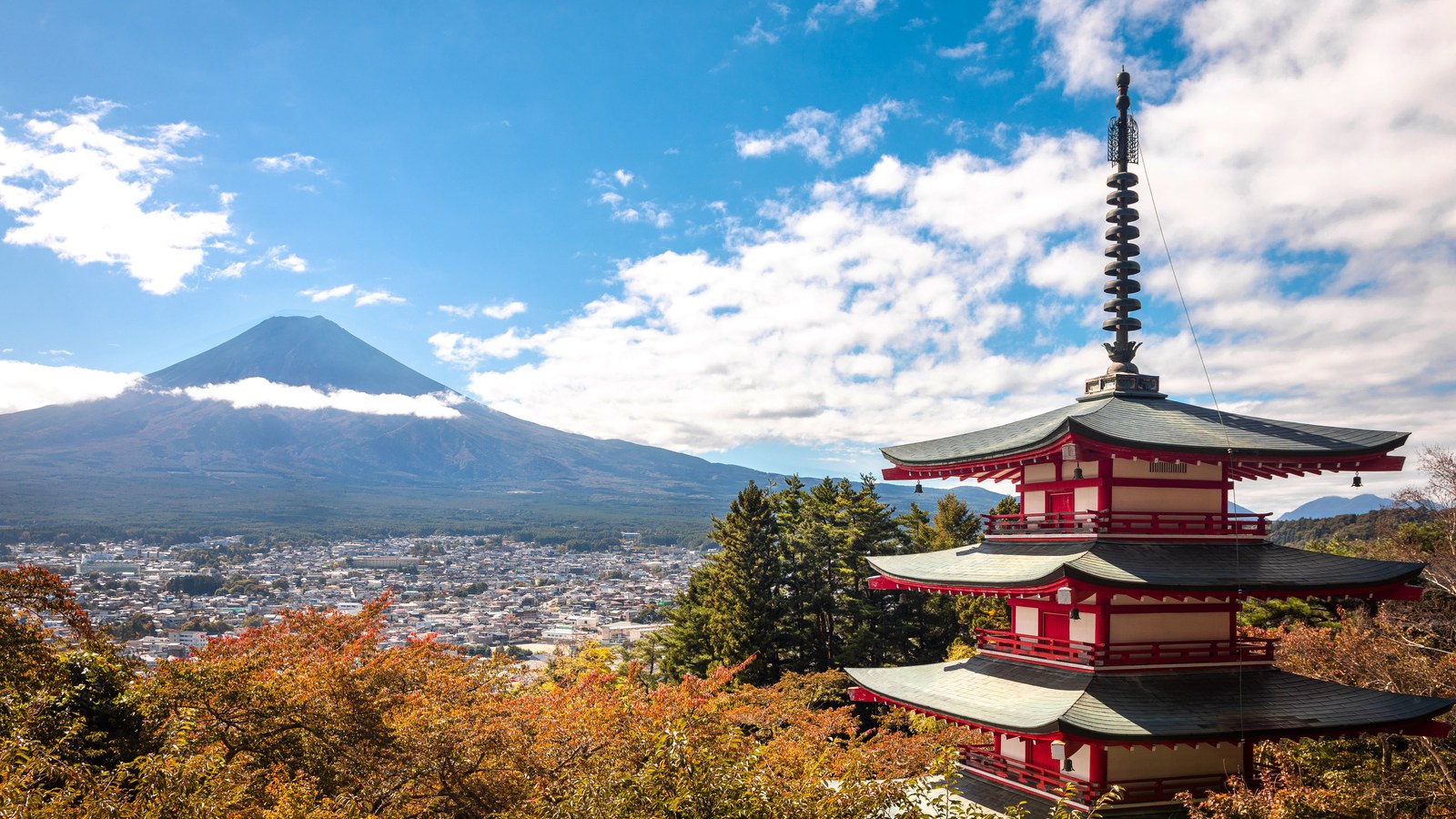
Fuji is a viewing problem before it is a destination. The mountain is clearest on winter mornings: Fuji City's 35-year record of 8am observations shows December fully visible on 62 percent of mornings, while June is the single worst month. Early morning beats afternoon in every season. Base yourself around the Fuji Five Lakes (Kawaguchiko is the easiest by train and bus) or Hakone for hot springs and the lake, and treat a clear Fuji as a bonus scheduled for the start of the day, not a promise. Going further south? Our Kyushu travel guide covers the volcanic south in the same spirit.
5. Hiroshima and Miyajima
Hiroshima pairs the Peace Memorial Park and Museum, which most visitors rate the most affecting stop in Japan, with Miyajima island 30 minutes away, where Itsukushima Shrine's great torii stands in the sea. The update that matters: the torii's three-and-a-half-year renovation finished in December 2022, so the 16-metre gate is fully visible with no scaffolding. The two together make a long but doable day or a comfortable overnight from Kansai, and this is the leg that can make a rail pass pay (see the transport section).
6. Nara
Nara, 45 minutes from Kyoto or Osaka, is the easy day trip: Todai-ji's Great Buddha in one of the world's largest wooden buildings, and a park full of deer. Handle the deer correctly: they are wild animals, protected as natural monuments, and the bowing is learned behaviour, theirs, not a trick taught to them. The only food you may give them is the shika senbei crackers sold in the park; human snacks harm them, and they will bow, nudge and occasionally nip for anything edible you are holding.
7. Kanazawa
Kanazawa is the preserved alternative to Kyoto: Kenrokuen, counted among Japan's three great gardens, faces Kanazawa Castle, and the city keeps both a geisha district (Higashi Chaya, with its gold-leaf shops) and a samurai district (Nagamachi) in working order, having escaped wartime bombing. It is about 2.5 hours from Tokyo on the Hokuriku Shinkansen and pairs naturally with Takayama and Shirakawa-go on a central-Japan loop.
8. Nikko
Nikko's shrines sit in cedar forest above the town: Toshogu, the UNESCO-listed mausoleum of Tokugawa Ieyasu, carries more than 500 carvings on its Yomeimon gate alone, including the Three Wise Monkeys. Above the town, the Irohazaka switchbacks climb to Lake Chuzenji and the 97-metre Kegon Falls. Because the lake sits about 800 metres above the shrines, Nikko's autumn colour arrives in two waves: mid to late October at the lake and falls, late October to mid-November at the shrines. One correction from older versions of this guide: Senjojiki is not in Nikko at all. It is a glacial cirque in Komagane, Nagano, reached by the Komagatake Ropeway to Japan's highest station at 2,612 metres, and it belongs on an Alps trip, not this one.
9. Takayama and Shirakawa-go
Takayama keeps an Edo-period old town of sake breweries and morning markets in the Hida mountains, and is the base for Shirakawa-go, the UNESCO village of steep-thatched gassho-zukuri farmhouses. If you are going for the famous winter light-up, plan like it is a concert: the 2027 light-up runs on just four nights (11, 17, 24 and 31 January, 17:30 to 19:30) and is fully reservation-only, through an overnight-stay lottery, reserved parking, or a bus tour from Takayama. There are no walk-ins and no tickets on the day.
Seasons, matched to the calendar
Cherry blossom (JMA long-term normals): Tokyo and Kyoto reach full bloom around 31 March and 4 April, so late March to the first week of April is the honest planning window, with recent years running a few days early. Autumn foliage peaks mid to late November into early December in Kyoto, and weeks earlier in Nikko's high country. The rainy season runs early June to mid-July across most of Honshu, and typhoons peak in August and September. Winter belongs to the north: the Sapporo Snow Festival is officially set for 4 to 11 February 2027, and Fuji's clearest mornings are in the same months. For the islands south of the mainland, our Okinawa travel guide covers seasons and ferries in detail.
Getting around: the JR Pass decision
The Japan Rail Pass changed fundamentally in late 2023, and old advice is now wrong. Official online prices are ¥50,000 for 7 days, ¥80,000 for 14 and ¥100,000 for 21 (Green ¥70,000, ¥110,000, ¥140,000; children 6 to 11 half). Since 1 October 2026, passes bought through overseas agencies cost more (¥53,000 for 7 days), so the official site is both the main and the cheapest channel. Do the maths before buying: a Tokyo to Kyoto round trip costs about ¥27,940, well under the 7-day pass, so the classic golden route usually loses money on a national pass. The pass pays when several long legs fall in one window, such as adding Hiroshima and returning within 7 days. Regional passes often beat it: JR West's Kansai-Hiroshima pass, JR East's passes for Tokyo, Nikko and the north, and JR Kyushu's Northern pass at ¥15,000 for 3 days. Pass holders can also ride Nozomi and Mizuho trains with a separate special ticket. Entry basics match our other Japan guides: 74 countries and regions are visa-exempt (90 days typical), Visit Japan Web is optional, and tax-free shopping switches to a refund-at-departure model on 1 November 2026.
Sources
- JNTO: official Japan travel guide
- Japan Rail Pass: official prices and rules
- MOFA: visa exemption list
- Shirakawa-go Tourist Association: light-up reservations
- teamLab: Borderless and Planets venue status
- Japan Meteorological Agency: cherry blossom observation data
- Sapporo Snow Festival: official 2027 dates
- Osaka Info: official city tourism (castle museum)