
Kyushu is Japan's third-largest island and its volcanic south: Fukuoka's food stalls, the steaming hells of Beppu, black-sand onsen towns, an active volcano you can look into on a good day, and castles and gardens that most first-time Japan itineraries skip. This guide covers the places that earn their place on a Kyushu trip, the JR Kyushu rail passes with current prices, real season dates, and the entry rules as they actually stand.
Quick picks
Kyushu has seven prefectures, but most first trips use the same spine: arrive in Fukuoka, cross to Beppu and the Aso caldera, then finish in Kagoshima or Nagasaki. Start here.
| Base | Go for | Key fact |
|---|---|---|
| Fukuoka | Arrival city, yatai food stalls, day trips | Airport subway reaches Hakata in about 5 minutes |
| Beppu | The seven hells and serious onsen | Combined hells ticket is 2,400 yen, valid across two days |
| Kurokawa Onsen | Ryokan village, outdoor baths | The 1,500 yen wooden tegata pass covers three baths |
| Kumamoto and Aso | The castle, then the caldera | Crater access depends on the alert level and gas on the day |
| Takachiho | The gorge and its waterfall | Boats are booked online only and sell out |
| Kagoshima | Sakurajima volcano across the bay | The ferry to the volcano runs 24 hours |
| Nagasaki | Peace Park, Dejima, Glover Garden | Atomic Bomb Museum entry is 200 yen |
When to go
Spring and autumn are the comfortable seasons in Kyushu; summer is hot, wet and typhoon-prone. The dates below follow Japan Meteorological Agency normals, not travel-blog folklore.
Spring: cherry blossom first
Kyushu blooms earlier than most of Japan: first flowers in mid to late March and full bloom around late March to very early April in Fukuoka. The same weeks suit onsen towns before the rains arrive.
Summer: rain, then typhoons
The rainy season (tsuyu) runs from about 30 May to 15 July in southern Kyushu and about 4 June to 19 July in the north. Typhoons can approach from June to October, peaking in August and September. Summer trips still work, but build in flex days and check the forecast before gorge boats or volcano visits.
Autumn: the best all-round window
October and November bring cooler air and the clearest volcano views. Kyushu's autumn colour comes late, generally mid-November to early December in the lowlands, earlier around Aso and Takachiho. Winter is mild in the cities, with the onsen towns at their most atmospheric.
If Kyushu is one leg of a longer Japan trip, pair it with the best places to visit in Japan for the classic route, or with Japan's other island region in our Okinawa budget travel guide.
Entry rules and money basics
Japan's visa exemption list covers 74 countries and regions, and most visitors from the US, Canada, the UK, Australia and the EU get 90 days on arrival (Ministry of Foreign Affairs visa exemption list). Travellers from India, the Philippines and China are NOT on that list and need a visa from a Japanese embassy or consulate before they travel. There is no tourist visa-on-arrival in Japan.
Visit Japan Web, the government's online arrival service, is optional, not mandatory: it replaces the paper arrival card and customs form with one QR code, and paper forms are still handed out on the plane. Tax-free shopping currently works at the till in licensed shops: show your passport and pay without the 10 percent consumption tax on purchases of 5,000 yen or more per store per day. From 1 November 2026 the system changes to a refund model: you pay the full price in store and claim the tax back at your departure airport after customs confirmation, so keep receipts and the goods unopened until you leave.
Getting around: JR Kyushu passes
Trains cover the main Kyushu spine well, and the JR Kyushu area passes are the main money decision. Current prices (JR Kyushu rail pass page):
| Pass | Durations and prices | Suits |
|---|---|---|
| Northern Kyushu Area Pass | 3 days 15,000 yen / 5 days 17,000 yen | Fukuoka, Beppu, Kumamoto, Nagasaki trips |
| Southern Kyushu Area Pass | 3 days 12,000 yen | Kagoshima, Miyazaki, Ibusuki trips |
| All Kyushu Area Pass | 3 days 22,000 yen / 5 days 24,000 yen / 7 days 26,000 yen | Full-island circuits |
The passes cover JR Kyushu trains in their area, including the Kyushu Shinkansen between Hakata and Kagoshima-Chuo and limited expresses like the Sonic and the Yufuin no Mori. They do not cover the Sanyo Shinkansen between Hakata and Kokura, which belongs to JR West. You need Temporary Visitor status and your passport to buy one. Buses fill the gaps the trains leave: Kurokawa Onsen and Takachiho have no stations at all.
Fukuoka: the easy arrival
Fukuoka is the natural start: the airport subway station sits under the domestic terminal, about 5 minutes and two stops from Hakata Station. Spend the first evening at a yatai, the open-air food stalls that set up from around 6 pm along the Nakasu riverbank, in Tenjin and at Nagahama. There are roughly 100 stalls across the city; order at least one dish and one drink per person, and bring cash. Hakata ramen, a rich tonkotsu pork-bone broth with thin straight noodles, is the dish to start with, and mentaiko (spicy salted pollock roe) is the souvenir to take home.
Dazaifu Tenmangu
Dazaifu Tenmangu, about 30 to 40 minutes from Tenjin by Nishitetsu train with a change at Futsukaichi, enshrines Sugawara no Michizane, the deity of learning, and is famous for its roughly 6,000 plum trees. The main hall is under its first major renovation in 124 years, running from May 2023 to around 2026; worship continues in a much-photographed temporary hall with a planted green roof in front of it, ahead of the restored hall's reveal planned for 2027.
Nanzoin and the reclining Buddha
Nanzoin Temple in Sasaguri, about 25 minutes by JR train from Hakata to Kido-Nanzoin-mae station, holds a bronze reclining Buddha 41 metres long and about 300 tons, described as the largest bronze statue of its kind in the world. The temple is the head of the Sasaguri Shikoku pilgrimage. A 500 yen admission fee for overseas visitors was introduced in May 2025; grounds open 9:00 to 17:00 with last entry at 16:30, so check the temple site before you go.
Beppu and Yufuin: onsen country
Beppu produces more hot-spring water than almost anywhere on earth, and its seven hells (jigoku) are the showpieces: vividly coloured, too-hot-to-enter ponds and a geyser, five in the Kannawa district and two in Shibaseki. The combined ticket for all seven costs 2,400 yen for adults and 1,200 yen for children, is valid across two consecutive days, and the hells open 8:00 to 17:00 (Beppu Jigoku Association). Single hells cost about 450 to 500 yen each, so the combined ticket pays off from five hells up. Beppu also features in our guide to places in Japan beyond Tokyo, alongside the 7 Hells' viewing etiquette. Neighbouring Yufuin, under an hour away, is the gentler alternative: a small, walkable town of galleries and cafes under Mount Yufu, best paired with Beppu rather than chosen instead of it.
Kurokawa Onsen: the tegata pass
Kurokawa Onsen, a ryokan village in the northern Aso caldera with no station and no chain hotels, is built around outdoor bathing. Buy the Nyuto Tegata, a wooden pass costing 1,500 yen for adults and 700 yen for children: it covers three open-air baths at participating ryokan (about 25 of them), is valid for six months, and is sold at the Kaze-no-Ya information centre and participating inns (Kurokawa Onsen Ryokan Association). Day bathing at a single inn usually costs 500 to 800 yen. Direct highway buses link Kurokawa with Fukuoka in about two and a half to three hours, and buses connect it with Aso Station and Beppu.
Kumamoto Castle and Mount Aso
Kumamoto Castle, built in 1601 to 1607 by Kato Kiyomasa and famous for its curved musha-gaeshi stone walls, was badly damaged in the April 2016 earthquake. The main tower was fully restored and reopened in June 2021, and visitors follow a special elevated route through the grounds while the rest of the complex is rebuilt over the coming decades. Admission is 800 yen (300 yen for school students), hours 9:00 to 17:00.
Mount Aso, east of Kumamoto, is one of the world's largest calderas, and its Nakadake crater is active. Whether you can approach the crater rim depends on the volcanic alert level and on the day's gas readings; the rim closes when either says no, and visitors with asthma, breathing or heart conditions are not allowed into the crater area at all. Plan a fallback every time: the Kusasenri grassland and Aso Volcano Museum below the crater, or Daikanbo, the viewpoint on the northern caldera rim with the classic view across the five peaks. Check the official Aso status page on the morning of your visit.
Takachiho Gorge
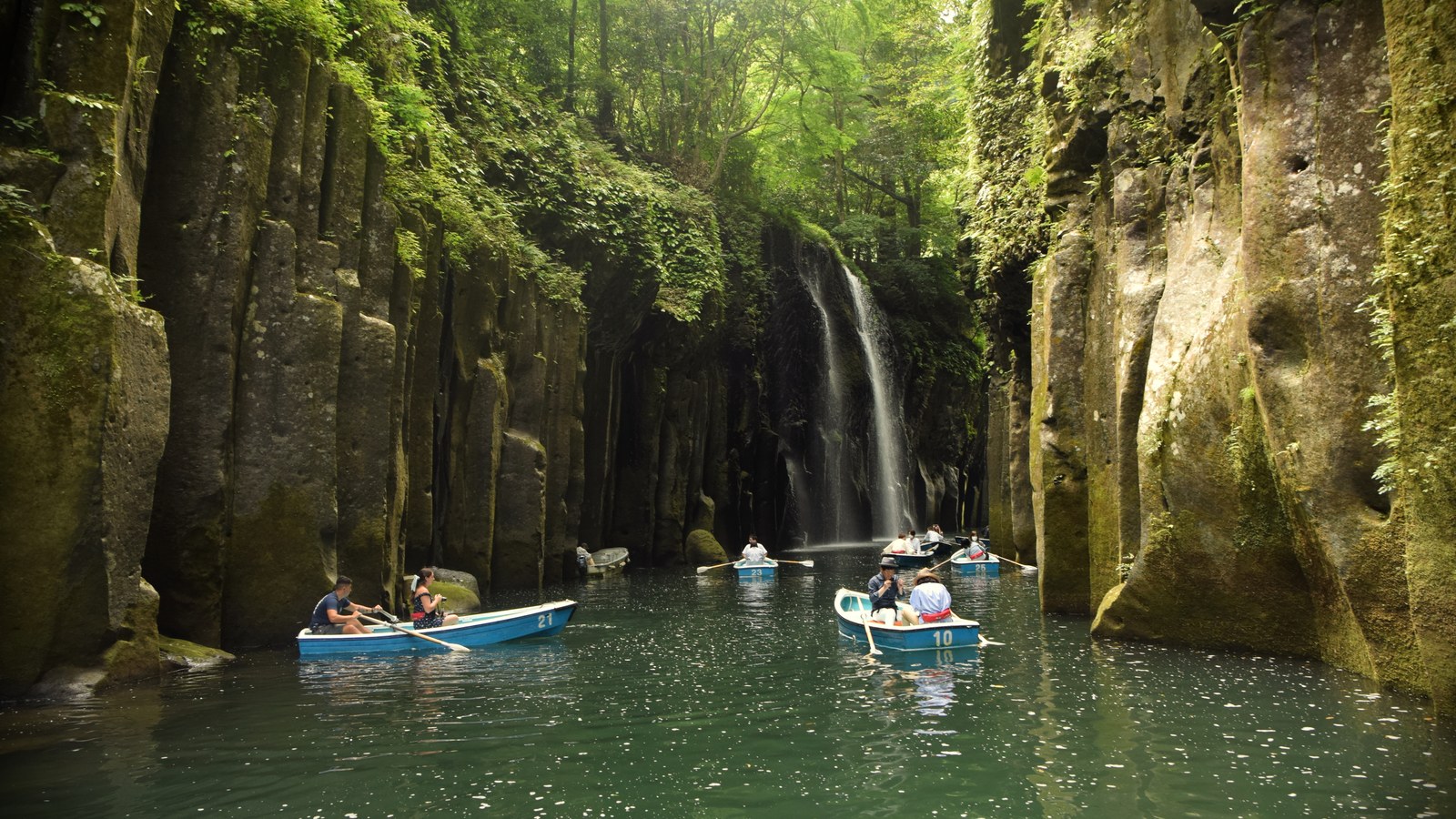
Takachiho Gorge in Miyazaki is a narrow basalt canyon cut by the Gokase River, with the 17 metre Manai Falls dropping beside the boat channel. Rowing a boat under the falls is the signature experience: boats hold up to three people, run 30 minutes, and cost 4,100 yen per boat on Tuesday to Thursday and 5,100 yen on Friday to Monday and in peak periods. Booking is online only, opens two weeks ahead and closes two days before, and boats stop when the river runs high. There is no railway to Takachiho: highway buses take about three hours from Kumamoto and three hours forty from Hakata, and the gorge is a 30 minute walk or short bus ride from Takachiho Bus Centre.
Kagoshima and Sakurajima
Kagoshima sits across a bay from Sakurajima, one of Japan's most active volcanoes, and the city ferry is the way over: it runs 24 hours, takes about 15 minutes, leaves every 15 to 20 minutes in the daytime, and costs 250 yen per adult one way, paid on arrival. On the island, the Island View loop bus serves Yunohira Observatory, the closest public viewpoint to the crater at about 373 metres, and the long Nagisa Park footbath near the port. Nobody goes within two kilometres of the craters; the observatory is as close as visitors get. Ash falls on Kagoshima often enough that locals treat it like weather, so keep sunglasses or a mask handy on ash days.
Nagasaki, and the Amakusa detour
Nagasaki rewards a full day at least. The Peace Park near the hypocentre of the 9 August 1945 bombing is free; the Atomic Bomb Museum beside it costs 200 yen and covers both the bombing and the city's recovery. Dejima, the fan-shaped island that was Japan's only Dutch trading post during the closed-country centuries, is restored as a national historic site (510 yen), and Glover Garden above the harbour preserves the Meiji-era merchants' houses, including the 1863 Glover House (620 yen).
If you have a spare day near Kumamoto, Amakusa offers two very different experiences: year-round wild dolphin watching by boat from Futae port, and Sakitsu village, a component of the 2018 UNESCO listing for the Hidden Christian Sites in the Nagasaki Region, where a small church with a tatami-floored interior stands in a working fishing village. Church interior visits need a reservation made by the afternoon of the day before.
A realistic 7-day route
- Day 1: Arrive Fukuoka, yatai dinner in Nakasu.
- Day 2: Dazaifu Tenmangu in the morning, Nanzoin in the afternoon.
- Day 3: Train to Beppu, the seven hells, onsen evening.
- Day 4: Bus to Kurokawa Onsen, tegata bathing, ryokan night.
- Day 5: Kumamoto Castle, then stay Kumamoto.
- Day 6: Aso day (crater if the alert and gas allow, Kusasenri and Daikanbo either way), or the Takachiho Gorge boat if you base in Kumamoto.
- Day 7: Shinkansen to Kagoshima, Sakurajima ferry and observatory, fly out of Kagoshima or return to Fukuoka.
Nagasaki swaps in cleanly for Day 6 or 7 on a northern-focused trip. The common mistake is trying to add Miyazaki city and Yakushima to the same week; both deserve their own days.