
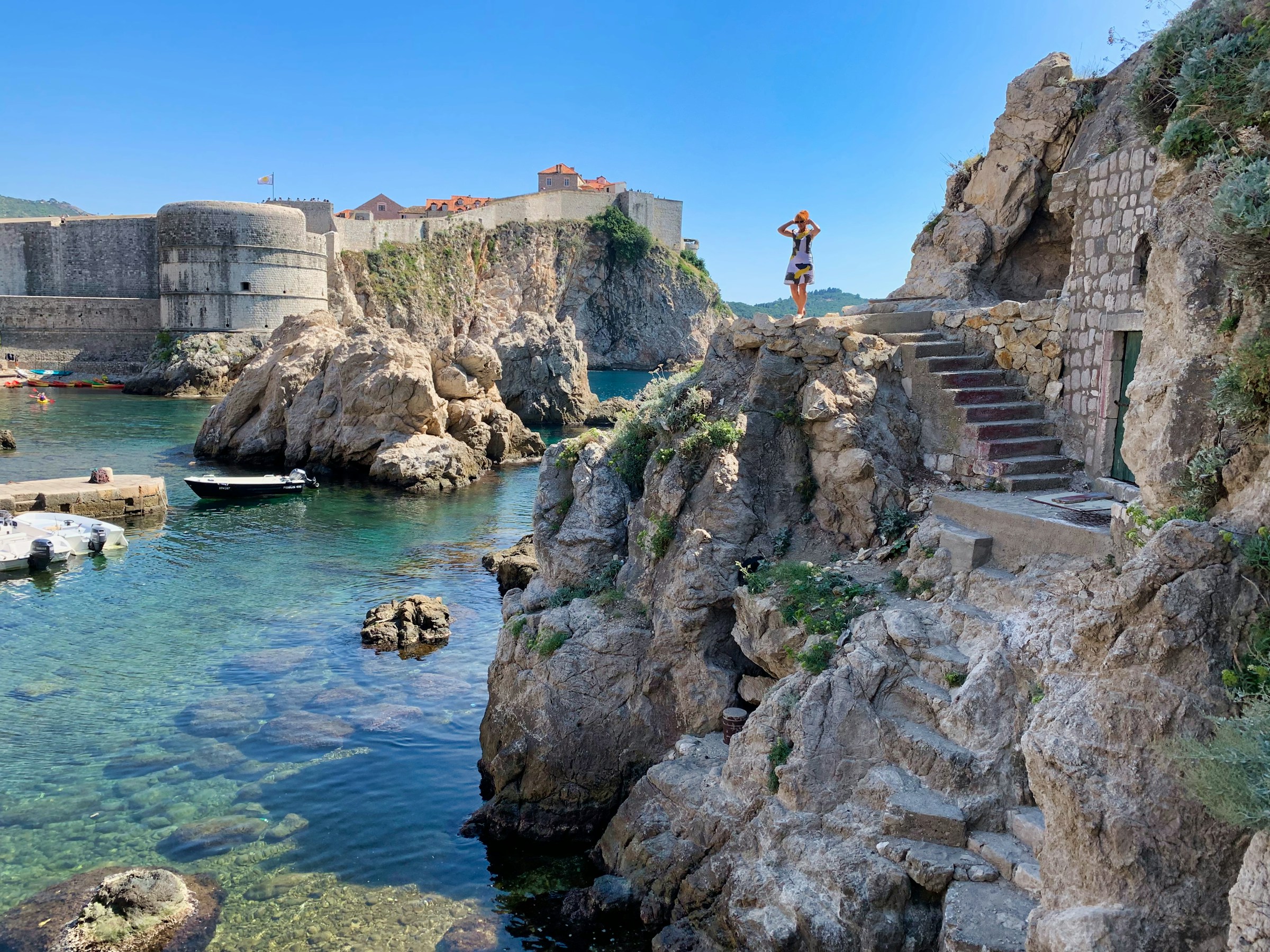
These five towns are worth your Croatia trip, but not for the reason this article used to give. Four of them are not hidden at all: Rovinj recorded 4,376,910 overnight stays in 2025 and was named Croatia's Tourism Champion for that year; Šibenik holds two UNESCO World Heritage inscriptions; Korčula Town trades on its claim to be Marco Polo's birthplace; and Primošten is a classic Dalmatian resort town. The fifth, Motovun, is genuinely small, a walled hilltop town above Istria's truffle forest. What they share is scale: each gives you the historic Adriatic at walking size, beyond the Dubrovnik and Split crowds, and each is reached differently, which the access notes under every town now state correctly.
The previous version of this article called all five "hidden towns" with "under 10,000 visitors", a threshold that exists nowhere. It directed readers to a "Rovinj Airport"; Rovinj has no airport, and the gateway is Pula, about 40 kilometres away on the City of Rovinj's own figures. It put Šibenik "approximately 45 km" from Zadar Airport; the Port of Šibenik Authority's figures are about 50 km to Split Airport and about 80 km to Zadar, so the old article had the distance wrong and the nearer airport wrong. And it sold Motovun partly on a film festival that no longer happens there. The towns survive the corrections easily. The framing did not.
The five, with their real access
| Town | What it actually is | Gateway, as the authorities publish it |
|---|---|---|
| Rovinj | One of Croatia's leading destinations (Tourism Champion 2025); peninsula old town under St Euphemia's tower | Pula Airport, about 40 km (City of Rovinj); no airport at Rovinj |
| Šibenik | The only Croatian city with two UNESCO inscriptions; gateway to Krka National Park | Split Airport about 50 km; Zadar Airport about 80 km (Port of Šibenik Authority) |
| Motovun | The genuinely small one: a walled medieval hilltop town, UNESCO tentative list, above the truffle forest | Inland Istria by road; Pula is the regional airport |
| Korčula Town | Walled island town presenting itself as Marco Polo's birthplace (1254) | Orebić to Dominče car ferry, 20 minutes, year-round (Jadrolinija); town catamarans are seasonal |
| Primošten | Old town on a peninsula plus the Raduča beaches; Bucavac's stone-lace vineyards behind it | Split Airport is the nearest airport (neither the airport nor the tourist board publishes a distance) |
Rovinj: famous, and worth it anyway
Start with the numbers, because they are the opposite of hidden. The Rovinj Tourist Board's year-end release records 4,376,910 overnight stays and 770,840 arrivals in 2025, up 4 and 5 percent on the year, and says the results confirm Rovinj's status as "one of Croatia's leading tourist destinations"; the town was then named Tourist Destination of the Year, the Croatian Tourism Champion 2025, at the national tourism awards. The Croatian Bureau of Statistics put it more bluntly in August 2025: Rovinj was "the most desirable destination among foreign tourists for a third month in a row", with 1.0 million tourist nights in that single month, ahead of Dubrovnik. What those visitors come for is real: an old town that "rises up on a peninsula", so tightly built it was declared a cultural monument in 1963, in the tourist board's words, crowned by the 18th-century Church of St Euphemia, whose 60-metre bell tower carries the copper statue of the town's patron saint, turning on a spindle to show the wind. Come in the shoulder months for the same streets with room to walk them, sleep in the campsites and apartments that take most of those 4.4 million nights (campsites alone account for 45 percent of them, per the tourist board), and fly to Pula: the airport is "only 40 kilometres from Rovinj" per the City of Rovinj, Rijeka Airport at about 115 km is the alternative, and Pula's schedule is heavily summer-weighted, 145,432 passengers in July 2026 alone against 554,247 in all of 2025 on the airport's and the statistics office's figures.
Šibenik: the city with two UNESCO listings
Šibenik's own tourist board leads with the fact, and it is a good one: "The only city in Croatia and one of the few in the world with two entries on the UNESCO World Heritage List." The first is the Cathedral of St James, inscribed in 2000, built between 1431 and 1535 entirely from stone by three successive architects from Northern Italy, Dalmatia and Tuscany, whose exchange, UNESCO says, produced a building in which "Gothic and Renaissance forms have been successfully blended", with unique construction techniques in its vaulting and dome and a frieze of 71 sculptured heads along its walls. The second, added on 7 July 2017, is St Nicholas Fortress at the entrance to St Anthony's Channel, Šibenik's component of the transnational Venetian Works of Defence, built in the 16th century to plans associated with the Venetian military architect Michele Sanmicheli to guard the town against attack from the sea. Šibenik is also the coastal base for Krka National Park: the park's own site lists four entrances (Lozovac, Skradin, Roški slap/Laškovica and Burnum/Puljane), with Lozovac and Skradin serving the Skradinski Buk side, and confirms the park is open year-round; it publishes no distance from Šibenik, so this guide prints none. Access, settled from the Port of Šibenik Authority's brochure: Split Airport in Kaštela is about 50 km away and Zadar Airport in Zemunik about 80 km, which makes Split, not Zadar, the sensible arrival airport, the reverse of what the old version of this article told you.
Motovun: the one genuinely small town
Motovun is what the old headline promised and the other four are not: a small, walled hilltop town in Istria's interior, which its tourist board calls "the medieval jewel of the interior of Istria". The substance is protected and listed: 26 protected cultural monuments in the old town, walls whose earliest preserved sections date to the 11th and 12th centuries, a 27-metre bell tower raised in the 13th century as the town's main tower, the parish church of St Stephen (built 1580 to 1614, its facade attributed to designs by Andrea Palladio) and a municipal palace the tourist board calls the best preserved Romanesque public building in Istria and Croatia. The town has sat on UNESCO's Tentative List since 2007. Below it, in the Mirna valley, lies the Motovun Forest, a special forest vegetation reserve since 1963 covering 275 hectares, and, in the Istria County tourist board's phrase, "the truffle epicenter of Istria", home of the white truffle, Tuber magnatum Pico. One famous thing must be put in the past tense: the Motovun Film Festival, founded in the town in 1999 and long held in late July, left after a split edition in 2023 and since 2025 takes place solely in Gorski Kotar under the name Cinehill (its 28th edition ran at Fužine, 21 to 26 July 2026; 2027 dates are not yet announced). Go to Motovun for the walls, the valley and the truffles, not for a festival that now happens in the mountains inland.
Korčula Town: a claim, a sword dance and a 20-minute ferry
Korčula presents its famous son without hedging: the island tourist board states that "the greatest traveler and explorer of all time, Marco Polo, was born here (Korčula, 1254 - Venice, 1324)", shows the preserved family house and tower, and records his capture at the naval battle between the Genoese and Venetian fleets off Korčula on 7 September 1298, after which he dictated Il Milione in captivity. The town tourist board's wording for the tower is the careful version: it is "believed to be the house in which the great world traveller and writer was born". This guide prints the claim as Korčula's claim, strongly held and locally documented, rather than as a proven fact, and the town's other statuses need the same precision: the historic town is on UNESCO's Tentative List (since 2007), not inscribed, and the Moreška sword dance, performed through the summer and on St Todor, 29 July, from a tradition recorded since 1666, is a protected intangible asset of the Republic of Croatia; its nomination to UNESCO's Intangible Heritage list was withdrawn in 2013, so any guide calling it UNESCO-listed is wrong. Getting there is the practical heart of it. The year-round spine is Jadrolinija's line 634 car ferry from Orebić on the mainland to Dominče, just outside the town: the official 2026 schedule states "Voyage duration - 20 minutes", rising to 22 departures a day each way in peak season. The Split to Vela Luka car ferry (three hours, year-round) lands at the island's far end, and the direct catamarans into Korčula Town's harbour are seasonal services, densest from spring to autumn, so a winter visit is planned around Orebić.
Primošten: resort town, stone-lace vineyards
Primošten is the honest resort town of the five: an old town on the small peninsula its people settled in the second half of the 15th century, when, under Turkish attacks, the inland parish moved onto the island then called Capocesto and built the Church of St George on its hill in 1485 (the present church dates to 1760, and is registered cultural property), and the beaches of the Raduča peninsula below, which are the town's summer engine. Its distinction is three kilometres south and easy to miss: Bucavac Veliki, where 56 drystone-walled lots totalling 18.4 hectares climb from the shore in rows UNESCO's tentative-list entry describes as cleared by hand from rock, planted with the indigenous Babić grape that "produces best quality wines precisely in the Primošten region". The Primošten tourist board calls the vineyard "stone lace", plots that "can only be worked by hand". The vineyards have been on UNESCO's Tentative List since 2007, which is a candidacy, not a World Heritage inscription, and this guide labels it as such. For the beach side of this coast done properly, see our guide to the best beaches in Croatia for families. Split Airport is Primošten's nearest airport; neither the airport nor the tourist board publishes the distance, so none is printed here.
The practical baseline
Two facts simplify every trip in this article. Croatia adopted the euro and joined the Schengen area fully on 1 January 2023 (the Foreign Ministry's own announcement), so there is no currency exchange to plan and no internal land or sea border check for Schengen arrivals; the standard Schengen short-stay rules and the EU's Entry/Exit System apply to everyone else. And the seasons are the real crowd control: the statistics in the Rovinj section are summer statistics, so the same towns in May, June, September and early October keep the architecture, the water and the wine while shedding a large share of the August volume, which is the truthful version of the promise this article's old headline made.
Sources
- Rovinj Tourist Board: "Rovinj Concludes a Successful 2025" (4,376,910 overnight stays; 770,840 arrivals; "one of Croatia's leading tourist destinations") and the 2025 Tourism Champion title; Rovinj TB portal: the peninsula old town, cultural monument 1963, St Euphemia and its 60-metre bell tower: rovinj-tourism.com; rovinj.com
- Croatian Bureau of Statistics (DZS): Rovinj the most desirable destination among foreign tourists in August 2025 with 1.0 million tourist nights; the national airport list (no Rovinj airport); Pula Airport's July 2026 passengers: dzs.gov.hr
- City of Rovinj: "Pula Airport is located only 40 kilometres from Rovinj" (Rijeka about 115 km; Zagreb 262 km): grad.hr; Pula Airport: 554,247 passengers in 2025 and its summer-weighted schedules: airport-pula.hr
- UNESCO World Heritage Centre: Cathedral of St James in Šibenik (963, inscribed 2000); Venetian Works of Defence (1533, inscribed 2017) and St Nicholas Fortress; Šibenik Tourist Board: "the only city in Croatia... with two entries on the UNESCO World Heritage List": whc.unesco.org; visitsibenik.hr
- Krka National Park: the four entrances (Lozovac, Skradin, Roški slap/Laškovica, Burnum/Puljane) and year-round opening: np-krka.hr; Port of Šibenik Authority brochure: Split Airport (Kaštela) 50 km, Zadar Airport (Zemunik) 80 km: portauthority-sibenik.hr
- Motovun Tourist Board: 26 protected monuments, the walls, the 27-metre bell tower, St Stephen and the Palladio attribution; UNESCO Tentative List, City of Motovun (2007); Istria County Tourist Board: the Motovun Forest reserve (1963, 275 ha) and the truffle epicentre; Cinehill (organizer): the festival's move from Motovun to Gorski Kotar, 28th edition at Fužine, 21 to 26 July 2026: tz-motovun.hr; istra.hr; cinehill.eu
- Korčula island and town tourist boards: the Marco Polo claim and the "believed to be" tower wording, the 1298 capture, Moreška as a protected intangible asset of Croatia; UNESCO Intangible Heritage: the 2013 Moreška nomination withdrawn; UNESCO Tentative List: historic town of Korčula (2007): visitkorculaisland.com; ich.unesco.org; whc.unesco.org
- Jadrolinija: line 634 Orebić to Dominče official 2026 schedule ("Voyage duration - 20 minutes", year-round, up to 22 departures a day in peak) and the Split to Vela Luka year-round ferry (three hours): jadrolinija.hr
- Primošten Tourist Board: Bucavac vineyard ("stone lace", hand-worked plots, Babić) and the Church of St George; UNESCO Tentative List, Primošten Vineyards (2007), 18.4 ha in 56 drystone lots: visitprimosten.com; whc.unesco.org/en/tentativelists/5102
- Ministry of Foreign and European Affairs, Republic of Croatia: euro adoption and full Schengen membership from 1 January 2023: mvep.gov.hr