
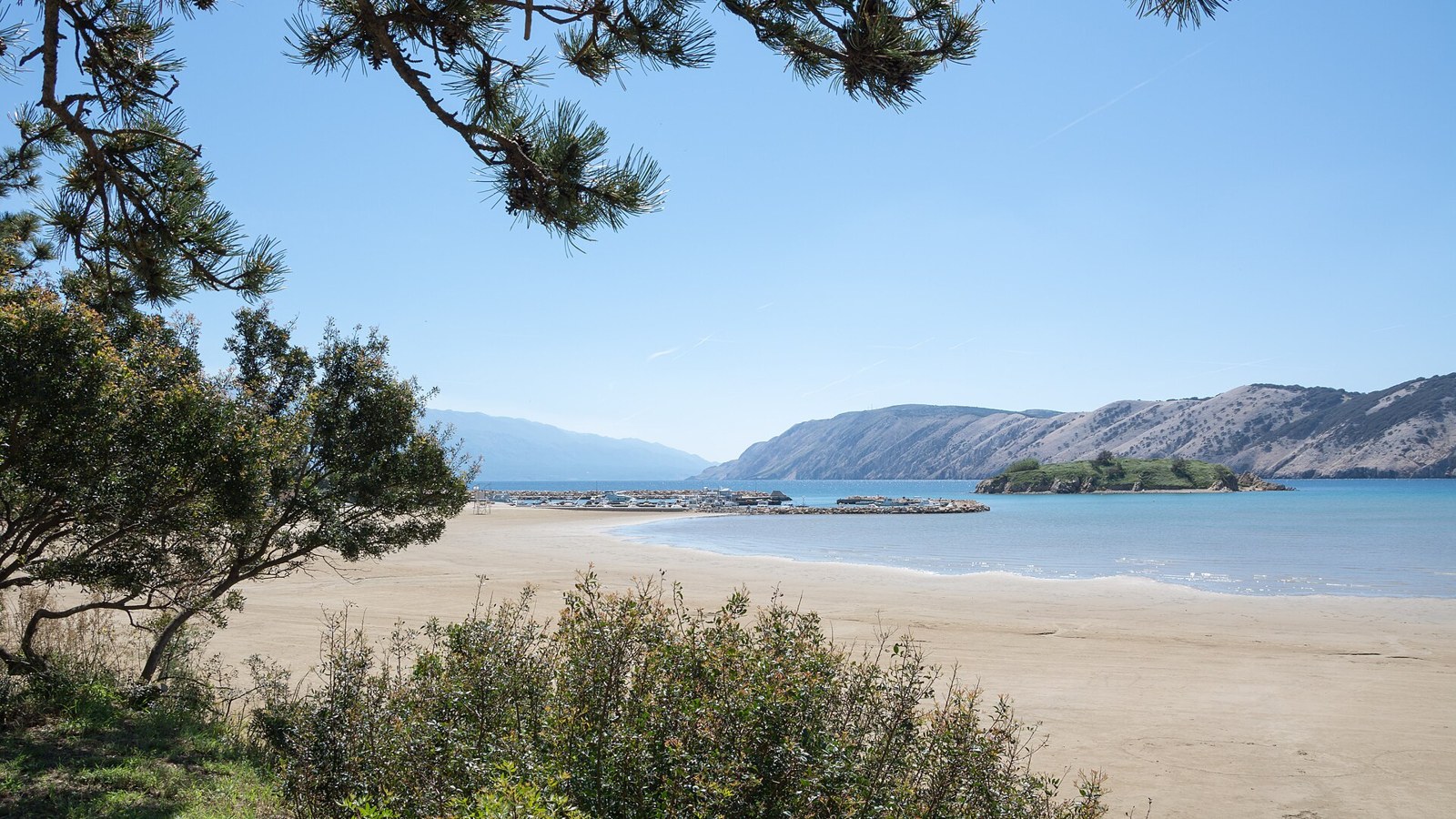
First, the truth about Croatian beaches: most are pebble, not sand, and that is fine, because the family winners are chosen for shallow entries, shade and clear water, not for sandcastles. The real sandy exceptions are Rajska Plaza on Rab (1.5 km of sand, knee-deep for a long way out, the toddler benchmark), Sunj on car-free Lopud, and Vela Przina on Korcula. Punta Rata in Brela is the best all-rounder within reach of Split, and Zlatni Rat is spectacular but deepens quickly, with currents at its tip. Croatia has no universal lifeguard service, so pick Blue Flag beaches and supervise as if the water were your own.
Croatia has over a thousand kilometres of island-dotted Adriatic coast and a national talent for naming every cove a beach. Families need a shorter list, filtered by what actually matters with children: how fast the water deepens, whether there is shade at midday, whether the shore hurts small feet, and how hard the place is to reach with a pushchair and a cool bag. Every beach below is described as it is, shore, depth and access included, using tourist-board and operator sources rather than review-site folklore. One warning repeated throughout: the Adriatic's famous clarity comes with pebbles and sea urchins, so water shoes earn their suitcase space on every beach in this guide.
The family shortlist
| Beach | Shore | Entry | Shade | Best for |
|---|---|---|---|---|
| Rajska Plaza, Lopar (Rab) | Sand | Extremely shallow for a long way out | Some pines; hire shade | Toddlers and weak swimmers |
| Punta Rata, Brela | Fine pebble, sandy in the water | Gentle, shallow | Dense pine forest | All-round family base near Split |
| Sunj, Lopud | Sand | Shallow for tens of metres | Limited; bring shade | Sand + a car-free island day |
| Vela Przina, Lumbarda (Korcula) | Sand | Gentle, shallow | Some; vineyards behind | Families based on Korcula |
| Sakarun, Dugi Otok | Fine light sand and pebble | Very gradual; about 3.5 m deep 250 m out | Pines at the back | A big shallow bay, minimal facilities |
| Zlatni Rat, Bol (Brac) | Fine pebble | Deepens fairly fast; currents at the tip | Pine forest behind | Older children and strong swimmers |
| Bacvice, Split | Sand and pebble | Shallow bay | Little natural shade | A city beach day, not an escape |
Rajska Plaza, Lopar: the toddler benchmark
Rajska Plaza ("Paradise Beach") is the beach Croatian families name first: 1.5 km of sand on the Lopar peninsula of Rab island, Blue Flag since 2003, with water so shallow that small children paddle a long way from shore and stay in their depth. The tourist board singles it out for families and weak swimmers, and the facilities match the billing: showers, toilets, hire loungers, cafes and the Aquagan water slides mid-beach. The honest costs are popularity and exposure: it gets busy in July and August, and the sand offers little natural shade, so the umbrella hire or a beach tent is part of the plan. Access is half the adventure: ferries from Stinica to Misnjak (about 15 minutes) or from Valbiska on Krk to Lopar (about 80 minutes), then a short drive across the island.
Punta Rata, Brela: the all-rounder
On the Makarska Riviera about an hour south of Split, Punta Rata wraps a headland in fine pebble that turns sandy under the water, with a gentle entry and the thing Brela does better than anywhere: a dense pine forest (protected since 1964) running down to the shore, so real shade exists all day. The Kamen Brela rock sits in the shallows offshore as the beach's landmark (look, do not climb; it is prohibited). Punta Rata is a long-running Blue Flag beach, first awarded in 1999, with lifeguards on duty in the busy season, and the flat promenade north towards Baska Voda is pushchair-friendly and lined with places to eat. If a family bases itself in one place on this coast, Brela is the pragmatic choice.
Sunj, Lopud: sand on a car-free island
Sunj, on the far side of Lopud in the Elaphiti islands, is the Dubrovnik area's genuine sandy beach: soft sand, and water shallow enough that you wade for tens of metres. Lopud has no cars; from the village harbour you cross the island on foot (20 to 30 minutes on a clear path) or by the little golf-cart taxis that meet the boats. The public ferry from Dubrovnik's Gruz port (Jadrolinija line 807) takes about 45 to 55 minutes, not the half hour some guides claim. Facilities at Sunj are a couple of seasonal beach bars and hire points, so bring water and shade for small children. As a day trip from Dubrovnik it is close to perfect: a boat ride, a walk through olive groves, and sand at the end of it.
Vela Przina, Lumbarda: Korcula's sand
Korcula's sandy beaches hide in Lumbarda, the village about 6 km from Korcula Town (local bus or a short taxi). Vela Przina, on the south side, is the island's largest sandy beach, backed by the Grk vineyards, with a shallow gentle entry and seasonal facilities. On Lumbarda's north side, Bilin Zal is a smaller sand bay (about 130 m) where you can wade roughly 100 m out. Either gives a Korcula-based family a proper sand day without a boat trip, and Lumbarda's konobas handle lunch. (Ignore older guides pointing you to "Punta Kriza" for this: that is a remote spot on the island's far west, not a family bus ride.)
Sakarun, Dugi Otok: the big quiet bay
Sakarun is an 800 m arc of pale sand and fine pebble on Dugi Otok's north-west coast, famous for water that stays shallow for an improbably long way (about 3.5 m deep even 250 m from shore) and for colours that look filtered. The trade for that space is effort and simplicity: reach it from Zadar by the car ferry to Brbinj (about 1 hour 40) or the catamaran to Bozava plus the seasonal shuttle, then the island road to Soline and a short walk. Facilities are a few seasonal beach bars and little else, and the pines at the back are your shade. Pack everything, including water, and it rewards you with the calmest big-family swim on this list.
Zlatni Rat, Bol: the icon, honestly
Zlatni Rat is Croatia's poster beach, a fine-pebble horn about 500 m long whose tip visibly shifts with the wind and currents, which is why no two postcards match. Families should know its real profile: the water deepens fairly fast for a headline beach, and currents converge around the tip, so the point itself is not a swimming place for children. What it does offer is lifeguarded, facility-complete (showers, hire, cafes, water sports) and backed by a pine forest, a short walk or tourist-train ride from Bol town. Getting there means a boat: the Jadrolinija ferry from Split to Supetar (about 50 minutes) plus 35 to 40 minutes across Brac by road, or the direct passenger catamaran from Split to Bol (about 65 minutes). There is no road from Split, whatever older versions of this article said. Come for the spectacle and swim on its flanks, and for toddlers choose Brela or Lopar instead.
Bacvice, Split: the city option
Bacvice is Split's official city beach, a sandy bay designated in 1919 with room for over 10,000 people, about 10 minutes on foot from the Old Town. Its fame is picigin, the acrobatic keep-the-ball-up game invented and still played in its knee-deep shallows, protected on Croatia's national register of intangible cultural heritage. As a family beach it is exactly what a city beach is: shallow, supervised in season, full of facilities and ice cream, and crowded, urban and short on shade. Use it happily on an arrival or departure day; do not plan the holiday around it. Note for your planning that Split's transport is buses only; the city has never had trams.
When to go: the sea temperature truth
| Month | Typical sea temperature | Family verdict |
|---|---|---|
| May | 17-19 C | Fresh. Hardy swimmers and short dips; beaches empty |
| June | 21-23 C | The sweet spot begins: warm enough, crowds still building |
| July-August | 24-26 C | Warmest water, fullest beaches, highest prices |
| September | 23-24 C | The family favourite: summer sea, September space |
| October | 20-21 C | Swimmable early in the month; many facilities closed |
Safety and water quality
- Lifeguards: Croatia has no universal lifeguard service. Busy Blue Flag beaches like Punta Rata, Rajska Plaza, Zlatni Rat and Bacvice have seasonal cover; Sakarun and Sunj are lighter. Supervise children as if there were none anywhere, because on the wrong beach there are none.
- Blue Flag, correctly understood: the flag (run by FEE, in Croatia with the Lijepa nasa association) certifies water quality, environmental management and safety provision, but its safety criterion does not guarantee a lifeguard on your beach. It is a good shortlisting tool, not a promise.
- Water quality: Croatia runs a real national bathing-water programme (results roughly every 15 days in season on the IZOR portal), and recent seasons have rated the overwhelming majority of tested beaches excellent, with none rated poor in the July 2026 round across 1,168 locations. The water is not the worry; depth and supervision are.
- Feet and sun: water shoes everywhere (sea urchins favour the rocky edges of even sandy bays), and treat midday shade as equipment: Brela and Zlatni Rat have pine forest, Rajska and Sunj largely do not.