
The nine experiences that define Alicante are the free climb to Santa Barbara Castle, the mosaic Explanada and Postiguet beach below it, the MARQ archaeological museum, the free MACA art museum in the old town, San Juan beach by tram, a boat to Tabarca island and its marine reserve, the Roman city of Lucentum, the Ocean Race museum in the port, and a rice lunch done the Alicante way. Everything is priced from the venues themselves, and two claims from the old version of this guide are corrected below, because both were wrong.
Correction one: flights. The previous version said Alicante-Elche Airport links directly to New York JFK and Miami. That is invented. Aena, which runs the airport, records a European short-haul network: in 2025 the biggest markets were the UK (about 6.6 million passengers), Germany, the Netherlands and Belgium, and the only non-European destinations served are Algiers, Oran, Casablanca and Istanbul. There are no scheduled flights to anywhere in the Americas. Correction two: the Hogueras festival is in June, not July (see the timing section below). One old claim does survive checking: the airport really is Spain's fifth-busiest by passengers, 19.95 million in 2025, but they arrive from Manchester, Gatwick and Amsterdam, not from across the Atlantic.
The nine at a glance
| Experience | Cost | Watch out for |
|---|---|---|
| Santa Barbara Castle | Free (lift EUR 2.70) | Closed 24 June; last entry 40 min before closing |
| Explanada and Postiguet beach | Free | Postiguet fills on summer weekends |
| MARQ archaeological museum | EUR 6 (EUR 3 Sundays) | Closed Mondays |
| MACA contemporary art museum | Free | Closed Mondays; Sunday mornings only |
| San Juan beach by TRAM | TRAM Zone A single EUR 1.50 | The beach is 2.9 km, plan your stop |
| Tabarca island | Boat about EUR 20 return | Seasonal, weather-dependent sailings |
| Lucentum Roman city | EUR 3 (or in the EUR 8 joint ticket) | Closed Mondays; almost no shade |
| The Ocean Race Museum | Free | Closed Mondays and Tuesdays |
| Mercado Central and a rice lunch | Market free; lunch varies | Market is mornings only, closed Sundays |
1. Santa Barbara Castle: the free fortress
Start at the top. The castle crowning Mount Benacantil, with origins in the Muslim era, is Alicante's defining monument, and entry is free, including the MUSA city museum inside its walls. The views do the talking: the bay, Tabarca on the horizon, the old town grid below.
Getting up is part of the experience, with three honest options. The lift, cut through the rock from opposite Postiguet beach on Avenida Juan Bautista Lafora, costs EUR 2.70 (free for retired pensioners with proof). A minibus from Plaza Puerta del Mar runs every 40 minutes at EUR 1.45 per trip. Or walk free, up through the Santa Cruz quarter and La Ereta Park, the route that earns the view. Hours stretch with the season: 10am to 6pm in winter, to 8pm in the shoulder months, and to 11pm from 17 June to 4 September. Note the closures: 24, 25 and 31 December, 1 and 6 January, and 24 June, for reasons the Hogueras section explains.
2. The Explanada and Postiguet: the city's front room
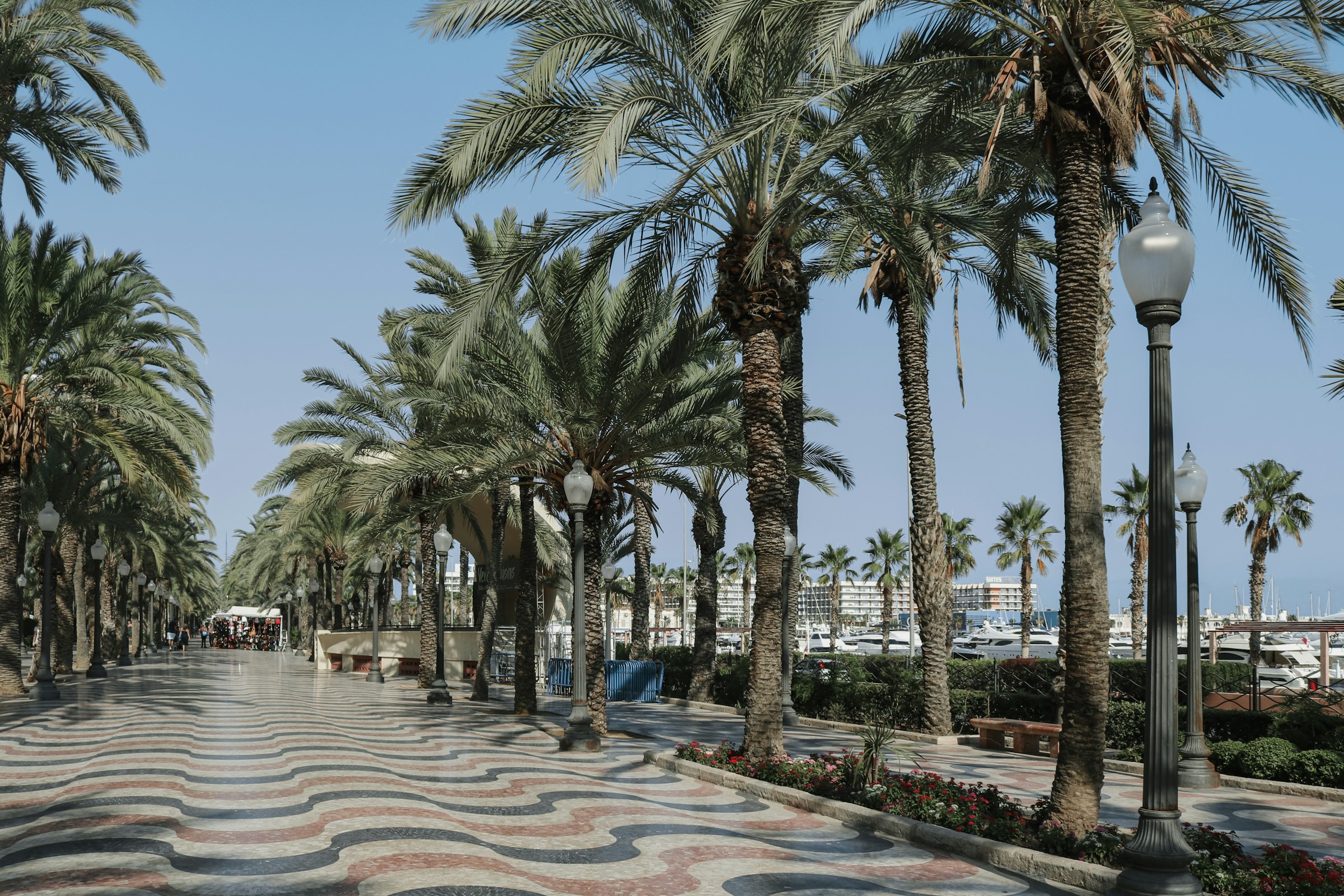
Descend to the waterfront and walk the Explanada de España, the promenade that runs along the port under four rows of palms. Its wave pattern is made of 6.5 million marble tiles in red, white and black, the figure published by Turespaña, Spain's national tourism portal. It is the city's evening ritual: slow walking, cafe terraces, market stalls.
At its end sits Playa del Postiguet, about 900 metres of fine sand directly under the castle, with lifeguards and full services. Postiguet's virtue is position, not wildness: you can swim in the middle of a sightseeing day and be back at a terrace in ten minutes. It fills on summer weekends; mornings are its best self.
3. MARQ: the museum that beat Europe's best
The MARQ, Alicante's provincial archaeological museum, is the rainy-day (or hot-afternoon) heavyweight. Housed in the renovated former Hospital de San Juan de Dios, its galleries run from prehistory to the modern era with three signature rooms on field, urban and underwater archaeology. In 2004 it won the European Museum of the Year Award, and it still shows.
General admission is EUR 6.00, dropping to EUR 3.00 on Sundays and public holidays, with under-8s free; the museum is closed on Mondays. The smart buy is the joint ticket at EUR 8.00, which adds the Lucentum and Illeta archaeological sites and the Almudaina Tower and stays valid for 30 days. The MARQ-Castillo TRAM station puts you at its door, at the foot of the castle hill.
4. MACA and the Santa Cruz quarter: art, then the climb
Five minutes away, the MACA contemporary art museum is free, and its building is half the story: the Casa de la Asegurada, which the museum describes as the oldest surviving civil building in the city, facing the Basilica of Santa Maria in the old town. Its collections, built around the Alicante artist Eusebio Sempere, cover 20th-century and contemporary art. Open Tuesday to Saturday 10am to 8pm, Sunday mornings, closed Mondays.
From its door, drift into the Barrio de Santa Cruz, the whitewashed quarter of steep, flower-hung lanes climbing the castle hill towards La Ereta Park. This is the Alicante of postcards before postcards: small houses, tiled shrines, neighbours' chairs in the street. Walk it up to the castle or down from it, slowly, ideally in the early morning or the golden hour before dinner.
5. San Juan beach: the big sand, by tram
When the beach itself is the plan, take the TRAM. Playa de San Juan is the city's resort beach: 2,900 metres long and 85 metres wide within the Alicante municipality (the 6 to 7 km figures online count the same sand continuing into El Campello as Muchavista), Blue Flag, open sea, promenade, sports areas and accessible points. Lines 4 and 5 run the length of it from the centre; a Zone A single has cost EUR 1.50 since the October 2026 fare revision.
The rhythm differs from Postiguet: come for hours, not a dip. The promenade's chiringuitos and the Golfe-adjacent northern end are calmer than the central stops. Combine it with Lucentum (below), which sits just inland from the Albufereta end.
6. Tabarca: the island and Spain's first marine reserve
Tabarca is the excursion that justifies a spare day. The only permanently inhabited island in the Valencian Community, it holds a small walled 18th-century village, built under Charles III for Genoese families ransomed from Tabarka in Tunisia, which is where the name came from. There are no cars; you walk it end to end, past the church, the Governor's House and the lighthouse, swimming from coves on both shores.
The water is the point. The sea around Tabarca was declared a marine reserve by order of 4 April 1986, the first marine reserve in Spain, and its Posidonia oceanica meadows keep it exceptionally clear, made for snorkelling. Boats from Alicante port take about 45 to 60 minutes (around EUR 20 return at operator prices); the crossing from Santa Pola, about 20 minutes by road from the city, is the short version at roughly 25 minutes. Sailings are seasonal and weather-dependent, fullest from June to September, so check the operator's timetable the day before.
7. Lucentum: the Roman city under the hill
Alicante did not start with the castle. On the Tossal de Manises hill above La Albufereta stands Lucentum, the excavated Iberian-Roman city that preceded it: streets, baths, forum remains and a Muslim cemetery layer on top, saved from development in the 1960s and run today by MARQ as an open-air archaeological park.
Entry is EUR 3.00 (EUR 1.50 on Sundays and holidays), or free inside the EUR 8.00 MARQ joint ticket; closed Mondays. There is almost no shade, and the site's published hours split around the midday heat, so go early or in the evening slot in summer. Pair it with the Albufereta and San Juan beaches on the same TRAM ride north.
8. The Ocean Race Museum: Alicante's ocean obsession
Down at the port's Muelle de Levante sits the Museo The Ocean Race, the only museum in the world dedicated to the round-the-world sailing race that has run since 1973 and has started from Alicante since 2008. Entry is free (it was renamed when the race dropped the Volvo title), and the paid extras, a sailing simulator and the chance to board the Brasil 1 yacht from the 2005-06 race, are priced inside.
Two practical notes: the museum is closed on Mondays and Tuesdays, and its hours have changed patterns recently, so check museotheoceanrace.com for the day you plan. It pairs naturally with the Explanada stroll and a harbour-front lunch.
9. Mercado Central and the rice: eat the city's signature
Alicante brands itself Ciudad del Arroz, City of Rice, and was Spanish Capital of Gastronomy 2025; rice here is not a dish, it is the civic identity. Start at the Mercado Central on Avenida Alfonso X el Sabio, the city's great food market: opened in November 1921 and officially inaugurated on 12 November 1922, two floors of fish, produce, meat and deli stalls, open mornings only and closed Sundays. Go before noon, buy nothing you cannot carry, and let it set your appetite.
Then eat the rice properly, at lunch, which is when Alicante eats it. The icon is arroz a banda: the City Council's own gastronomy guide explains that it began in fishermen's kitchens, where the rice was cooked separately (a banda, on the side) in the broth from the fish, which was eaten as its own course. Its companion is arroz del senyoret, seafood peeled and fish boned so the young master could eat without getting his hands dirty. Judge any version by the socarrat, the caramelised crust at the base of the pan, which the tourism board treats as the mark of a well-made Alicante rice.
Timing it right: Hogueras is in June
If you can choose your dates, choose 20 to 24 June. The Hogueras de San Juan, a Festival of International Tourist Interest, is Alicante's great fiesta: every district plants a huge satirical monument (la plantà, through 20 June), mascletà firecracker displays shake Plaza de los Luceros daily at 2pm sharp, flower offerings fill the streets, and at midnight on 24 June a palm-tree firework bursts from the castle summit and every monument in the city is burned in la cremà, after which firefighters hose the crowds down in the banyà. The castle is closed that day; the whole city is in the street instead. A fireworks contest then fires nightly from beside Postiguet, 25 to 29 June.
For 2027 the dates and skeleton are fixed as every year, the official monuments will be planted by the morning of 20 and 21 June, and the detailed day-by-day programme is published nearer the fiesta. Book beds early; this is the city's fullest week.
The honest detour: Daya Vieja's palm
Older versions of this guide listed a "hidden spiral palm-tree walkway" in Daya Vieja as an Alicante gem. The structure is real; the framing was not. Daya Vieja is a small village in the Vega Baja, south of the city towards Torrevieja, and in its main square a three-storey steel spiral ramp, a 2011 work called Variation Guggenheim 3 by architect Joaquín Alvado Bañón, wraps a centuries-old palm (the project record describes six arms) and ends in a lookout over the square. It was built as a support corset, mostly funded by the provincial council, to stop the famous palm collapsing, and the provincial cultural institute runs guided architecture visits to it.
Verdict: a genuine curiosity if you are driving the Vega Baja, no entry product, just a public square. It is not an Alicante city sight, and no city itinerary should pretend otherwise.
Getting there and around: the honest version
Alicante-Elche Miguel Hernández Airport sits 9 km south-west of the city with one terminal. From the Americas you connect: the practical routings are via Madrid or Barcelona on the same ticket, or a European hub such as London, Amsterdam or Frankfurt, which is exactly the traffic the airport exists for. From Madrid, the train competes with the connection: OUIGO publishes 2 hours 20 minutes Madrid-Chamartín to Alicante Terminal, Renfe's AVE and Avlo run the same route, long-distance tickets include the Combinado Cercanías covering the TRAM, and Renfe's Euromed trains run north to Valencia and Barcelona (our Gothic Quarter guide covers that end of the line). For a wider route that includes Alicante, see our Spain 7-day itinerary.
From the airport, the C6 bus is the public link: it runs every day of the year to the centre, stopping at the railway station, Alfonso el Sabio and Luceros for TRAM connections, at EUR 4.60 for the operator's published single. Taxis are metered with a EUR 4.25 airport supplement; no authority publishes a flat city fare, so treat any quoted set price with suspicion. There is no train or tram station at the airport: a rail link with an airport station, part of the Variante de Torrellano project, had its study definitively approved in October 2026 and is in design, with no official opening date. Do not let any guide tell you otherwise.
In the city, the TRAM does the work. Luceros, Mercado and MARQ-Castillo are the central stations; line 1 runs to Benidorm, where line 9 continues to Dénia past Altea and Calp; lines 4 and 5 serve San Juan beach. City-zone fares were revised on 1 October 2026 (Zone A single EUR 1.50, a new unlimited monthly Mobilis at EUR 35, under-14s free), and fares rise by zones on the longer rides, so check FGV's fare page for the Benidorm run.
When to come: the climate, without the slogan
AEMET's climate normals for Alicante (1991-2020) describe a dry Mediterranean city: 285 mm of rain a year across about 37 rain days, concentrated in autumn (October is the wettest month), a January mean of 11.8 degrees with average highs of 17, and an August mean of 26.4 with average highs of 31. AEMET's airport observatory normals record around 2,950 hours of sunshine a year. The "320 days of sun" line in tourism promotion is a slogan, not a measurement; the measured numbers are already generous enough.
Practically: late spring and September give warm sea and bearable sightseeing; July and August demand the local rhythm (castle early, museum or siesta at midday, beach and Explanada in the evening); and June adds the Hogueras. Entry for most visitors is Schengen-standard: EES has been fully operational since April 2026 for non-EU travellers, and ETIAS is not in operation, with no official launch date, so ignore any site offering to sell you one.
Sources
- Aena: Alicante-Elche Airport presentation, business data and 2025 traffic statistics; airport bus and taxi pages: aena.es
- Alicante City and Beach Tourism: Santa Barbara Castle, Hogueras de San Juan, gastronomy guides: alicanteturismo.com
- MARQ Museum, official tariffs (MARQ, Lucentum, joint ticket): marqalicante.com
- Turespaña (Spain.info): Explanada de España, 6.5 million tiles
- Government of Spain (La Moncloa / Agriculture Ministry): Tabarca marine reserve, declared 4 April 1986, first in Spain
- FGV / Generalitat Valenciana and Ayuntamiento de Alicante: TRAM network lines and the 1 October 2026 fare revision
- Renfe and OUIGO: Madrid to Alicante services (OUIGO publishes 2h20); Renfe Euromed corridor
- AEMET: climate normals for Alicante (1991-2020) and the airport observatory sunshine record
- Diputación de Alicante (IAC Juan Gil-Albert): Daya Vieja, Variation Guggenheim 3 guided-visit notes