
A good 7-day Jordan itinerary is Amman, two full days in Petra, two days in Wadi Rum, a Dead Sea day and Amman again, and it runs on numbers you can check: Petra tickets at 50 JOD for one day, 55 for two and 60 for three from the Petra authority; the Jordan Pass at 70 to 80 JOD, worth it if you buy before arrival and stay at least two nights; one JETT bus a day from Amman to Petra; and no official price anywhere for a Wadi Rum camp, because camps are private. One famous thing is not on the itinerary at all: the tomb excavated beneath the Treasury in 2024 is a closed research dig, and no ticket on earth includes it.
The previous version of this itinerary sold readers a chamber they could not enter. It promised that a "2-day Petra Pass" costing US$70 covered "the newly opened sealed chamber" under the Treasury, quoted bus fares in dollars that no operator publishes, priced "budget" desert camps at about US$190 a night from market data that does not exist, and moved travellers between cities on a "Rum Bus" that is not a real product. It also dated a second discovery, a satellite-mapped facade, to 2024; that survey was published in 2016 and its find is still unexcavated. This rebuild keeps the 7-day shape, which is a good one, and replaces every invented element with the published fact.
Petra tickets and the Jordan Pass, at the published prices
| Ticket | Price | What the authority says |
|---|---|---|
| Petra, 1 day | 50 JOD | Visitor staying at least one night in Jordan; children under 12 free |
| Petra, 2 days | 55 JOD | Same basis; tickets are non-refundable and valid only for the period printed |
| Petra, 3 days | 60 JOD | Same basis |
| Petra, 1 day, day-tripper | 90 JOD | For visitors not staying a night in Jordan |
| Jordan Pass Wanderer / Explorer / Expert | 70 / 75 / 80 JOD | Includes 1 / 2 / 3 days in Petra plus 40-plus other sites, including Jerash and Wadi Rum entry |
| Petra by Night | 30 JOD | Separate ticket, Sunday to Thursday, 8:30 to 10:30 pm; a valid daytime ticket is also required |
The pass arithmetic is the first decision of the trip. Paid separately, a single-entry visa on arrival costs 40 JOD and Petra alone costs 50 to 60 JOD, which is 90 to 100 JOD before you have seen Jerash or entered Wadi Rum. The Jordan Pass beats that on its own, but only under its two conditions, stated on the pass site itself: buy it before you arrive, and stay a minimum of two whole nights (three days), which is what triggers the visa-fee waiver, checked when you leave. A two-night-or-more itinerary like this one qualifies; a flying visit does not. Inside Petra, the practicalities are simple: the site opens at 06:00 and closes at 18:00 in summer and 16:00 in winter, the multi-day tickets above are the whole of the pricing structure, and the only extras the authority itself prices are optional ones such as the golf cart. Everything else you will be offered at the gate is a private service, priced by the person offering it.
The tomb beneath the Treasury: the real story
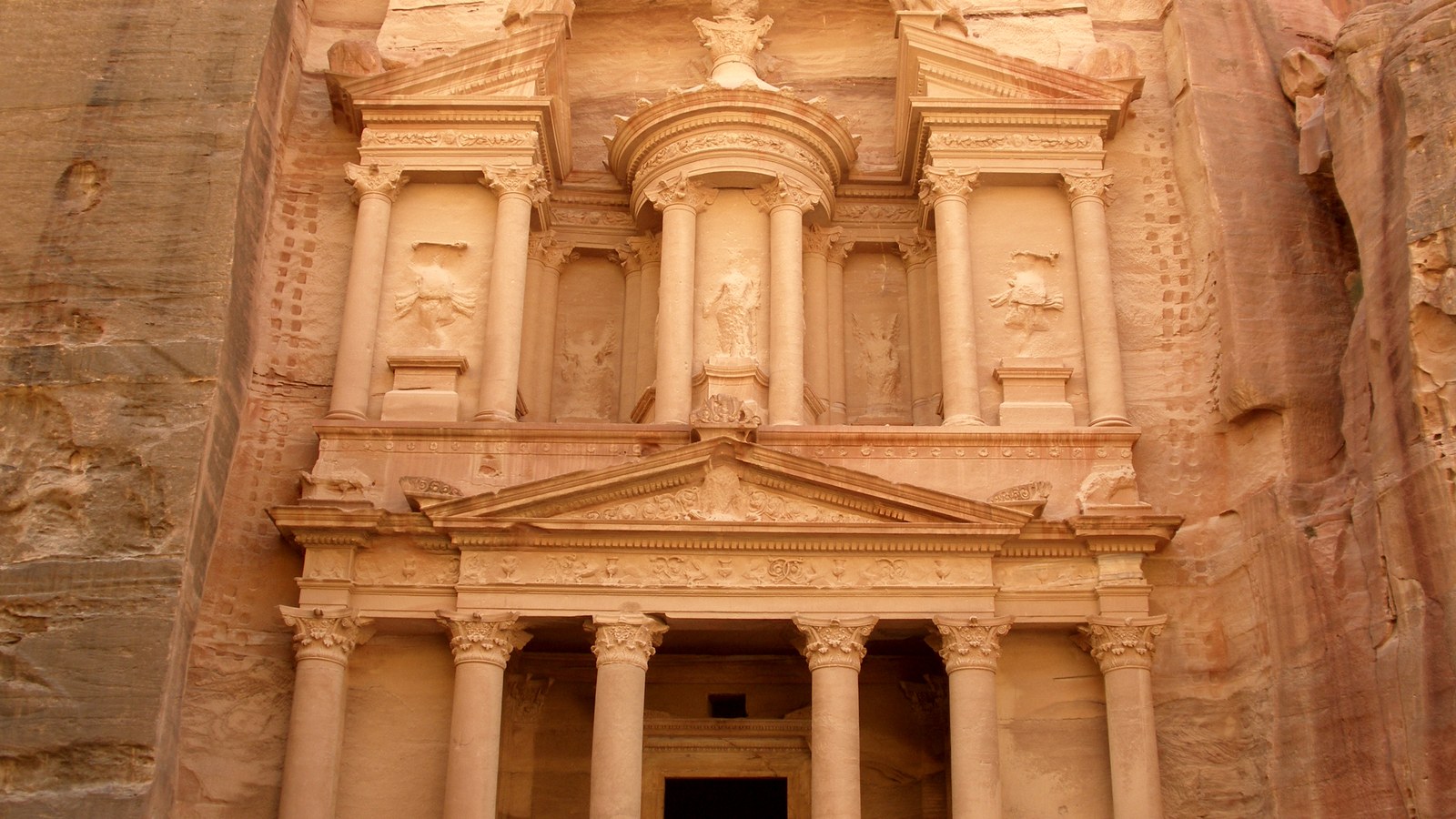
In October 2024, Jordan announced a genuinely exciting find. Beneath the courtyard in front of the Treasury, in a tomb catalogued as 62C, archaeologists excavated 12 skeletons with grave goods of bronze, iron and ceramic, one individual grasping a broken ceramic jug that the world's press promptly christened a "holy grail" chalice. The burials date to about the 1st century BC to the 1st century AD. The team was Jordanian and international in the way Petra research usually is: the Department of Antiquities, the Petra authority and the Petra National Trust, with ACOR, the American Center of Research, and the University of St Andrews, where geophysicist Richard Bates's remote sensing located the voids and Pearce Paul Creasman led the excavation side.
Three facts about it matter for your itinerary, and all three contradict what this article used to say. First, the tomb was not discovered in 2024: the Department of Antiquities found it in 2003 and left it unexcavated for two decades. The 2024 return was driven as much by engineering as archaeology, since the radar survey was commissioned to understand the ground beneath the Treasury plaza and the Siq exit ahead of flood-water diversion works for one of the world's most flood-vulnerable sites. Second, nothing about it is visitable: it is a working research excavation, included in no ticket, on no route, and no authoritative source reports any of the 2024 finds on public display; analysis of the remains was still ongoing, with the excavators themselves noting that funding was needed even to complete the work. Third, what you can do is stand in the Treasury courtyard, look at the most famous facade in Jordan, and know that a Nabataean family tomb lies beneath the plaza at your feet. That is less than a chamber tour. It is also true, and it costs nothing extra.
The companion "discovery" in the old article deserves the same treatment in one paragraph. A large monumental platform south of the city centre was indeed found with satellite imagery, by Sarah Parcak and Christopher Tuttle, and published in 2016; pottery dated it to the mid-2nd century BC. It is not a facade, it is not on a western ridge, it is not from 2024, and it is not excavated or visitable either. Petra still holds secrets. It simply does not sell tickets to them.
The 7 days
Day 1: Arrive in Amman, start with the museum
Fly into Queen Alia International Airport. The airport express bus, run by Sariyah, leaves every half hour for the city; its fare is not published online, so pay it on the day rather than trusting a figure in a guide, this one included. With the afternoon, go to the Jordan Museum, whose headline treasures the Tourism Board itself names: the Dead Sea Scrolls, and the Ain Ghazal statues, among the oldest human statues ever made, at about 9,000 years old. They are the right first hour in Jordan: everything after them, Nabataean, Roman, Byzantine, Islamic, has a context. Sleep in Amman.
Day 2: The JETT bus to Petra, and the walk to the Treasury
The bus pattern is fixed and early: JETT's daily service leaves Abdali at 06:30 and the 7th Circle at 07:00, and reaches Petra at about 10:00 to 10:30, with the return bus at 17:00 for those doing it as a day trip, which you are not. JETT sells seats through its own booking site and publishes its fares only inside that booking flow, so book there and ignore any fare quoted elsewhere, including the day-tour price JETT's tour arm charges, which is a different product. Check in at Wadi Musa, the town above the site, then walk in: the visitor centre, the Siq, the long shaded slot canyon that is half the experience, and the Treasury at the end of it, with the tomb of 2024 beneath the courtyard you are standing in. Continue down the Street of Facades to the theatre and the Royal Tombs as the afternoon light comes on. If your second night falls on a Sunday to Thursday, Petra by Night (30 JOD, 8:30 to 10:30 pm, bought on site, daytime ticket required) is tonight or tomorrow.
Day 3: Petra properly, the Monastery and the high places
Day two in Petra is why the 55 JOD two-day ticket, or the Explorer pass, exists. Enter early again, walk the main trail the length of the basin, and climb the long stairway cut into the mountain to Ad Deir, the Monastery, the largest facade in Petra and the one day-trippers never reach. Add the High Place of Sacrifice for the panorama over the basin and, on the way down or the way back, the Royal Tombs at close range. Build in Little Petra as well if legs allow: the smaller gorge at Siq al-Barid, for which the Petra authority sells no separate ticket. Sleep a second night in Wadi Musa.
Day 4: South to Wadi Rum, jeep tour and a camp night
Petra to Wadi Rum is 1.5 to 2 hours by road, about 107 km on the Tourism Board's figures, and the leg with no public timetable: there is no scheduled bus product to book, so the transfer is arranged privately, usually by your camp or your Wadi Musa hotel, which is the standard way everyone does it. At the Rum Visitor Centre you pay the protected area's entry fee (the Jordan Pass includes Rum entry) and meet your camp's driver. From there the programme is your camp's: a jeep tour through the valley's gorges, arches and inscriptions, dinner, and a night in the desert. On prices, this guide will tell you the unfashionable truth: no authority publishes camp tariffs, camps sell complete programmes at their own prices, and the honest comparison is programme against programme, jeep hours, meals and tent type included, never a nightly number quoted from nowhere.
Day 5: Rum morning, then back to Amman
Take the morning in the desert, a sunrise walk or a second short tour, then travel back to Amman by the road you came on, in a transfer arranged the same way as the way in. The Desert Highway run from the south to Amman is the long leg of the trip; the Tourism Board puts Amman to Petra at about 3 hours and 235 km, and Rum lies beyond Petra. An evening arrival in Amman, a downtown dinner and a hammam if you find one open are the right pace for the day.
Day 6: The Dead Sea, as a day trip
The Dead Sea is about an hour from Amman on the Tourism Board's figures, close enough to do properly as a day trip. The shore here is, in the Tourism Board's words, 427 metres below sea level, the lowest land on Earth. Day visitors use the public Amman Tourist Beach, which the Tourism Board names for exactly this purpose, or buy a resort day pass at prices each resort sets and no authority publishes, so check the resort's own page. Float, coat yourself in the mud if you are so inclined, and be back in Amman for the evening.
Day 7: The Citadel and the Roman Theatre, then out
Keep the last morning for Amman's own antiquities, which most itineraries skip and should not. The Citadel sits on the highest hill in the city, in the Tourism Board's description, with the Temple of Hercules and the Umayyad Palace on it and the whole of Amman's hills spread below. Below it, the Roman Theatre is carved into the hillside in the city centre. Then to the airport by taxi or the airport bus, and out, with the Jordan Pass's visa waiver verified at departure exactly as its conditions describe.
When to go, briefly
The standard guidance, which tour operators and guidebooks share, is spring and autumn for Petra and the desert: milder days for the Monastery climb and bearable nights under canvas, against summer heat in the basin and genuinely cold desert nights in mid-winter. This guide prints no temperature table, because no official Jordanian source publishes one for Petra, and invented precision is how the old version of this article went wrong. What is checkable, use: the site's own opening hours shorten in winter (06:00 to 16:00), Petra by Night runs five nights a week, and the two-day ticket exists precisely because one winter day is too short for this site.
Sources
- Petra Development and Tourism Region Authority: ticketing terms and prices (50 / 55 / 60 JOD, 90 JOD day-tripper, children under 12 free, hours 06:00 to 16:00 and 18:00): petrapass.pdtra.gov.jo, visitpetra.jo
- Jordan Pass: tiers (Wanderer 70, Explorer 75, Expert 80 JOD), 40-plus sites including Jerash and Wadi Rum, visa-waiver conditions (buy before arrival, stay a minimum of two whole nights): jordanpass.jo
- Petra by Night: 30 JOD, Sunday to Thursday, valid daytime ticket required: petrabynight.jo
- University of St Andrews and ACOR: the 2024 excavation of tomb 62C beneath the Treasury courtyard (announced 15 October 2024), the 2003 discovery, and the flood-diversion survey context: st-andrews.ac.uk, acorjordan.org
- Parcak and Tuttle, Bulletin of the American Schools of Oriental Research 375 (2016): the satellite-identified monumental platform south of Petra's city centre
- Jordan Tourism Board: JETT bus pattern (Abdali 06:30, 7th Circle 07:00, return 17:00), road distances and times, the Jordan Museum and Citadel descriptions, and the Dead Sea at 427 metres below sea level: international.visitjordan.com
- JETT: network and online booking (fares published inside the booking flow only): jett.com.jo; Sariyah Airport Express: half-hourly airport bus: sariyahexpress.com