
You cannot climb Mount Toubkal on your own: a licensed local guide has been mandatory on the summit route since 2019, and officials check passports and guide credentials at control points on the trail. Entry to Morocco itself is the easy part (visa-free for 90 days for US, UK and EU citizens), there is no park entry fee, and the standard trip takes 2 days from Imlil: up to the refuges at 3,207 m on day one, the 4,167 m summit and all the way back down on day two. Go in spring or autumn unless you are equipped for winter mountaineering.
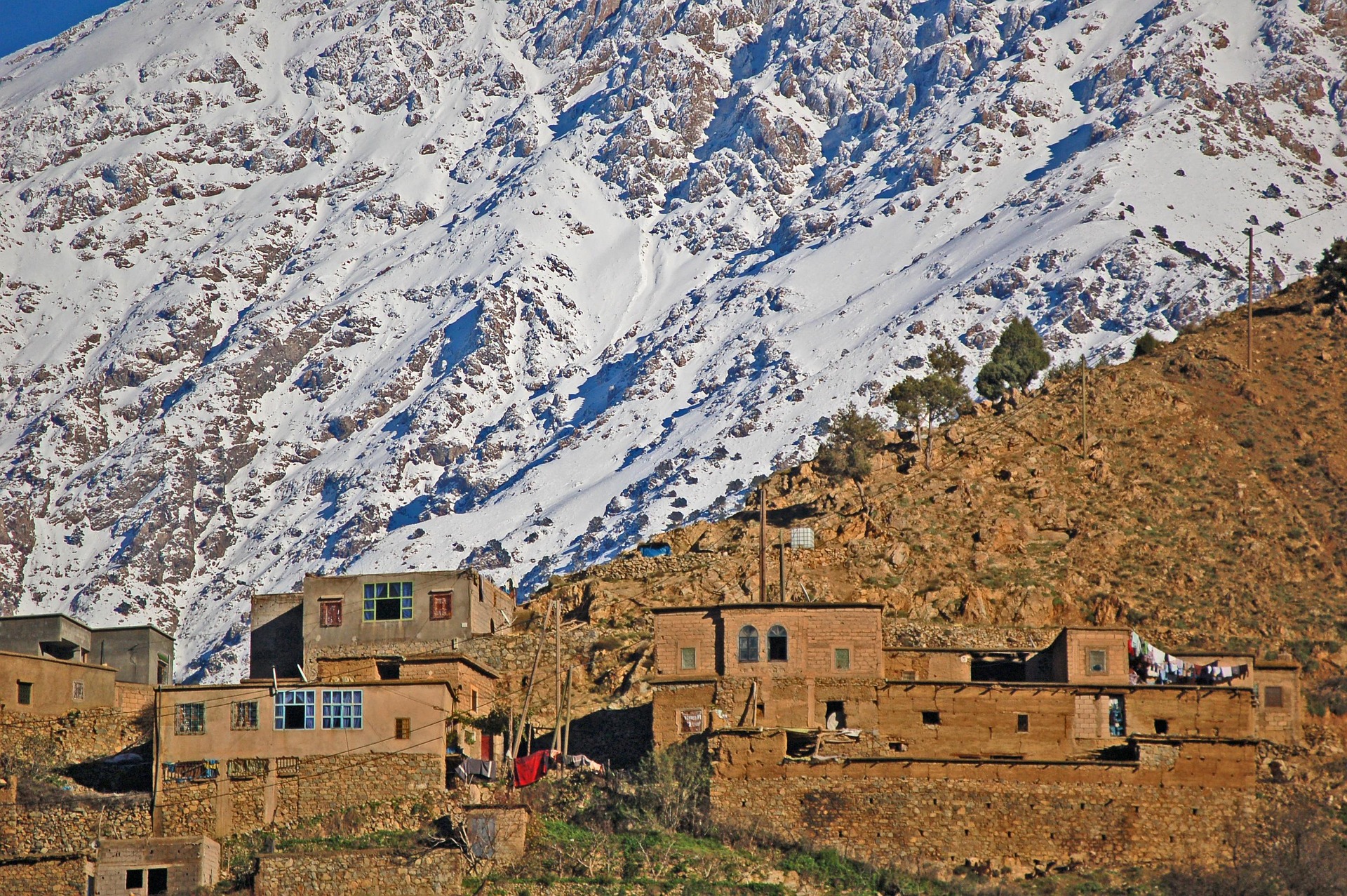
The High Atlas is North Africa's great mountain wall, rising an hour and a half from Marrakech to the highest summit in the region. Jebel Toubkal (4,167 m) is its famous peak, but the range also holds the M'Goun massif, the Ait Bouguemez valley and dozens of Berber villages linked by mule tracks. This guide covers the rules as they actually are in 2026, the Toubkal route stage by stage, the quieter M'Goun traverse, and what everything costs, checked against official entry guidance, the refuge operators and the trekking organisations that work on the mountain. If you are pairing the trek with time elsewhere in the country, our Morocco beyond Marrakech guide covers the regions most visitors miss.
The Atlas at a glance
| Question | Answer |
|---|---|
| Highest peak | Jebel Toubkal, 4,167 m, the highest summit in North Africa |
| Can I trek independently? | No. A licensed local guide is mandatory on the Toubkal route, with passport checks at trail checkpoints. There is no park entry fee |
| Visa | None for US, UK and EU citizens: 90 days visa-free. Get the entry stamp on arrival |
| Standard Toubkal trip | 2 days from Imlil (1,740 m): refuges at 3,207 m, then summit and descend the same day. About 28 to 30 km return |
| Best seasons | April to early June and September to October. Winter (about November to April) is snow and ice: crampons, ice axe, winter skills |
| Typical cost | 2-day guided packages from Marrakech run about 93 to 185 euros per person, operator-published |
First, the rules: visas and the guide law
Visas are a non-issue. US, UK and EU citizens enter Morocco visa-free for up to 90 days for tourism: no application, no form, no fee, just a passport stamp on arrival (make sure you actually receive the stamp, because leaving without one causes problems). A passport with 6 months' validity is the safe standard to carry. Ignore any older guide that walks you through a visa application for Morocco: the process it describes does not exist for these passports. Extensions beyond 90 days are requested inside Morocco at a police station.
The guide rule is real, and it is the law of the mountain. After the December 2018 murders of two Scandinavian tourists near Imlil, Morocco tightened control of the Toubkal area. Since 2019, trekking the summit route requires a licensed local mountain guide, even for a short day hike, and the trail is checkpointed: officials record passport details and verify your guide's credentials at control points including Imlil, Sidi Chamharouch and the refuges. Camping wild on the mountain is no longer possible; you sleep in villages or refuges. There is, however, no park entry fee: the checkpoints are identity and guide checks, not ticket gates, and the word "permit" on some tour pages is marketing, not a document you buy.
In practice you book the whole thing in one step: a licensed guide (directly through the guides' network in Imlil or via a reputable trekking company) assembles the mule, the muleteer and, on longer treks, a cook. You do not need to negotiate each piece separately unless you want to.
Climbing Toubkal: the route stage by stage
Almost every Toubkal climb follows the South Cirque route from Imlil, and its shape explains both the mountain's popularity and its main risk: the altitude gain is fast.
| Stage | Elevation | What it involves |
|---|---|---|
| Marrakech to Imlil | 1,740 m | About 64 km, roughly 1.5 hours by road via Asni |
| Imlil to Aremd | About 1,900 m | The first village above Imlil, on a clear mule track |
| Aremd to Sidi Chamharouch | About 2,310 m | A shrine village and the usual tea and lunch stop; only Muslims may cross the bridge to the shrine itself |
| Chamharouch to the refuges | 3,207 m | Day one totals 5 to 6 hours of walking and about 1,500 m of ascent |
| Summit day | 4,167 m | 3 to 4 hours up (about 960 m of ascent), then the long descent past the refuges to Imlil: 9 to 10 hours of walking in total |
Two refuges sit side by side at 3,207 m. The Refuge du Toubkal (the Neltner refuge, run by the French alpine club's Casablanca section) was built in 1938, sleeps 89 in five dormitories and is staffed all year; Les Mouflons next door is the private alternative. Both serve dinner and breakfast, both are booked solid in peak season, and both are where the summit bid starts before dawn. The summit itself is a steep scree and rock climb to a metal tripod marker, with views on a clear morning to the Sahara's edge one way and the Atlantic plain the other.
The honest altitude warning. The standard 2-day trip sleeps at 3,207 m on the first night after starting at 1,740 m. CDC high-altitude guidance advises against sleeping above 2,750 m on day one and gaining more than 500 m a day of sleeping altitude after that, which this itinerary plainly exceeds, and altitude sickness on Toubkal is correspondingly common. No percentage risk figure exists, whatever older guides claim. The mitigations are simple: sleep a night in Imlil first (or take the 3-day version with a gentler build), walk slowly, drink, tell your guide about symptoms early, and treat turning around as a normal outcome, not a failure. Guides see it every week.
Winter is a different mountain. From about November to April the summit routes carry snow and ice, crampons and an ice axe are required (both rentable in Imlil), and the climb becomes a winter mountaineering day for people with the skills to match. The refuges stay open year-round, and a clear winter summit is magnificent, but it is not the summer trek with extra clothing.
More time: the Toubkal circuit and M'Goun
The 6-day Toubkal circuit
If you have a week, the circuit beats the up-and-down: over the Tizi Likemt pass (3,555 m) to the village of Amsouzert, up to Lake Ifni (about 2,300 m, the only large lake in the High Atlas), then over the Tizi n'Ouanoums (3,664 m) to the refuges and the summit, roughly 65 to 70 km in 6 days, running May to October. It acclimatises properly by design, which makes the summit day easier than the 2-day version despite the extra distance.
M'Goun and Ait Bouguemez
The Central High Atlas offers the wilder alternative. Jebel M'Goun (4,071 m) is the highest summit of the central range, approached from the Ait Bouguemez, the "Happy Valley", about 5 hours' drive from Marrakech, where treks sleep in gites d'etape (village guesthouses) rather than refuges. A typical traverse runs from the valley through Azib Ikiss (2,300 m), over the Tizi n'Oughri area to the high Tarkeddit plateau (2,900 m), up M'Goun, and out over the Tizi n'Ait Imi (2,905 m), 4 to 6 days depending on the variant, in season from spring (April or May) to October. The gorges of the Tessaout and Arous rivers are the other classic walk here, and in early summer their river crossings are part of the adventure (check conditions locally, because routes follow the water). There is no Toubkal-style checkpoint regime in this valley, but you still trek with a local guide and mule team, arranged in Tabant, the valley's main village.
Shorter Atlas options
Not everyone needs a summit. The Ourika valley, about an hour from Marrakech, leads to Setti Fatma and its chain of waterfalls on a straightforward day hike. At the western end of the Anti-Atlas, Jebel Siroua (3,305 m) rises above Taliouine, Morocco's saffron town, a quieter 2 to 3 day trekking area. And around Tafraoute, the Anti-Atlas granite boulders and painted rocks make easy walking country paired with the Ameln valley. All three work as add-ons to a Marrakech stay when the Toubkal weather window closes.
When to go
Two main windows dominate. April to early June brings wildflowers, running water, snow retreating to the highest faces and comfortable valley temperatures. September and October are the connoisseur's months: stable weather, clear skies, harvest time in the valleys and, by November, Marrakech itself at its best (it is one of our best places to visit in November). High summer (July and August) is trekable on Toubkal but hot on the approaches, with afternoon thunderstorms a real pattern; winter (about November to April) is the mountaineering season described above. Rather than a fake precision weather table, work on this rule: the higher you sleep, the bigger the swing, and you pack for below freezing at the refuges in every month of the year.
One piece of recent history belongs in any honest guide. The earthquake of 8 September 2023 (magnitude 6.8, epicentre near Ighil in Al Haouz province) devastated parts of this region and killed more than 2,900 people. Imlil itself was far less damaged than the remote villages, with road and power restored within days, and trekking has operated normally since; reconstruction in the wider province continued through 2025. Your guide fees and gite stays are part of that recovery economy, which is one more reason to book locally.
Costs and logistics
| Item | Typical cost | Notes |
|---|---|---|
| 2-day guided Toubkal package from Marrakech | About 93 to 185 euros per person | Operator-published range; usually includes transfers, guide, mule, refuge night and meals on the mountain. Check what is excluded (drinks, tips, equipment rental) |
| Shared grand taxi, Marrakech to Imlil | 50 to 70 MAD per seat | Fill-and-go from the taxi stand; whole taxi 250 to 500 MAD |
| Private transfer | 600 to 900 MAD per vehicle | Booked through hotels and trekking companies |
| Park entry / permit | None | Checkpoints are ID and guide checks, not tickets |
Three logistics facts save trips. First, no bus reaches Imlil: CTM and Supratours stop at Asni, 17 km short, so it is taxi or transfer for the last stretch. Second, there is no ATM in Imlil and the mountains run on cash: draw dirhams in Marrakech, in small notes. Third, mobile coverage is decent on the main route but not guaranteed on the summit ridge; your guide is the communications plan. Guides, muleteers and refuge staff are tipped as a matter of custom; ask your operator what the current local norm is and budget for it rather than guessing at the trailhead.
Safety and practical notes
- Emergency numbers (Morocco): police 19 in towns, Royal Gendarmerie 177 (the rural force, the one that matters in the mountains), fire and ambulance 15, and 112 works on mobile phones. Mountain rescue runs through guides, refuges and the gendarmerie; there is no guaranteed helicopter service, which is why insurance with high-altitude evacuation cover is worth checking properly before a summit trek.
- Altitude, again: the single biggest medical issue on Toubkal is the fast ascent profile. Build in the Imlil night, and read the CDC guidance linked below before choosing the 2-day version.
- Culture: the Atlas villages are Amazigh (Berber) communities and conservative in dress and custom; ask before photographing people, dress modestly in villages, and never cross to the Chamharouch shrine unless you are Muslim. During Ramadan, guiding and mule services still operate but meals shift to after dark; confirm arrangements with your operator and expect a slower rhythm.
- Water and food: refuge dinners are generous (tagine, bread, soup); carry treatment or buy bottled water on the route rather than drinking from streams near villages and grazing areas.