
Most pages get the date wrong. The astronomical winter solstice falls on Monday 21 December 2026 at 20:50 GMT, after sunset, so English Heritage holds its stonehenge winter solstice 2026 gathering on the morning of Tuesday 22 December 2026, when the sun rises at 08:09 over the stones. If you turn up on 21 December, you will miss it. This guide gives you the full morning timeline, the parking and bus arrangements, the rules, what actually happens as the sun comes up, and a plan for the rest of the day.
The winter solstice is the shortest day of the year and the longest night in the northern hemisphere, and the gathering at Stonehenge is the most famous way to mark it in Britain. Entry to the stones is free, with no ticket and no booking, but parking must be pre-booked and the car park opens at 05:15, so the morning needs planning. The sections below cover the timeline, how to get there with or without a car, the driving routes for each direction, the rules inside the stone circle, what to wear for a December dawn, and why midwinter mattered more than midsummer to the builders. December is the busiest month for festive travel, so if you want more December trips, our Christmas in Europe guide and our best Christmas markets in the UK pair well with a solstice morning.
Why the Stonehenge winter solstice gathering is on 22 December, not 21 December
The confusion comes from two different dates. The astronomical solstice in 2026 falls on Monday 21 December at 20:50 GMT, which is 8:50pm in the UK. That is after sunset in Britain, so the sun has already set on the shortest day before the solstice moment itself arrives. The first sunrise after the solstice is therefore the morning of Tuesday 22 December, at 08:09, and that is the morning English Heritage opens the stones for its managed open access gathering. The stonehenge winter solstice 2026 gathering is a sunrise event, and the sunrise that follows the solstice falls on 22 December.
Any page that dates the 2026 gathering to 21 December is wrong. Several ticket resellers and one well-known guide site give 21 December, confusing the astronomical solstice with the gathering. English Heritage, the operator of the site, states Tuesday 22 December on both its Stonehenge page and its dedicated Winter Solstice 2026 page, and that is the date to trust. The solstice can fall on 20, 21 or 22 December depending on the year, so always check the year you are travelling in.
The solstice marks the start of astronomical winter, which answers the question many people ask at this time of year: when is the first day of winter. In 2026 the answer is Monday 21 December, the day of the solstice itself, even though the Stonehenge gathering takes place the next morning. Sunset at Stonehenge on Tuesday 22 December is at 16:02, which gives about 7 hours 53 minutes of daylight, against about 7 hours 50 minutes in London on 21 December. The short day is the point of the gathering: the sun rises late, sets early, and the light returns from its lowest point.
The morning timeline for Tuesday 22 December 2026
The stonehenge winter solstice 2026 morning runs on a tight schedule, and the times below put every stage in one place. Use this table as your plan for the morning and work backwards from sunrise at 08:09. The car park opens at 05:15, and the last parking admission for sunrise viewing is 07:00, so anyone driving needs to be on the road well before dawn. Everyone must leave the car park by 11:00, and Stonehenge opens as normal, on tickets, from about 1pm.
| Time | What happens |
|---|---|
| 05:15 | Car park opens |
| 07:00 | Last parking admission for sunrise viewing |
| About 07:45 | Managed access to the stones opens |
| 08:09 | Sunrise |
| 09:00 | Last parking admission |
| About 10:00 | Managed access ends |
| 11:00 | Car park clear |
| About 1pm | Normal ticketed opening resumes |
The managed access window of about 07:45 to 10:00 comes from the Stonehenge Stone Circle blog, which reported the English Heritage arrangements on 4 November 2026. The English Heritage page itself gives the car park times only, so treat the window as blog-reported rather than as an English Heritage direct quote. Shuttle buses run from the car parks to the stones, and from the Visitor Centre to the Stone Circle, at regular intervals. If you park at the Visitor Centre, the walk to the stones takes 25 to 30 minutes and covers about 1.5 miles in low light, so a torch is essential. The stonehenge sunrise winter solstice morning follows this fixed pattern every year, and the times above are the 2026 version of it.
Free entry and pre-booked parking at Stonehenge
Entry to the stones for the stonehenge winter solstice 2026 gathering is free, with no ticket and no booking needed for entry itself. That is the first thing to understand, because it catches people out in both directions: some visitors expect to pay, and some assume that free entry means they can simply turn up by car. Parking is a different matter. Parking must be pre-booked if you do not travel by public transport, and cars and other vehicles without a booking will be turned away. English Heritage advises visitors not to travel by car, because parking is limited and queues are expected.
Parking prices for the solstice are £16 for a car or van, £21 for a motorhome and £5 for a motorbike. Blue badge holders pay £16 per vehicle, with limited numbers available, and must pre-book. Parking booking opened on 2 November 2026, so check the English Heritage booking page before you travel. English Heritage gives no price for coaches or minibuses on its solstice page. A dedicated car sharing website is available for the event, which is worth using if you are travelling with friends.
For accessible parking, make yourself known to the steward at the car park entrance. Do not park on the A303 or other neighbouring roads. Cars parked illegally or causing an obstruction will be towed away. The stonehenge winter solstice is free to attend, but the parking charge and the pre-booking rule are the parts of the morning that need money and planning, so sort the parking first.
Getting to Stonehenge without a car
Salisbury is the hub for the stonehenge winter solstice 2026 gathering if you do not drive. Salisbury station is 9 miles direct from the stones, or 12 miles by road, so the two figures you see in different guides are both right: 9 miles is the direct distance and 12 miles is the road distance from the station. Trains from London Waterloo to Salisbury are direct on South Western Railway, take 1 hour 23 to 1 hour 31 minutes, and run twice an hour on weekdays. On Sundays there is one train an hour in the morning, starting at 08:15. Advance singles from London Waterloo to Salisbury cost from £16.40, and the cheapest same-day return is £32.80, though the exact fare depends on the ticket type.
Salisbury Reds operate a dedicated solstice bus service from Salisbury train station via Amesbury for the gathering. English Heritage says to check the Salisbury Reds website for details, and no timetable or fares were published in the sources for this guide, so check the operator site before you travel. The dedicated bus matters because the normal winter Stonehenge Tour bus cannot get you there for sunrise. That bus, also run by Salisbury Reds, leaves Salisbury station at 10:05, 11:05, 12:05, 13:05 and 14:05, reaching Stonehenge in about 35 minutes. Those times are useless for an 08:09 sunrise, so the dedicated solstice service is the only public transport option that works for the gathering itself.
The Stonehenge Tour bus is hop-on hop-off, with commentary in ten languages, and returns via Old Sarum. A bus-only ticket costs £20.50 for an adult and £14.00 for a child, while a bus plus Old Sarum plus Stonehenge entry ticket costs £43.50 for an adult, £29.00 for a child and £131.00 for a family. The bus stops at the Visitor Centre only, not at the stones, and the on-site shuttle covers the roughly 2.5 km from the Visitor Centre to the stones. The hard truth is that no train and bus combination reaches the stones for a 05:15 car park opening or a 07:00 last admission, which is why staying in Salisbury the night before is the only workable plan, as the last section explains.
Driving to Stonehenge on solstice morning
Do not rely on sat nav on solstice morning. Temporary road closures and one-way traffic systems will be in place for the event and will not be reflected on navigation systems. From the moment you join the designated approach roads, follow the yellow event signage marked "Solstice - Ticket Holders". English Heritage sets out a route for each direction, and following the signed route matters more than following the shortest line on a map.
From the north-west (Bristol, Bath, Gloucestershire, South Wales, M4), take the A36 south past Warminster, at Heytesbury take the B390 east through Chitterne to Shrewton, then join the A360 southbound. From the west (Devon, Cornwall, West Somerset), take the A303 eastbound. The A360 northbound is closed at the A303 junction, so do not turn off there. Continue east past Winterbourne Stoke to Countess Roundabout at Amesbury, then go north on the A345 and west along The Packway. From the south (Salisbury, Southampton, Bournemouth, Dorset), take the A360 northbound from Salisbury, at the A303 turn east to Countess Roundabout, then go north on the A345 and west along The Packway. From the east (London, the Home Counties, M3), take the M3 to the A303 and continue westbound. Exit at Countess Roundabout at Amesbury, then go north on the A345 and west along The Packway.
Driving from London is about 90 miles to the south-west, roughly two hours via the M3 and A303, traffic permitting. The A303 congests near Stonehenge at weekends and in summer, and solstice morning adds its own queues, so leave far more time than the map suggests. Exact road closure start and end times for 22 December are not published by English Heritage, so expect closures and one-way systems without a published timetable. Work out your route for the stonehenge winter solstice 2026 drive the night before, and do not trust the sat nav on the morning. Do not park on the A303 or other neighbouring roads, since cars parked illegally or causing an obstruction will be towed away.
What happens at the winter solstice gathering
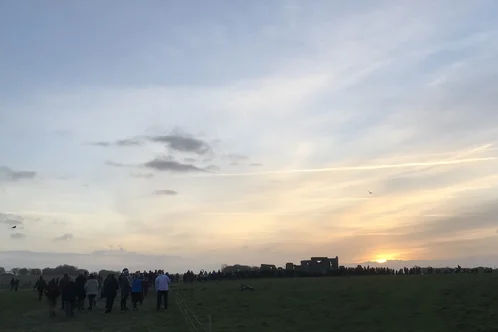
People come from across the world to watch the sunrise on the shortest day of the year, including druids, pagans, photographers, history enthusiasts and international travellers. As the crowd waits for daylight, drumming, chanting, horn-blowing, dancing and quieter ceremonies all contribute to the atmosphere. Many wear traditional druid and pagan attire, and many hold up smartphones to photograph the sunrise. The crowd cheers as the sun rises. What happens at stonehenge on winter solstice is therefore a mix of ceremony, music and shared waiting, rather than a formal programme.
The winter gathering is more reflective than the huge summer solstice gathering, but it is not an empty field. The summer solstice draws tens of thousands of people, far more than the winter event, yet the winter gathering still draws thousands. Around 8,500 people attended in 2025, according to English Heritage, and the stonehenge winter solstice 2026 gathering runs on the same managed open access basis. Approximately 4,500 people attended in 2024, and approximately 6,000 in 2023, according to English Heritage spokesperson Rebecca Eade, with a further 98,500 watching the sunrise live online that year. Some pages wrongly quote 8,500 for 2023 or 15,000 for 2024. For many attendees the occasion carries genuine spiritual significance, and visitors should remain respectful during rituals. The gathering is a twice-yearly pilgrimage for many, with the summer solstice in June the larger of the two.
Managed solstice access lets visitors walk among the stones, inside the circle area. On a normal visit a rope keeps visitors at a set distance, so the solstice is the rare chance to stand among them. The winter solstice is one of the few days when visitors are allowed to touch the stones, yet you must not climb on them, sit on them or lean against them, since Stonehenge is a fragile monument. The livestream and press photography take place during the gathering, so attendees may appear on camera. Stonehenge at winter solstice is a working sacred site, not a show, and the best way to enjoy it is to arrive early, find a spot, and wait quietly for the light.
The rules at Stonehenge on solstice morning
Access to the stonehenge winter solstice 2026 gathering is subject to the English Heritage Conditions of Entry, and the rules are strict because the monument is fragile and the crowd is large. No drugs or alcohol are permitted in any area of Stonehenge during the solstice. Glass is banned, to protect livestock, wildlife and barefoot visitors. No pets or other animals may be brought, except assistance dogs, to protect wildlife. No drones, no candles or naked flames, and no tents or sleeping bags are allowed. Only small bags are permitted, about 30 by 25 by 15 cm, and bags may be searched. Large umbrellas are not allowed.
Do not climb on, sit on or lean against the ancient stones. Stonehenge is a World Heritage Site and a fragile archaeological monument. Take your rubbish home, and respect people for whom the site is a sacred place. Personal photography is welcome, but drones are banned, and English Heritage has not published tripod rules for the gathering, so check the conditions of entry before you travel if you plan to use a tripod. Wiltshire Police and the ambulance service are at Stonehenge for the gathering, with stewards at the site and the car park, and everyone attends at their own risk. English Heritage provides the managed open access in partnership with Wiltshire Police and Wiltshire Council, so follow the stewards if they ask you to move.
What to wear and bring for a December dawn at Stonehenge
Stonehenge stands in a field on Salisbury Plain, and the weather in December will be cold and wet, so dress for the worst. English Heritage recommends warm waterproof clothing, sensible shoes, a small torch, and a small ground sheet or blanket. Thermal base layers, a waterproof outer layer, gloves, warm socks and sturdy waterproof boots matter more than fashionable winter clothing. Even if it is not raining, the ground will be wet from dew and there may also be frost. Our winter hiking guide covers layering for cold dawns in full, and the same principles apply here: layers you can add or remove, a waterproof shell, and warm hands and feet.
The walk from the Visitor Centre to the stones takes 25 to 30 minutes and covers about 1.5 miles in low light, so a torch is essential. Darkness, uneven ground, mud and crowds can turn the approach walk into the most physically challenging part of the morning. The 1.5-mile walk is a short winter walk in its own right, and our winter walks guide has more cold-morning routes. Travellers with mobility limitations should investigate accessible transport options in advance. Shuttle buses run from the car parks to the stones, and accessible parking is available through the car park steward.
Food options around the monument itself are limited during the pre-dawn gathering. The Visitor Centre normally offers food and hot drinks during standard operating periods, while Salisbury offers far more for breakfast, so eat before you travel or plan breakfast in Salisbury afterwards. December averages for England, from Met Office figures for 1991 to 2020, are a daytime high of 7.6 degrees C, an overnight low of 1.9 degrees C, and about 13.5 days with at least 1mm of rain. For the south-west the averages are a high of 8 degrees C and a low of 2 degrees C. Salisbury Plain is exposed, and December can bring cold, rain, strong wind and saturated ground. No December 2026 forecast exists yet, so check the Met Office forecast in the week before the gathering.
The midwinter sunset alignment behind the stones
The sunrise gathering can mislead you about what the monument was built for. The principal axis at Stonehenge is aligned on the midwinter sunset in one direction and the midsummer sunrise in the other. Viewed from the centre of the circle, the sun rises adjacent to the Heel Stone at midsummer and sets between the stones of the tallest trilithon at midwinter. At the winter solstice, the sun would originally have set between the two uprights of the tallest trilithon and dropped down over the Altar Stone. That effect is lost today because half of the trilithon has fallen, yet the axis remains, and it is the midwinter sunset, not the sunrise, that the builders framed.
The Heel Stone is a large upright stone, standing where the Avenue meets the earthwork enclosure. Unlike all the other sarsen stones, it is unworked and retains its natural shape. It marks the position of the rising sun at the summer solstice. A large stone hole to the left of the Heel Stone may have held a partner stone, and if so, the two stones would have framed the midsummer sunrise. The Avenue is a ceremonial route of parallel banks and ditches, about 2.8 to 3 km long and about 12 metres wide, linking Stonehenge to the River Avon, and its final straight stretch is aligned on the north-east to south-west solar axis. The stonehenge solstice winter alignment is therefore a sunset alignment first and a sunrise gathering second: the crowd gathers at dawn for a monument built to frame the setting midwinter sun.
Sunset on Tuesday 22 December is at 16:02, and winter hours run from 9:30am to 5:00pm, so visitors on a normal ticket that afternoon can stay for the sunset, since the site opens as normal from about 1pm. The midwinter sunset is the quieter half of the solstice, with no crowd and no ceremony, and it is the half the builders cared about most.
Why midwinter mattered more than midsummer to the builders
English Heritage curator Win Scutt says the winter solstice was always more significant in the cultural calendar than the summer one. "This is the time of the year that people in prehistory really revered and it was really important to them," he said at the 2025 event. Midwinter may have been more important than midsummer for the people who built Stonehenge, partly because the alignments towards the setting midwinter sun are ahead of you when walking up the Avenue and entering the monument. You walk towards the sunset as you enter, and the monument frames the light as you arrive.
The evidence for midwinter as a season of gathering comes from Durrington Walls, a Neolithic settlement about two miles from Stonehenge, which held huge midwinter feasts. Excavations show pigs were killed for feasting in midwinter: the pigs are eight months old, and sows farrow in the spring, so the age of the bones fixes the season. Cattle were butchered and dairy products were eaten from Grooved Ware pottery, and animals for the feasts came from considerable distances across Britain. Woodhenge, a timber monument near Durrington Walls, was built on the same axis. There is no evidence that the builders marked the midpoints between the solstices, in spring and autumn, which makes the two solstices the only fixed points in their year.
The facts about stonehenge in england that most visitors ask about start with its age. Stonehenge was built in phases from around 3000 BC to around 1600 BC, a span of roughly 1,500 years, so the stonehenge age is not one date but a long building history. Phase 1, around 3000 BC, was a circular ditch and bank enclosure about 110 metres across, with a ring of 56 pits, the Aubrey Holes, inside it. It was used as a cremation cemetery, and at least 150 cremated individuals were buried there. The great stone phase came around 2500 BC: an outer circle of 30 sarsen uprights, each about 4 metres tall and weighing around 25 tonnes, locked together with mortise and tenon joints, and a horseshoe of five trilithons. The sarsens came from West Woods on the Marlborough Downs, about 20 miles away. The smaller bluestones came from the Preseli Hills in south-west Wales, about 155 miles away, and weigh 2 to 5 tonnes each. The Altar Stone was traced instead to northern Scotland. Stonehenge and winter solstice are linked by this history: the monument was raised in stages over 1,500 years, and the solar alignment survived every stage.
Stonehenge was inscribed as a UNESCO World Heritage Site in 1986, jointly with Avebury, and has been legally protected as a Scheduled Monument since 1882. The stones are managed by English Heritage, and the surrounding downland belongs to the National Trust. Stonehenge was not built by the Druids: its stone phase dates to about 2500 BC, long before the Druids of the Iron Age.
What a normal Stonehenge visit costs and when it opens
The stonehenge winter solstice 2026 gathering itself is free, but a normal visit to Stonehenge is not, and the two prices are easy to confuse. Questions about stonehenge admission fees usually mean the normal ticket prices, set out in the table below alongside the solstice costs. A normal adult ticket booked online costs £24.65 on an off-peak weekday and £27.03 at the weekend, in the winter period to 16 March 2027, without the voluntary Gift Aid donation. A normal adult ticket bought on the day costs £29.00 on a weekday and £31.80 at the weekend. Children aged 5 to 17 pay £12.32 on a weekday and £13.51 at the weekend online, or £14.50 and £15.90 on the day. Children under 5 go free, and English Heritage and National Trust members go free, though a timed slot booking is still required.
| What it costs | Price |
|---|---|
| Solstice entry | Free |
| Solstice parking, car or van | £16 |
| Solstice parking, motorhome | £21 |
| Solstice parking, motorbike | £5 |
| Solstice parking, blue badge | £16 |
| Stonehenge Tour bus only | £20.50 adult, £14.00 child |
| London Waterloo to Salisbury advance single | From £16.40 |
| Normal adult ticket online | £24.65 weekday, £27.03 weekend |
| Normal adult ticket on the day | £29.00 weekday, £31.80 weekend |
| Children 5 to 17 online | £12.32 weekday, £13.51 weekend |
| Under 5s | Free |
With the voluntary 10 percent Gift Aid donation, adult prices are £27.20, £29.75 or £32.30 by date band. A family ticket for two adults and up to three children costs £68.00 to £80.75 in advance. Booking online in advance, up to midnight the day before, saves up to 15 percent. Winter opening hours are 9:30am to 5:00pm every day, with last entry at 3:00pm, and Stonehenge is closed on Christmas Day only. A normal ticket is valid for one day and includes the shuttle bus, the exhibition and the Neolithic houses. On 22 December, normal opening times are subject to change, and the site opens as normal from approximately 1pm. A separate Stone Circle Experience, a one-hour visit inside the stones outside normal hours, costs from £70 for adults and from £40 for children aged 5 to 17, with under-5s free. No sessions run in October or November.
A full solstice day after sunrise: Avebury, Salisbury and Old Sarum
The stonehenge winter solstice 2026 gathering ends at about 10:00 and everyone must leave the car park by 11:00, which leaves most of the day free. Start with Avebury, about 20 miles north of Stonehenge, though the distance runs from 20 to 25 miles depending on the route. Avebury is home to the largest stone circle in the world, it is free to visit, and visitors can walk directly among the stones, a very different experience from Stonehenge, where a rope keeps you back on a normal visit. Avebury dates from the Late Neolithic period, 3500 BC to 2200 BC.
Woodhenge sits close to Stonehenge on the way to Avebury, a free timber monument built on the same solar axis. Visit Salisbury gives its distance as 1.5 miles, while English Heritage gives 3.19 miles, the direct distance against the road distance. Either way it is a short stop. Durrington Walls, the settlement that held the great midwinter feasts, lies about two miles from Stonehenge, though little of it is visible above ground today.
Salisbury itself is the natural base for the day. Salisbury is 9 miles from Stonehenge by the direct distance, a cathedral city with a walkable medieval centre, and the station is about a 20 to 30 minute walk from the town centre. Salisbury Cathedral's spire is 123 metres tall, the tallest in Britain, and the cathedral was built between 1220 and 1258, with the spire added between 1310 and 1330. The cathedral holds the best-preserved of only four surviving original 1215 Magna Carta copies, on permanent display in the Chapter House, and the world's oldest working mechanical clock, dating to around 1386. Check opening times before you visit, since hours and prices for 22 December were not confirmed in the sources for this guide.
Old Sarum is 6.77 miles from Stonehenge and 2 miles from Salisbury. It is the Iron Age hillfort and ruined site of the original Salisbury, is free to visit, and gives 360-degree views across the plain. The Stonehenge Tour bus returns via Old Sarum, so the two sites pair naturally on one ticket. If you want a city after the stones, Bath sits about 40 miles south-east, roughly an hour's drive via the A36 and A303, and our Bath at Christmas guide covers its market and lights. For another December guide, our Lake District at Christmas guide covers markets, light trails and Santa trains. The winter solstice stonehenge morning is the start of the day, not the whole of it.
Stonehenge and Newgrange at the winter solstice
Stonehenge is not the only great Neolithic monument built for the winter solstice, and the comparison with Newgrange in County Meath, Ireland, shows why Stonehenge is the easier one to visit. At Newgrange the rising sun lights the chamber through the roof-box for several days around 21 December, for up to 17 minutes. Places inside are by lottery only, and the 2026 draw is closed. The lottery now takes entries for the 2027 draw only, with a deadline of midnight Irish time on Sunday 26 September 2027. The Bru na Boinne Visitor Centre opens earlier on solstice mornings, from 19 to 23 December, and is closed from 24 to 27 December and on 1 January.
For the stonehenge winter solstice 2026, Stonehenge is the solstice site you can simply turn up to. Entry is free, with no ticket, no booking and no lottery, and the only thing to arrange in advance is parking if you drive. Newgrange gives you a few minutes of light inside a chamber, if you win a lottery a year ahead. Stonehenge gives you a whole morning among the stones, with thousands of people, music and ceremony, for nothing. Both monuments mark the same turning point of the year, but only one lets you walk in on the morning itself.
Watching the Stonehenge sunrise online
If you cannot be at Stonehenge for the stonehenge winter solstice 2026, you can still watch the sunrise. English Heritage will live stream the sunrise on the morning of 22 December for free on its digital channels: the official Stonehenge and English Heritage Facebook pages, and the English Heritage YouTube channel. English Heritage has not published a start time for the 2026 stream, so check its channels on the morning rather than relying on a time from a third-party page. Beware of fake or scam Facebook pages, events and groups, which appear around the solstice every year. Use only the official Stonehenge and English Heritage pages. English Heritage also runs the Stonehenge Skyscape website, a live sky view of the monument.
The online audience is large. Around 98,500 people watched the sunrise live online in 2023, alongside the roughly 6,000 who attended in person. Watching online is free, needs no parking booking, and works from anywhere in the world. Stonehenge at winter solstice is a global event as well as a local one, and the stream is how most of the world sees it.
Staying overnight in Salisbury for the solstice morning
Stay in Salisbury the night before the stonehenge winter solstice 2026. That is the single most useful piece of advice in this guide. No train and bus combination gets you to the stones for a 05:15 car park opening or a 07:00 last admission, because the first trains from London reach Salisbury long after the car park has opened, and the dedicated solstice bus runs from Salisbury station, not from London. If you stay in Salisbury, you are nine miles from the stones, the dedicated bus leaves from the station in the town, and you can reach the car park before the 07:00 cut-off without a dawn drive on unfamiliar roads.
Salisbury is a cathedral city with a walkable medieval centre, and the station is about a 20 to 30 minute walk from the town centre, so an overnight stay puts you within easy reach of the bus and of breakfast afterwards. The car park must be clear by 11:00 and Stonehenge opens as normal from about 1pm, so an overnight stay also gives you the full day for Avebury, Salisbury Cathedral and Old Sarum.
There is one more reason to stay the night, and it costs nothing. The Ursid meteor shower peaks on the night of Tuesday 22 into Wednesday 23 December, the same night as the gathering, and it is active from 17 to 26 December, with about 10 meteors per hour under ideal dark skies. The Ursids come from comet 8P/Tuttle, which orbits the Sun about every 13.6 years. The Moon is 98 percent lit on the peak night, so faint meteors will be washed out, and the shower is a modest one beside December's stronger Geminids, which peaked on the night of 13 to 14 December. Even so, a clear sky after the gathering is a second sky event on the same trip.