

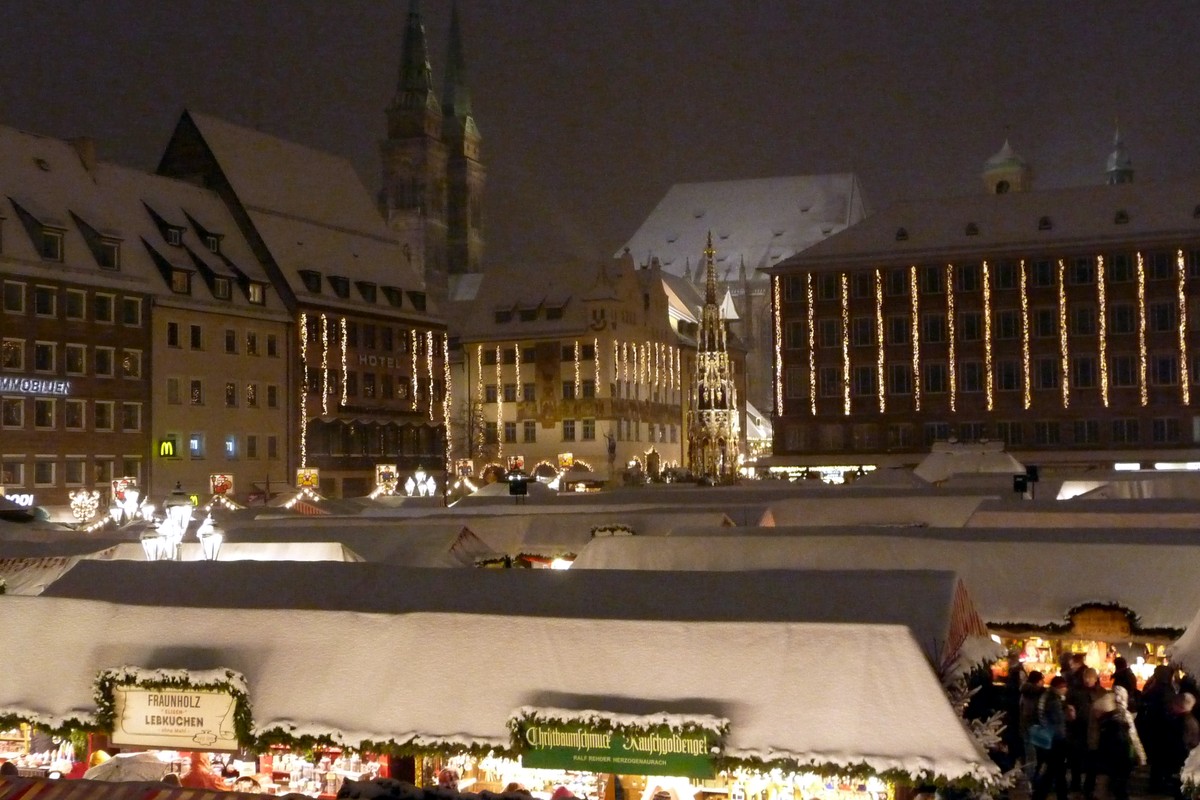
Nuremberg Christmas Market 2026 runs from Friday 27 November to Thursday 24 December on the Hauptmarkt, the main square in the old town, with free entry every day. Stalls open from ten in the morning to nine in the evening, and on Christmas Eve they close early at two in the afternoon. The Nuremberg Christmas Market opens with the Christkind reciting the prologue from the balcony of the Frauenkirche at half past five on Friday 27 November, and more than two million visitors are expected across the 28-day season. This guide to the German Christmas Market Nuremberg gives you the dates, the hours, the food, the three markets and the practical detail you need to plan a visit, including the honest position on prices, because no official 2026 price list exists.
When Nuremberg Christmas Market opens in 2026
The market opens on the Friday before the first Sunday of Advent, as it has done since 1973. In 2026 the first Sunday of Advent falls on 29 November, so the market opens on Friday 27 November and runs for 28 days until Thursday 24 December. The Nuremberg Christmas Market dates are 27 November to 24 December 2026, and the season is short, so Advent weekends fill fast.
The opening ceremony starts at half past five on Friday 27 November, when the Christkind recites the prologue from the gallery on the front of the Frauenkirche. The lights around the Hauptmarkt go out, thousands pack the square, and trading pauses for about half an hour while the Christkind speaks. Unless you stand near the front you will see little, and the prologue can be watched as a recording on the market website afterwards. The stalls stay open late that evening for the Long Night, so plan for a long first night.
The Nuremberg Christmas Market has opened on the Friday before Advent since 1973, because the old start date of 4 December could no longer cope with the crowds. The 2027 edition is already published, running from Friday 26 November to Thursday 24 December 2027. If you want the quietest visit, come on a weekday morning in the first week of December, after the opening weekend and before schools break up.
Where the market is: the Hauptmarkt and the two other markets
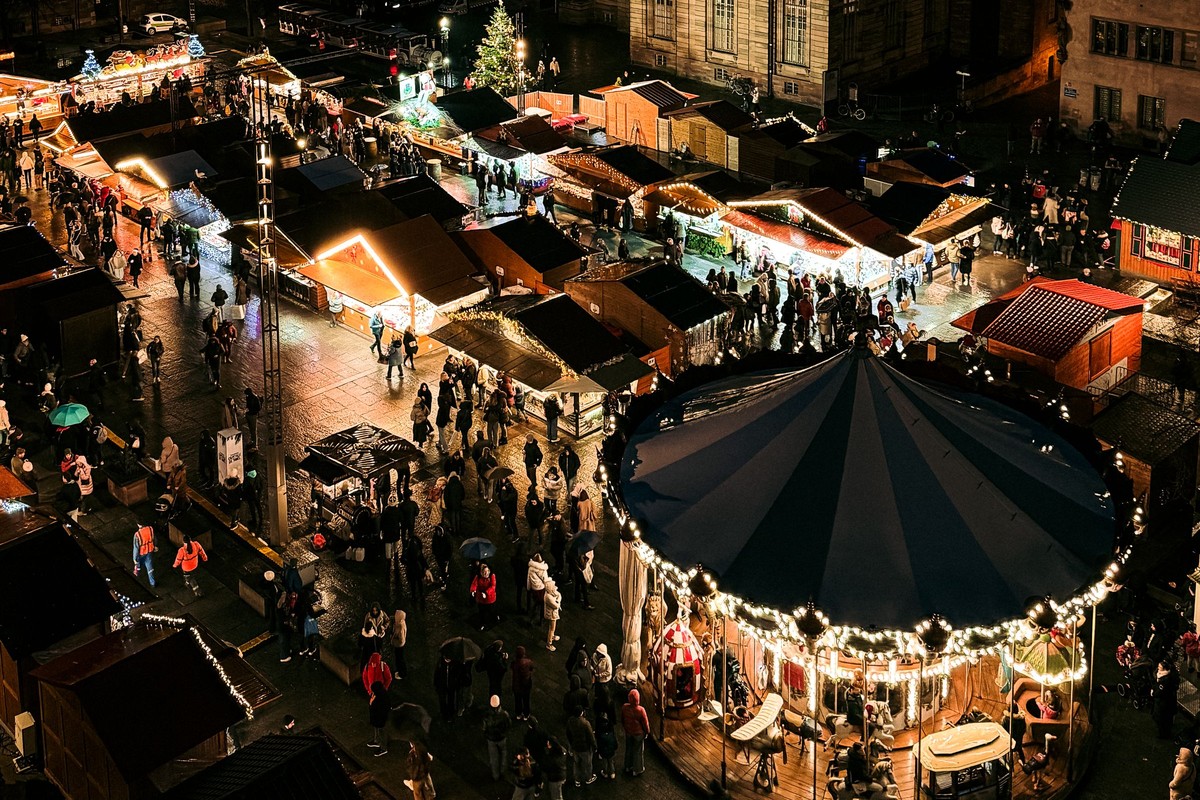
The Nuremberg Christmas Market location is the Hauptmarkt, the main market square in the historic old town, postcode 90402. The Frauenkirche stands on the east side of the square, the Schoener Brunnen fountain stands in one corner, and St Sebaldus Church is visible to the north. Around 180 stalls with red and white striped canvas roofs fill the square in rows that radiate from the fountain, and the market spills onto the side streets. The event goes by several names in English search results, including Christmas Market Nuremberg and the German Christkindlesmarkt, but on the ground it is one square and one unmistakable skyline.
Nuremberg has three Christmas markets in total, and all three sit within a short walk of each other. The Christkindlesmarkt stands on the Hauptmarkt. The Sister Cities Market stands a few steps north on Rathausplatz. The Kinderweihnacht stands about 100 metres east on Hans-Sachs-Platz. The Winterdorf stands on Jakobsplatz by the Weisser Turm underground station, and the Original Regional stalls stand in the niches of St Sebaldus Church opposite the Old Town Hall.
The Hauptmarkt sits in the middle of the old town, about fifteen to twenty minutes on foot from the main station along Koenigstrasse, and the nearest underground station is Lorenzkirche, a short distance away. Nuremberg sits in Bavaria, in the Franconia region, and the city calls its market the most famous Christkindlesmarkt in the world. Start with our Christmas in Europe guide if you are planning more than one Advent trip this year.
Opening hours at Nuremberg Christmas Market
The Nuremberg Christmas Market opens from ten in the morning to nine in the evening every day, Monday to Sunday. On Christmas Eve, Thursday 24 December, it opens from ten in the morning to two in the afternoon only, and it does not open on Christmas Day or after. The dates are settled, and the hours below cover all five sites, because Nuremberg Christmas Markets keep different hours across the sites, and several top guides blur them into one line. Check the table before you travel, and the official site again on the day.
On the opening evening the market pauses from about half past five to six while the Christkind speaks, and the stalls do not sell during the pause. Most guides say the Nuremberg Christmas Market stays open until ten that night, but the city market notice lists ten in the morning to nine in the evening every day with a pause, so this guide does not promise the extra hour. Treat the opening evening as a late night for the ceremony and the Long Night, and do not plan around a ten o'clock close.
Shops in the old town are closed on Advent Sundays, but the market runs as normal, and sunset in December is around half past four, so the lights come on early.
| Market | Dates | Hours |
|---|---|---|
| Main market, Hauptmarkt | 27 November to 24 December 2026 | 10am to 9pm daily; 24 December 10am to 2pm |
| Sister Cities Market, Rathausplatz | 27 November to 23 December 2026 | 10am to 9pm daily |
| Kinderweihnacht, Hans-Sachs-Platz | 27 November to 30 December 2026 | To 23 December 10am to 9pm; 24 December 10am to 2pm; 25 December closed; 26 to 30 December 11am to 8pm |
| Winterdorf, Jakobsplatz | 12 November 2026 to 9 January 2027 | 11am to 9pm daily; Friday and Saturday to 10pm; 24 December to 2pm; closed 25 December, 31 December, 1 January |
| Feuerzangenbowle, Fleischbruecke | To 31 December 2026 | Sunday to Wednesday 11am to 9pm; Thursday 11am to 10pm; Friday and Saturday 11am to 11pm |
The Christkind and the opening ceremony
The Christkind is a young woman in a white and gold gown with a golden crown and a long blonde curly wig, representing the Christ Child. She is not a baby in a manger. The Christkind is chosen by a jury for two years at a time. The prologue begins with the words Ihr Herrn und Fraun, die Ihr einst Kinder wart, which means You ladies and gentlemen who once were children, and it was written by Friedrich Broeger for the revival of the market in 1948. She opened the market in 2025 on Friday 28 November, and the same ceremony opens the 2026 season.
The 2026 Christkind is Nora Falk, born in 2009 and a pupil at the Willstaetter Gymnasium in Nuremberg, selected in July 2025. She serves a two-year term, so 2026 is her second and final year.
The idea that the Christkind brings children their gifts goes back to Martin Luther, who moved gift giving in his household to Christmas Eve, away from St Nicholas Day on 6 December. Today the Christkind appears at schools and hospitals, in the Sternenhaus programme and on the balcony of the Frauenkirche on the opening night.
The stalls and what to buy
Around 180 stalls with red and white striped roofs fill the Hauptmarkt, and the goods are strictly regulated: no plastic pine needles, no cheap mass-produced goods, nothing made outside Germany on the main market stalls. A jury has picked the most beautiful stalls at the Nuremberg Christmas Market every year since 1981, and the market is nicknamed a Staedtlein aus Holz und Tuch, a little town of wood and cloth.
Zwetschgenmaennle are little figures made of dried plums and figs, in more than 350 varieties, from chimney sweeps to kissing couples. They stand 9 to 22 cm tall, and they are decorative, not food. The Rauschgoldengel is a golden angel of folded metallic material, described as the city's most traditional Christmas ambassador. Genuine versions are handmade, and the angels have been made in Nuremberg since the 1600s. In the middle of the market stands a large nativity scene with a thatched roof and a star, brass bands and choirs play on the stage through Advent, and a trail of nativity scenes, the Krippenweg, links the main market and the children's market.
Other traditional goods include handmade decorations, glass, woodwork, jewellery, nativity figures, candles, wooden toys, and hand-cast pewter figurines, a craft Nuremberg has been known for since the sixteenth century. The market runs a licensed souvenir scheme, and the official giftware carries the Original Christkindlesmarkt logo, so you can tell a genuine market souvenir from a copy. Nuremberg has been a toy-making city for centuries and still hosts the world's biggest toy fair. The Handwerkerhof crafts courtyard behind the city walls sells handicrafts and Franconian specialities, and the pedestrian shopping zone around the market was created in 1966 and is one of the largest in Europe.
Food and drink at Nuremberg Christmas Market
Food is the heart of the German Christmas Market Nuremberg, and the two tastes to try first are the small sausages and the gingerbread. Nuernberger Rostbratwuerste are small sausages roughly the length of a finger, seasoned with marjoram and grilled over beechwood, and the sausage tradition is more than 700 years old. At the market they are sold as Drei im Weggla, three in a bread roll with mustard. The size, weight and recipe, 7 to 9 cm and 20 to 25 g, are protected by the EU protected geographical indication seal, so the real thing may only be made in Nuremberg.
Nuernberger Lebkuchen is gingerbread baked on a thin wafer base, made in Nuremberg for more than 600 years. The top grade is Elisenlebkuchen, which must contain at least 25 percent nuts and no more than 10 percent flour. It keeps for weeks, and under EU law Nuremberg Lebkuchen may only be produced within the city limits. Nuremberg gluehwein has had protected status since the early 1990s, and as well as classic red and white you should try the blueberry version, a local speciality. Gluehwein is served in a ceramic mug decorated with a Nuremberg motif and the year, for which you pay a deposit, and you can return your mug at any stall or keep it as a souvenir. The market was the first in Germany to introduce a uniform mug deposit system.
No official 2026 food or drink price list exists, and each stall sets its own prices, so this guide quotes only guide estimates and labels them as estimates. Most guides put gluehwein at 3.50 to 5 euros a cup, the mug deposit at 2 to 5 euros, and Drei im Weggla at 3.50 to 5 euros. A food budget planning allowance of 20 to 30 euros per person is a sensible planning figure, not a verified menu price. Other food at the Nuremberg Christmas Market includes roasted almonds, stollen, fruit bread, roast chestnuts, potato pancakes and Spekulatius cookies. Potato pancakes are often fried in lard, so ask before buying if that matters to you, and hot chocolate, spiced apple drinks and Franconian white gluehwein cover the non-alcoholic side.
Feuerzangenbowle is red wine punch with a rum-soaked sugarloaf set alight above the pot, and the stand by the Fleischbruecke bridge claims the largest in the world, a cauldron 2.5 metres across holding up to 9,000 litres. Many stalls now take cards, but smaller gingerbread and decoration sellers still mostly want cash, so carry a few tens of euros in small notes and coins. The city also sells Christkindlesmarkt-Taler coins worth 5 euros each, in packs of ten for 45 euros, with a maximum of 100 per person while stocks last.
The children's market and the Sternenhaus
The Kinderweihnacht has stood on Hans-Sachs-Platz since 1999, a market just for children, and it is one of the few children's Christmas markets in the world. At its centre spins a two-storey carousel modelled on the old steam-driven ones, next to a small Ferris wheel and a little train. In the workshops children can make a candle, bake biscuits or write a letter to the Christkind at the children's post office. The Christkind visits the Kinderweihnacht every Tuesday to Friday at half past two from 1 to 23 December and invites children for a free carousel ride, before moving on to the Hauptmarkt at around three, and she reads fairy tales in the Sternenhaus on Tuesdays and Thursdays at two in the afternoon. The Kinderweihnacht is a must-visit with kids, and without kids it can be skipped.
The Sternenhaus programme runs from Saturday 28 November to Wednesday 23 December 2026 at the Heilig-Geist-Haus, Hans-Sachs-Platz 2, with theatre, puppets, magicians and music for children. The shows are in German, so the puppet and music performances work best for young children who do not speak it. Tickets are sold online.
The children's market is free to enter, so a family can leave after twenty minutes without financial regret, and the hours after Christmas are shorter, from eleven to eight from 26 to 30 December. Visit on a weekday afternoon when the Christkind visits and the carousel queues are short, and keep the main market for the evening lights.
The Sister Cities Market
The Markt der Partnerstaedte is a small Christmas village of the world on Rathausplatz, where twin and partner cities run stalls with their own food, drink and gifts. Around twenty stalls take part, and the market runs from Friday 27 November to Wednesday 23 December 2026, daily ten to nine. It has already finished by Christmas Eve, so visit it in the first three weeks.
Stalls have included Antalya (Turkey), Atlanta (USA), Vienna (Austria), Kharkiv (Ukraine), Gera (Germany), Glasgow (Scotland), Kavala (Greece), Krakow (Poland), Nice (France), Prague (Czech Republic), San Carlos (Nicaragua), Shenzhen (China), Skopje (North Macedonia), Venice (Italy) and Limousin (France), with friend cities Bar (Montenegro), Kalkudah (Sri Lanka) and Verona (Italy) also present. An international art vending machine at the market helps fund charitable projects in Krakow, San Carlos and Skopje.
The Sister Cities Market is calmer than the Hauptmarkt and a favourite with repeat visitors. The exact stall count and line-up change from year to year, and the guides disagree on both, so this guide gives the honest figure of around twenty stalls and names no founding year. Come before 23 December, because it closes a day before the Nuremberg Christmas Market ends.
Getting to Nuremberg Christmas Market: flights, trains and parking
London has direct flights to Nuremberg through the season. Ryanair flies direct from London Stansted all winter, daily, in about one hour and 35 minutes, with starting fares advertised from about 15 pounds each way, though December weekends cost much more, with typical returns of 50 to 200 pounds. easyJet starts seasonal flights from London Gatwick on 19 November 2026 and from London Luton on 23 November 2026, a few times a week, and British Airways is scheduled to fly from London Heathrow about four times a week over the Christmas period. Munich and Frankfurt airports are bigger alternatives with onward ICE trains to Nuremberg.
Nuremberg Airport lies about 5 km north of the city centre, and the U2 line runs from the airport to Hauptbahnhof in about 12 to 13 minutes. The market is about 15 to 20 minutes on foot from the station along Koenigstrasse, or one stop to Lorenzkirche. Lorenzkirche has construction closures during the Lorenzer Passage works, with exits toward Museumsbruecke and Stangengaesschen closed, so follow signs toward Karolinenstrasse or Koenigstrasse. Check current access before travelling.
A single public transport ticket costs 3.90 euros and is valid for 90 minutes. A TagesTicket Plus day ticket for up to six people costs 15.50 euros, but no more than two may be aged 18 or over, and a Saturday ticket also covers Sunday, so check validity rather than assuming a six-adult or rolling 24-hour ticket. On Advent weekends underground services run at double frequency in the centre, trams take leashed dogs free, and trains, particularly the Munich route, get packed during market season.
From Prague, FlixBus runs several times a day and RegioJet roughly once a day, and the journey takes about three and a half hours to the bus station next to the main railway station. By train there is no direct service, and connections take around four and a half hours, via Plzen with a change in Schwandorf, or via Cheb with a change at Marktredwitz. By car it is roughly 300 km and about three hours, on the Czech D5 via Rozvadov and then the German A6, and Nuremberg has no low-emission zone, so no green sticker is needed.
Parking at Park and Ride sites is free for up to 48 hours with a valid public transport ticket. The most practical site from the Prague direction is Langwasser Sued, with around 300 spaces, at the end of underground line U1, from where you ride without changing to Lorenzkirche station. Old town car parks are often full by mid-morning on Advent Saturdays, and the paid car parks closest to the market are Parkhaus Hauptmarkt on Augustinerstrasse, Augustinerhof and Findelgasse. Nuremberg rewards visitors who arrive by train and on foot, so leave the car outside the centre if you can.
The lantern procession, mail coach and other Advent events
The lantern procession, known as the Lichterzug, is the highlight of Advent after the opening ceremony, and it runs on the evening of Thursday 10 December 2026 at about quarter to six. Around a thousand children from Nuremberg schools follow the Christkind with lanterns they have made themselves, from the Fleischbruecke bridge across the Hauptmarkt, past the town hall and St Sebaldus Church and up to the castle, where older pupils perform a living nativity scene by the rocks below the walls. The procession takes place for the 76th time, according to the market guide, so if you want to see it, arrive early, because the streets fill up quickly.
The mail coach from the Museum for Communication runs every day during the Nuremberg Christmas Market through the decorated old town. It is a replica of an 1874 express mail coach, built in 1939 and pulled by horses.
Smaller Advent events fill the gaps between the three Nuremberg Christmas Markets. The Original Regional stalls stand in the niches of St Sebaldus Church opposite the Old Town Hall, selling honey, regional mulled wine, Franconian schnapps and smoked meats, and they close on 23 December. Kunst and Handwerk, a market of contemporary craftspeople, runs from 4 to 13 December 2026 at the Stadtmuseum im Fembo-Haus, Burgstrasse 15. The nativity exhibition at St Egidien runs from 27 November 2026 to 6 January 2027, daily eleven to five, closed on 24, 25 and 31 December, with admission at 4 euros and children under 14 free.
Where to stay near Nuremberg Christmas Market
The best area to stay is the Sebald side of the old town, north of the river Pegnitz around the Hauptmarkt and below the castle, the prettiest area and the most expensive, with everything within walking distance. The Lorenz side around Koenigstrasse is busier and more about shopping, ten minutes from the market, and cheaper rooms sit near the main station or in Gostenhof on underground line U1.
Named hotels within walking distance, with no December 2026 rates verified, include Le Meridien Grand Hotel opposite the main station; Sorat Hotel Saxx at Hauptmarkt 17, right on the market square; Hotel Drei Raben at Koenigstrasse 63; Hotel Elch by the Weinmarkt, a half-timbered house dating from 1342; Duerer-Hotel at Neutormauer 32; Five Reasons Hostel and Hotel at Frauentormauer 42; and Hotel Karl August, less than 100 metres from the Old Town Square. No December 2026 hotel rates exist in any source, so this guide quotes none.
Book early, because Advent weekends fill up and the rooms that go fastest are for the opening weekend, 27 to 29 November. If the centre is full, look near the main station or in Gostenhof, where the underground puts you back at the market in minutes.
How much a visit to Nuremberg Christmas Market costs
Entry to the Nuremberg Christmas Market is free, and that is the first thing to know about the budget. What costs money is food, drink and rides, the Ferris wheel, the Sternenhaus shows, museums, the castle, the cellars tour, the ice skating and the St Egidien exhibition. The costs below use 2026 figures from the market guides and the venues, and every figure is labelled. A generic German-market budget puts a day at around 95 to 125 euros for an independent traveller, but that figure is generic, not Nuremberg-verified, so treat it as a rough guide only.
| Item | Price | Source and year |
|---|---|---|
| Entry to all three markets | Free | City market guide 2026 |
| Gluehwein | 3.50 to 5 euros per cup | Guide estimate 2026 |
| Mug deposit | 2 to 5 euros | Guide estimate 2026 |
| Drei im Weggla | 3.50 to 5 euros | Guide estimate 2026 |
| Food budget allowance | 20 to 30 euros per person | Planning figure 2026 |
| Ferris wheel | 6 euros adult, 4 euros child to 1.40m | Winterdorf 2026 |
| Imperial Castle | 10 euros adult, under 18 free | Castle 2026 |
| Rock-cut cellars tour | 13 euros adult | Market guide 2026 |
| Germanisches Nationalmuseum | 10 euros adult, free Wednesdays from 5.30pm | Museum 2026 |
| Toy Museum and Duerer's House | 7.50 euros each | Museums 2026 |
| St Egidien nativity exhibition | 4 euros, under 14 free | Krippenfreunde association 2026 |
| Ice skating at PSD Bank Nuernberg Arena | 8 euros adult, 19 euros family, 5 euros hire | Arena 2026 |
| Single public transport ticket | 3.90 euros, 90 minutes | VGN 2026 |
| TagesTicket Plus | 15.50 euros, up to six people | VGN 2026 |
Tips for visiting Nuremberg Christmas Market
Saturdays are the worst day to visit: on Advent Saturday afternoons you move between the stalls at a snail's pace, and with a pushchair you barely move at all. It is quietest on weekday mornings. One guide calls Nuremberg the most crowded market they visited in Europe, and they recommend Sunday if you can, with a warning that Saturday nights are the busiest. Travellers often search for Christmas Market Nuremberg alongside the German name Christkindlesmarkt, and the advice holds whatever you call it: come midweek, come early, and come for at least one night.
A long weekend from Friday to Sunday suits Nuremberg better than a day trip, with at least one night so you see the Hauptmarkt lit in the evening and quiet in the morning. One full day works for the main market and nearby stops, and two days suit a museum visit or a slower family outing. The Hauptmarkt is outdoors, so dress warmly, and the stalls are cash-friendly, so carry small notes and coins. In dense crowds keep your wallet and phone in a front pocket or a closed bag in front of you, especially around the mulled wine stalls and at the opening ceremony.
The market is accessible by public transport and listed as accessible, but step-free detail for the aisles is thin, so verify access on the official site before travelling. Visitor feedback gives the same warning every year: crowds are the number one complaint, especially at weekends and in the evenings. The Sister Cities and children's markets offer more variety, so use them as your escape when the Hauptmarkt fills up.
Nuremberg beyond the markets: castle, museums and day trips
Nuremberg is a city with more to see than the stalls. The Imperial Castle above the old town is a ten-minute uphill walk from the Hauptmarkt, and it is open daily from ten in the morning to four in the afternoon, with admission at 10 euros for adults and free for under 18s, and closed on 24, 25 and 31 December. The city also has the rock-cut cellars under the old town, where the guided tour takes about an hour, starts on the hour and costs 13 euros, with only twenty people per tour, so book ahead at weekends.
Duerer's House, the Germanisches Nationalmuseum, the Toy Museum, St Sebaldus Church and St Lorenz Church are all in the old town near the market. The Germanisches Nationalmuseum costs 10 euros, with free entry on Wednesdays from half past five. The Toy Museum costs 7.50 euros and stays open on Mondays too while the market is on. St Sebaldus Church dates back to 1225.
The Memorium Nuremberg Trials, in Courtroom 600, is open November to March, Wednesday to Monday from ten in the morning to six in the evening, closed Tuesdays. The Documentation Centre on the former rally grounds has had a new permanent exhibition since May 2026, Monday to Friday nine to six and weekends ten to six, and it is not recommended for children under 14.
Bamberg is about 35 minutes by ICE, with a UNESCO old town and a Christmas market on Maxplatz from 24 November to 23 December 2026. Wuerzburg is 50 to 70 minutes by train, with the Marienburg Fortress, the Residenz Palace and a Christmas market by St Mary's Cathedral. Rothenburg is a popular day trip, but no train time is verified in any source, so this guide gives none. For a half-day break from the markets, the Kristall Palm Beach thermal baths in Stein charge from 23.50 euros for two hours, or 39.50 euros for a full day including saunas.
Why Nuremberg Christmas Market is worth a visit
Nuremberg earns its fame from the whole picture: a Gothic square full of red and white stalls, a Christkind on a church balcony, small sausages and gingerbread with protected names, and three markets within a short walk. The city calls its market the most famous Christkindlesmarkt in the world. Nuremberg Germany Christmas markets are at their best on a weekday morning in the first week of December, when the stalls are open, the crowds are thin, and the Hauptmarkt is yours for an hour before the day fills up.
Nuremberg Christmas Market 2026 rewards visitors who plan around the facts: the market ends on Christmas Eve, the children's market runs to 30 December, the Winterdorf runs to 9 January, and the prices are honest estimates, not official figures. Come for the opening ceremony if you can stand the crowds, come midweek if you cannot, and leave time for the castle and at least one day trip. For more ideas, see our best Christmas markets in the UK guide, our Dublin at Christmas guide, our York at Christmas guide, our Leeds at Christmas guide and our Strasbourg Christmas Market guide.