

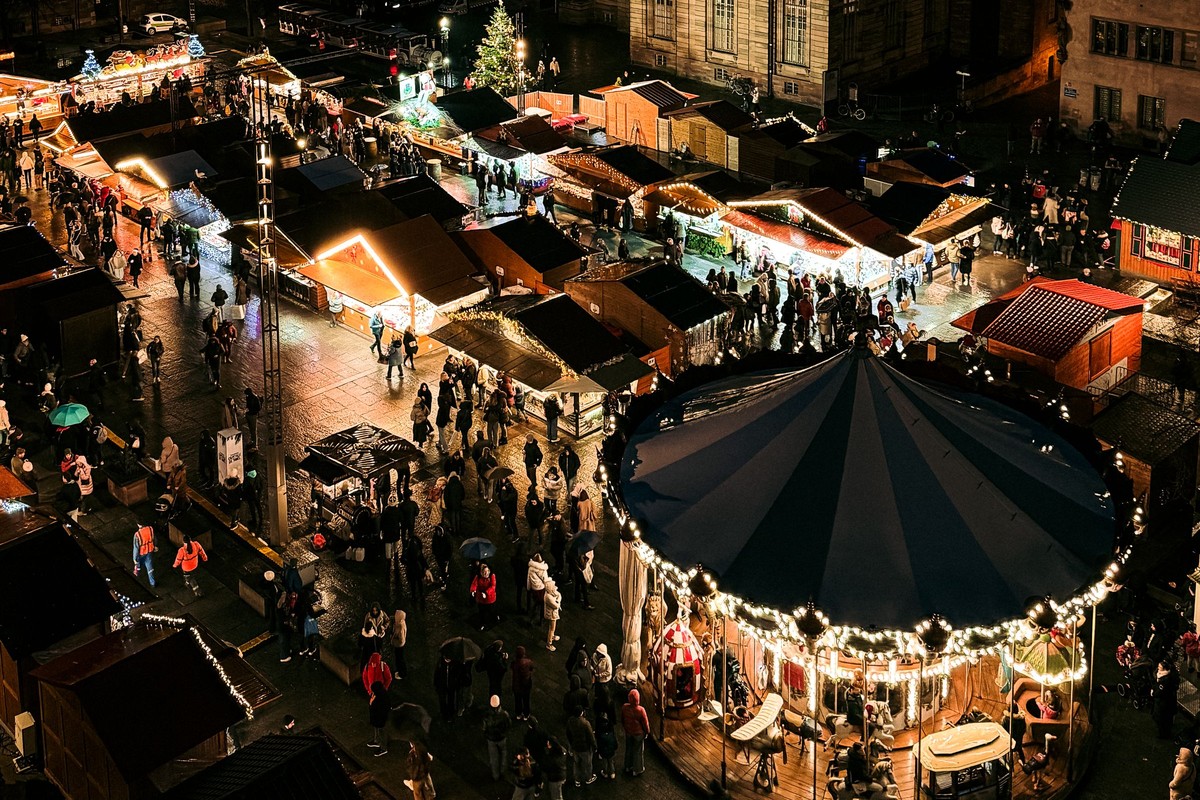
Strasbourg Christmas Market 2026 fills the Grande Île from 27 November to 24 December, and it is the oldest Christmas market in France. More than 300 wooden chalets stand across eight official markets on the river island old town, beneath the cathedral and around the Great Christmas Tree on Place Kléber. Entry is free everywhere, with no ticket and no booking needed to walk in, and the market trades every day until Christmas Eve, when the chalets close for good at 6pm.
This guide gives the opening hours for every date, a walk through the eight markets, the food and drink worth seeking out, the new ice rink in the courtyard of Palais Rohan, and the prices as they actually stand. Two warnings sit up front: the ice rink price had not been published when this guide was written, so this guide quotes no figure for it, and no official 2026 food price list exists, so the food figures here are the latest reported figures, not official menu prices. This guide also names the points where other guides go wrong: the rink moved from Place Kléber to Palais Rohan for 2026, and nothing opens on Christmas Day or after.
For the wider season, our Best Christmas Markets UK 2026 guide sets Strasbourg beside the big UK markets, and our Christmas in Europe guide covers the season across the continent. Strasbourg stands out in that company for its age: a market that dates to 1570, held on an island old town that UNESCO listed in 1988, with a season that runs for 28 days and ends, sharply, on Christmas Eve.
When Strasbourg Christmas Market opens in 2026
Strasbourg Christmas Market 2026 opens on Friday 27 November, and it runs until Thursday 24 December 2026. That is 28 days in total, from 27 to 30 November plus 1 to 24 December, and the market opens on the fourth Friday of November, as it traditionally does each year. This guide goes live on Saturday 21 November, six days before the first chalets open, so the dates below are the plan to book around, not a report of a market already trading.
The Christkindelsmärik dates to 1570, making it the oldest Christmas market in France and one of the oldest in Europe. Its name is Alsatian for "market of the Christ Child", and it began as an act of the Protestant Reformation: in December 1570 Pastor Johannes Flinner preached against the St Nicholas tradition, and the Town Council, the Council of Twenty-One, decided to transfer gift giving to the Christ Child and move the market to just before Christmas. Before that, a medieval St Nicholas market ran in the city from about 6 December until Christmas Eve.
One date in the opening week already belongs to the past in most guides, and it is worth naming so nobody books around it. Several pages still show 26 November as the opening day, but that was the 2025 opening. The 2026 opening is Friday 27 November, confirmed by the official site and every 2026 checked guide, and the market opens at 2pm that day. The Great Tree is lit on opening day, when the market opens, and the official opening is traditionally built around that first lighting, though the exact time of the 2026 opening ceremony had not been published when this guide was written.
The season ends as sharply as it starts. The market closes for good at 6pm on Thursday 24 December, and no chalet opens on Christmas Day or at any point between Christmas and New Year. The ice rink at Palais Rohan runs longer, to 3 January 2027, and the city illuminations run from the evening of Friday 20 November, but the market itself is a 28 day season and nothing more. The 2020 market was cancelled because of the pandemic, though the Great Tree was still put up that year.
Where the market is: eight markets across the Grande Île
The Strasbourg Christmas Market in France spreads across the Grande Île, the river island old town encircled by the River Ill. The organiser lists eight official markets for 2026, plus the Marché OFF, and all eight sites sit within about a 15 minute walk of each other, so the whole market is one walkable circuit. The Strasbourg Christmas Markets are, in practice, one market in eight parts. The Grande Île became a UNESCO World Heritage Site in 1988, the first entire city centre on the list, and Strasbourg has called itself Capitale de Noël, the Capital of Christmas, since 1992.
Christkindelsmärik, on Place Broglie, is the historic market, the one that started in 1570, and it moved to Place Broglie in 1871 and has stayed there. It stands in front of the Hôtel de Ville, and it is the place for sausages, pretzels and traditional gifts under the illuminated entrance arch, which is new for 2026. Around the cathedral, Place de la Cathédrale and Place du Château hold the handicraft market in the shadow of the cathedral, and the market continues along Rue des Hallebardes and Rue Gutenberg.
Place Kléber holds the market at the foot of the Great Christmas Tree, which has its own section below. Petite France holds two markets: Place Benjamin Zix, its market square, and Place Saint-Thomas, a convivial market much appreciated by residents, beside a Protestant church built from 1196 that became Protestant in 1524. The Carré d'Or on Place du Temple Neuf is artisan and gourmet shopping, with jewellers, candlemakers and chocolatiers across more than 15 stalls, and the surrounding Rue des Orfèvres has some of the best street illuminations in the city.
Le Quai des Délices, on Terrasse Rohan and Place du Marché-aux-Poissons, is the food market, covered in the food section below. One JDS article calls the same food market Quai des saveurs et des savoir-faire, so the name on the 2026 signage is unresolved, and this guide uses the organiser's name. Les Irréductibles Petits Producteurs d'Alsace, on Square Louise-Weiss, is the small producers' market, with about 20 producers and the Advent Village, and the Marché OFF on Place Grimmeissen is the alternative market, for vintage, second hand, organic and local goods, where Strasbourg residents actually go.
Other guides count the sites differently, at 11, 12 or 13 locations, by including individual streets and squares such as Rue Gutenberg, Rue des Hallebardes and Place du Corbeau. This guide uses the official eight plus the OFF market, because those are the markets the organiser lists, and the extra counts are streets the market spills onto rather than markets of their own.
Opening hours at Strasbourg Christmas Market
The dates matter more than anything else in this guide, so here they are without decoration. The market opens on Friday 27 November at 2pm, trades daily until Christmas Eve, and closes entirely on Christmas Day. On an ordinary day the chalets trade from 11am to 9pm, with the only changes on the dates in the table below.
One conflict sits behind that 11am opening, and this guide states it plainly rather than picking a side without saying so. The official 2026 FAQ gives 11am to 9pm, but several pages, including one English page on the official site, still show 11.30am, which was the 2025 timetable. Use 11am, and check the official site before you travel, because a stale page can still mislead. The same caution applies to the opening date itself: pages that show 26 November are showing the 2025 opening, not the 2026 one.
Christmas Eve runs from 11am to 6pm, and the four late nights, Friday 11, Saturday 12, Friday 18 and Saturday 19 December, run to 10pm. The last day, Thursday 24 December, closes at 6pm, and the Marché OFF follows the same season and also closes at 6pm on 24 December. The ice rink keeps its own hours, covered in the rides section below, and runs past Christmas Day, when the market itself is shut.
| Day | Market hours |
|---|---|
| Friday 27 November (opening day) | 14:00 to 21:00 |
| Usual day | 11:00 to 21:00 |
| Friday 11 December | 11:00 to 22:00 |
| Saturday 12 December | 11:00 to 22:00 |
| Friday 18 December | 11:00 to 22:00 |
| Saturday 19 December | 11:00 to 22:00 |
| Thursday 24 December (last day) | 11:00 to 18:00 |
| Friday 25 December | Closed |
The Great Christmas Tree on Place Kléber
The Great Christmas Tree, the Grand Sapin, stands on Place Kléber, the largest square in central Strasbourg. The 2026 tree is about 30 metres tall and 92 years old, and it was erected on Place Kléber on 26 October 2026, awaiting its illumination for the market opening on 27 November. One guide gives 31 metres for the tree, but most sources, including the 2026 tree report, say 30 metres, so this guide uses 30 metres. The tree is the centrepiece of Strasbourg Christmas Market.
Each year a conifer from the Vosges mountains, around 30 metres high, is chosen and prepared by the National Forests Office. The tree's dressing in a recent edition included 250 ornaments, 6.5 km of light garland and 7 km of electric cables, with every light an LED to cut energy use, though that dressing is not confirmed as the 2026 dressing, so treat it as a guide to the scale rather than a promise for this year. The decoration follows a new theme each year: past themes run from "Letter to Father Christmas" in 2018 and "Yesteryear Toys" in 2019 to the snowflake in 2022 and the heart in 2023, and the 2026 theme had not been published when this guide was written.
The tree is lit on opening day, 27 November, when the market opens, and it puts on a light and music show every hour from 4pm to 9pm, then lights without music from 10pm to midnight. The tree stays lit after the market closes, though the end date is unresolved: the city's lights page gives the tree lit every day from 27 November to 5 January, while another official reading gives the city illuminations to 3 January. Under the tree stands a model of an Alsatian village with houses lit from the inside, reproducing a typical Alsace village with its Catholic and Protestant churches.
At the foot of the tree is the Village du Partage, where about 110 charitable associations take turns presenting their work and raising funds, including a soup made by a Michelin-starred chef. The Village du Partage is free and open to all, and it is the quietest corner of the market, a place to pause between the stalls rather than another place to shop.
The traders and what to buy
More than 300 wooden chalets fill the Grande Île, and the municipality imposes a model for the chalets to guarantee visual harmony across the markets, so the stalls look like one market rather than a jumble of competing stands. The stalls at Strasbourg Christmas Market mix Alsatian tradition with the standard Christmas market repertoire. Stallholders change from year to year, so a trader list from last season is a guide to what you will find, not a promise.
The cathedral square stalls sell glass baubles, wooden toys, nativity figures, star shaped paper lanterns and Alsatian pottery, and the square is dedicated to handicrafts, with Alsatian food such as pretzels, mannele, kougelhopf and mulled wine alongside the crafts. The best edible buys are pain d'épices, jars of local honey, Alsatian wines and bredele biscuits, and the historic bakeries around Place Broglie and Petite France have the best reputations for gingerbread.
The Carré d'Or on Place du Temple Neuf is the artisan quarter of the market, with jewellers, candlemakers and chocolatiers across more than 15 stalls, and the surrounding Rue des Orfèvres has some of the best street illuminations in the city. Rue des Dentelles is a picturesque shopping street with Alsace specialist shops, including Mireille Oster gingerbread and Un Noël en Alsace, a Christmas shop open all year round. Place Broglie is the place for sausages, pretzels and traditional gifts.
On Place du Château, a small, recently renovated square bordered by the cathedral, the old building of the Œuvre Notre-Dame museum and the Palais Rohan, stands a chalet for La Féerie de Noël, the Käthe Wohlfahrt Christmas shop, which also trades in Riquewihr and in Rothenburg ob der Tauber in Germany. Start with the local gifts, while the choice is widest, and browse the rest of the market afterwards.
Food and drink at Strasbourg Christmas Market
The food at Strasbourg Christmas Market follows the Alsatian template, and the market's own food quarter, Le Quai des Délices, sits on Terrasse Rohan and Place du Marché-aux-Poissons, with proper hot meals under a canopy of illuminated stars, Alsace wine tastings and bredele. The delicacies market around Palais Rohan also sells foie gras from local farmer producers, Alsatian wines from the Couronne d'Or growers, and beers from the corporation of traditional brewers, plus beignets at about €5.
Vin chaud, mulled wine, is served in red and white versions, and the white is made with local wine, often Riesling or Gewürztraminer, rather than a generic table wine. A cup costs around €3, according to the Eurochange Mulled Wine Index 2026, which surveyed 55 European markets, while other 2026 guides give €3.50 to €4.50 a cup. Every drinks stall uses the same reusable market cup, with a €1 deposit added to the first drink, refunded on return or given as a solidarity donation.
There is no official 2026 price list for food and drink, and stallholders set their own prices, so the menu boards at the chalets are the reliable source once you are there, and every figure in this section is the latest reported figure, not an official menu price. Tarte flambée, the thin, crisp Alsatian flatbread with cream, onions and lardons, costs around €8 to €12. A fresh bretzel costs €2 to €3. Bredele, small spiced Christmas biscuits in dozens of varieties, cost roughly €8 to €15 for a mixed box, and roughly €5 to €8 per 100g sold by weight.
Mannele are small brioche figures with raisin or chocolate eyes, traditionally eaten around St Nicholas' Day on 6 December, and the cathedral market is the place to get one. Choucroute and sausages are the classic hot meal, and Place Broglie is the classic spot for them. Pain d'épices, Alsatian gingerbread, is sold across the markets, and kougelhopf, a cake dusted with sugar, is sold by the slice.
The ice rink at Palais Rohan and the carousels
There is a real ice rink at Strasbourg Christmas Market in 2026, and it is new in two ways: it is the first rink in the courtyard of Palais Rohan, beside the cathedral, in exceptional historic surroundings, and it runs longer than the market itself, from 27 November 2026 to 3 January 2027. In earlier editions the rink stood on Place Kléber, in front of the Aubette building, and for 2026 it moved to the Palais Rohan courtyard, so older guides that place the rink on Place Kléber are out of date.
Rink hours are normally 11.30am to 9pm, with these exceptions: 27 November 2pm to 9pm; 11, 12, 18 and 19 December 11.30am to 10pm; and 24, 25, 26 and 31 December 11.30am to 6pm. That means the rink is open on Christmas Day, when the market is shut, and it runs into the new year, ten days after the last chalet closes. Skate hire is available on site, and sledges and sleighs are provided for younger children.
Rink admission is charged, but the price had not been published when this guide was written, and the listings magazine JDS lists it as price not announced, so this guide quotes no figure for it. One aggregator listing shows a range, and one social media video claims entry is free and the rink runs until March 2027, but both contradict the official 2026 guide, which says the rink is paid and runs to 3 January 2027, so neither claim is usable. Check the official page before you go.
Classic wooden carousels stand at Place Gutenberg, Place du Château and Place Broglie, at €3 to €4 per trip, with cheaper multi ticket passes, and a small carousel stands on Place du Château for young children. No Ferris wheel appears in the official 2026 programme or in any 2026 guide checked, so do not plan a ride on one. Batorama boat trips run on the River Ill from the Embarcadère Cathédrale, on Place du Marché aux Poissons about 150 metres from the cathedral, or from the Quai au Sable pontoons while the Cathédrale pontoons are renewed. Circuit Rouge takes 70 minutes over 8 km, at €16.20 for an adult, and Circuit Bleu takes 45 minutes over 4 km, at €12.50 for an adult, with fares revised every 1 January, and at Christmas the boat trips come with a Christmas elves audio story in English.
Santa, St Nicholas and family at Strasbourg Christmas Market
There is no dedicated Santa's grotto at Strasbourg Christmas Market in 2026. No grotto is listed in the official 2026 programme, so do not promise children a visit to one, and do not plan a day around it. What the market offers families instead is St Nicholas, the Advent Village, the carousels and the cathedral, and this section sets out each one plainly.
St Nicholas' Day is 6 December, and mannele are the traditional biscuit for it: small brioche figures with raisin or chocolate eyes, sold at the cathedral market. Before 1570, a medieval St Nicholas market ran in the city from about 6 December until Christmas Eve, and the mannele keep that older tradition on the stalls. Square Louise-Weiss hosts the Advent Village, with kids' workshops and shows, and it is the most family friendly zone in the market, with about 20 small producers trading beside the workshops.
The wooden carousels suit young children, and inside the cathedral stands a monumental Nativity scene, nearly 20 metres long, one of the biggest in France. The cathedral's astronomical clock performs its apostles' procession every day at 12.30, with a mechanical cockerel crowing, though one guide warns the show does not run on some Sundays and feast days or during the Christmas market, so check the day's times before you go.
Getting to Strasbourg Christmas Market: train, tram and parking
For this market, the train is the obvious choice. Direct TGV INOUI trains leave Paris Gare de l'Est for Strasbourg, the fastest taking about 1 hour 45 minutes, and fares start from about €25 one way when booked early, on SNCF Connect. The low cost OUIGO is slower, has fewer departures and strict luggage limits, so the TGV is the better choice for a market weekend. The last TGV back to Paris leaves at 8.52pm on the November 2026 timetable, so check SNCF Connect for your date before you plan a late return.
From London, the route is Eurostar from St Pancras to Paris Gare du Nord in about 2 hours 20 minutes, a 10 minute walk to Gare de l'Est, then the TGV to Strasbourg, and the whole trip takes 5 hours 30 minutes to 6 hours 30 minutes. For UK visitors, the Strasbourg Christmas Market in France is reached entirely by train, with no flight needed. Strasbourg station, also called Strasbourg-Ville, is about a 10 minute walk from the first chalets, so the market starts almost as soon as you leave the station.
Trams A, C, D and F stop near the market squares, and Place Broglie, Homme de Fer and Langstross Grand'Rue are the handiest stops. Place de l'Homme de Fer is a tram hub served by lines A, B, C, D and E, though some tram stops inside the core pedestrian zone may be closed or diverted during the market, so allow extra time. CTS tram and bus fares are a single ride at €1.90 via the CTS app or Badgéo card, or €2.50 if bought on board, with a 24 hour Solo unlimited day pass at €4.60, and those are June 2026 figures, so check the CTS app for the current fare.
There is no parking set aside for the event, and the Grande Île is closed to motor traffic during market hours, with cars not allowed on the island while the stalls are open, and bikes and scooters have to be pushed. Park and Ride costs €4.20 a day, including parking plus a return tram ticket, or unlimited tram and bus travel that day, for everyone in the car, up to seven people, and sites on the tram network include Rotonde, Elsau, Baggersee and Hoenheim Gare. Strasbourg has a low emission zone, and every car entering it needs a Crit'Air sticker, including foreign registered cars, with fines from €68 for non compliance.
Strasbourg-Entzheim Airport sits about 12 km southwest of the city centre, and a direct TER regional train links the airport station to Strasbourg Gare Centrale in roughly 12 minutes, with services every 20 minutes and a one way TER ticket at approximately €3.20. A taxi from the airport takes around 15 minutes and costs roughly €40 to €55, with a 20 percent taxi surcharge between 9pm and 6am, and the combined Bus-Tram+TER day pass at €4.60 covers the airport journey plus unlimited city travel for 24 hours. There is no left luggage service on the market grounds, for security reasons, so leave bags at the hotel.
Lights, the Hôtel de Ville and the wider city at Christmas
Strasbourg has no single night when the lights go on. The city illuminations run from the evening of Friday 20 November, a week before the market opens, and the Great Tree is lit on 27 November, when the market opens. The end date is unresolved: one official reading gives the city illuminations to 3 January, while the city's lights page gives the tree lit to 5 January, so the lights stay up into the new year either way, and the market itself still ends on 24 December.
New for 2026, the façade of the Hôtel de Ville, imagined by designer Victor Weinsanto, is transformed each evening until midnight into an animated Alsatian house by a light mapping show, from 27 November to 3 January 2027. New for 2026 too, the Compagnie Carabosse brings fire poetry to Petite France after dark, with fire installations lighting up the Ponts Couverts on the opening weekend, 27 and 28 November, from 6pm to 9pm. The Gate of Lights, a tall arch twinkling in gold and white, supported by two giant bears, stands at the junction of Rue du Vieux-Marché-aux-Poissons and Pont au Corbeau, and it marks the southern entrance to Strasbourg, the Capital of Christmas.
Rue Mercière is the best photo street: garlands of luminous angels sounding trumpets frame the view of the cathedral's western façade. Rue des Grandes Arcades is decorated with light garlands in the shape of giant twinkling mannele, framed by two red curtains, and Rue des Tonneliers has 22 twinkling barrels hung above the street, a reference to the coopers who once rolled barrels along it to the old town's shops.
Two guided walks are offered at €5 per person, free for under 16s: "La Ronde du Veilleur de Nuit" on 4 and 11 December at 8.30pm, departing Place du Château, and "Strasbourg, ville en lumière" on 22 December at 6pm, departing the forecourt of Sainte-Madeleine church. The official opening is traditionally built around the first lighting of the Great Tree on the evening of opening day, though the exact time of the 2026 opening ceremony had not been published when this guide was written, so do not plan an evening around a ceremony time that no source states.
Where to stay near Strasbourg Christmas Market
The Grande Île is walkable end to end in about 20 minutes, so any hotel on the island or in Petite France puts Strasbourg Christmas Market on the doorstep, and the choice is between three areas rather than three streets. Grande Île centre, around Kléber, Broglie and the cathedral, is the best base for stepping out into the markets, and it is also the most expensive in December, sells out first, and carries weekend noise until late.
Petite France is quieter at night, with canal views and a 10 minute walk to Place Kléber, though the walk runs over cobbles under luggage. The station area is a 15 minute walk into the markets, with none of the old town atmosphere, but it is the best budget choice and the easiest for parking, and it suits a TGV arrival with bags. Book by early October at the latest: December weekend rates run 50 to 100 percent above autumn levels, and the island hotels sell out for the last two market weekends by November.
No live December hotel rates were published in the guides checked, so this guide states none, and the September "from" rates in older guides are not live December prices, so do not book on the strength of them. The first week of the season and the second week of December give the best balance of atmosphere and crowds, while the last weekend before Christmas is the most expensive and the most crowded.
How much a visit to Strasbourg Christmas Market costs
Entry costs nothing, which sets the shape of the whole budget. No ticket is needed to walk in. What you spend depends on what you ride, what you book, and what you eat and drink, and the honest position on food is that no official 2026 price list exists, so the food figures below are the latest reported figures.
For food and drink, figure €4 to €5 for drinks and €8 to €13 for hot food, per person, and one planning guide suggests a €20 to €35 per person allowance for food and a drink, with admission and refundable deposits extra. Every drink carries a €1 refundable cup deposit, so the first vin chaud costs a euro more than the menu price, and the deposit comes back when you return the cup. Park and Ride costs €4.20 a day for the car, including tram travel for up to seven people, which makes it the cheapest way in for a group.
Paid attractions with verified 2026 prices are the wooden carousels at €3 to €4 per trip, the guided walks at €5 per person and free for under 16s, Batorama Circuit Rouge at €16.20 for an adult and Circuit Bleu at €12.50, and the cathedral viewing platform at €10 with the astronomical clock show at €4. One guide gives the platform at €8, but the November 2026 checked figure is €10, so this guide uses €10 and advises checking. The ice rink price was not published when this guide was written, so the table below marks it as unpublished, and no figure is quoted for it anywhere in this guide.
One 2026 checked estimate puts the fixed costs of a 3 day trip at about €52.30 per person for local transport, airport transfer return and the paid sights listed, before hotel, food and flights.
| Item | Price |
|---|---|
| Strasbourg Christmas Market entry | Free |
| Vin chaud (reported) | €3 to €4.50 |
| Tarte flambée (reported) | €8 to €12 |
| Bretzel (reported) | €2 to €3 |
| Bredele, mixed box (reported) | €8 to €15 |
| Wooden carousels | €3 to €4 per trip |
| Guided walks | €5 per person (free under 16) |
| Batorama Circuit Rouge, adult | €16.20 |
| Batorama Circuit Bleu, adult | €12.50 |
| Cathedral viewing platform | €10 |
| Astronomical clock show | €4 |
| Ice rink | Price unpublished |
| Park and Ride | €4.20 per day |
| Food and drink | No official 2026 price list |
Tips for visiting Strasbourg Christmas Market
Go in the first week of the season or the second week of December, with full atmosphere and manageable crowds, and avoid 20 to 24 December, the worst dates of the season. The best days are Monday to Wednesday, and Saturdays are the peak by a wide margin, with day trip coaches from Germany and Switzerland adding to the crowds. The stalls are calm until about 2pm, the worst window is 4pm to 7pm at weekends, and late evening, after 8pm, empties again.
Closing time is strictly enforced: at 9pm the chalets shut with no gradual wind down, so plan the last vin chaud for 8.30pm, and save the illuminated stroll through Petite France for after the stalls close. Security stands at the bridge entrances to the Grande Île, and pedestrians and cyclists may face random checks at access points and inside the markets, while large items such as suitcases, backpacks and cargo bikes are systematically inspected on entering the island. Security has been reinforced since the attack of 11 December 2018, in which five people were killed and eleven injured, so expect the checks and do not argue with them.
Pickpocketing is the crime visitors are most likely to meet, moderate in crowds, especially at the Christmas market, the cathedral square, on trams and at the station, so keep valuables out of easy reach. Most food stalls take contactless, but some small craft stalls are cash only, so carry euros and a few €1 coins for cup deposits. Mobile data slows to a crawl on the Grande Île on December Saturdays, when crowds share the same cell towers, so save the official market map to your phone before arrival.
Dress for December in Alsace: daytime highs around 6°C, overnight lows around 1°C, an average of about 3 to 4°C, rain on roughly 10 to 14 days and snow on 2 to 5 days. December is the cloudiest month, overcast or mostly cloudy 64 percent of the time, and the shortest day, 21 December, has 8 hours 17 minutes of daylight.
Strasbourg beyond the markets: the cathedral and Petite France
Beyond the stalls, the cathedral quarter and Petite France are the two places to walk. The cathedral dominates the island, and its viewing platform gives the roofs of the Grande Île and the river from above, while the streets at its foot, Rue Mercière, Rue des Hallebardes and Rue Gutenberg, carry the market crowds and the handicraft stalls. Petite France is the prettiest setting in the city: half timbered houses, canals and swing bridges, decorated end to end, with Place Benjamin Zix as its market square.
Step outside the island for the Neustadt, the German imperial district built from 1871 to 1918, which the UNESCO listing extended to in 2017, and for the European quarter, home to the European Parliament and the European institutions. Strasbourg has changed country five times since 1681: French under Louis XIV in 1681, German after the Franco-Prussian War in 1871, French again in 1918, German again in 1940, and French again in 1945, and that history sits in the streets, in the Alsatian name of the market and in the mix of French and German food on the stalls.
For centuries the Strasbourg market was effectively the only Christmas market in France, and the Christmas markets in Strasbourg, France, still carry that first-market character. The city has called itself the Capital of Christmas since 1992. The Strasbourg Christmas Market you walk through today is the same market that began in 1570, on the same island, and that continuity is the reason Strasbourg feels different from every other market in this series.
Why Strasbourg Christmas Market is worth a visit
Strasbourg Christmas Market is worth a visit because of its age and its setting. The market dates to 1570, the oldest in France, and the Strasbourg Christmas Market in France fills a river island old town that UNESCO listed in 1988, with 300 plus chalets across the eight Strasbourg Christmas Markets, a 92 year old tree on the largest square in the city, and a new ice rink in a palace courtyard. No other French market has that history, and the 28 day season runs from the last Friday in November to Christmas Eve.
This guide states what the market offers, limits included. Entry is free, the hours are published, the food figures are the latest reported figures where no official list exists, and the facts that run out are named as running out: no rink price published, no food price list, no Ferris wheel, no grotto, and the open questions left open rather than guessed. An honest guide beats a confident one, and that is the standard this guide holds itself to.
Strasbourg sits well beside the other markets in this series. Our Dublin at Christmas guide covers the Irish capital at Christmas. Our York at Christmas guide covers a cathedral city market in the north of England. Our Leeds at Christmas guide covers Leeds at Christmas, a northern city market. Our Edinburgh Christmas Market guide covers a market that runs to 3 January, ten days after Strasbourg closes. Strasbourg closes on Christmas Eve, and it ends there. Come before the last weekend, and come for the oldest market in France.